
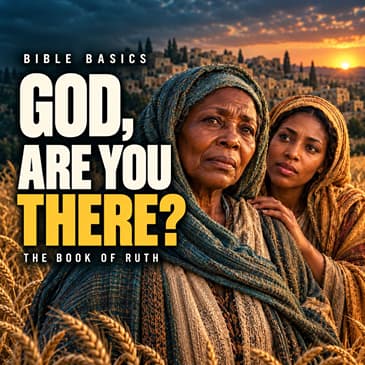

We walk through Ruth as a tightly written story that begins with Naomi’s emptiness and ends with unexpected fullness, using one simple observation tool to track what changes. Along the way, we see God’s care unfold through Ruth’s loyalty, Boaz’s generosity, and ordinary decisions that become part of a much bigger redemption story.
• Reading Ruth like a short story with a beginning, setbacks, turning points, and an ending
• Using a simple Bible reading tool: start, end, what changed
• Naomi’s grief, bitterness, and honest words about feeling empty
• Ruth’s costly loyalty and commitment to Naomi’s people and God
• Gleaning laws as built-in provision for widows and foreigners
• Boaz’s protection and kindness that preserves dignity
• Guardian redeemer explained: property, protection, family line
• Ruth’s bold request at the threshing floor and Boaz’s response
• The town gate decision and the story’s move from empty-handed to filled
• Obed, David, and the surprising link to Jesus in Matthew’s genealogy
• Reflection questions on who stays beside us and who we can stay beside
Read the book of Ruth in one setting.
Until then, keep reading, keep seeking, and keep growing in your faith.
SOURCES:
· Barry, J. D., Mangum, D., Brown, D. R., Heiser, M. S., Custis, M., Ritzema, E., Whitehead, M. M., Grigoni, M. R., & Bomar, D. (Eds.). (2016). Faithlife Study Bible. Lexham Press.
· Beetham, C. A., & Erickson, N. L. (Eds.). (2024). The NIV Application Commentary on the Bible: One-volume edition. Zondervan Academic.
· Cerone, J. N. (2016). Naomi. In J. D. Barry, D. Bomar, D. R. Brown, R. Klippenstein, D. Mangum, C. S. Wolcott, L. Wentz, E. Ritzema, & W. Widder (Eds.), The Lexham Bible Dictionary. Lexham Press.
· Stuart, D. (1986). Naomi. In G. W. Bromiley (Ed.), The International Standard Bible Encyclopedia (Rev. ed., Vol. 3, p. 489). Eerdmans.
· Sweeney, M. A., & Powell, M. A. (2011). Naomi. In M. A. Powell (Ed.), The HarperCollins Bible Dictionary (3rd ed., p. 689). HarperOne.
RELATED EPISODE:
Does God Approve of Everything in the Bible?
We'd love to hear from you - Click Here to Text Us a Message.
Want to live with more purpose and intention? Check out my book, Life Planning God's Way: A Guide to Living with Purpose and Intention. It's a practical, faith-friendly guide to goal-setting and building a life that reflects what God has placed in your heart.
Grab your copy on Amazon: https://a.co/d/0h7uLiwL
Have questions about what it means to follow Jesus?
Whether you’re just starting your faith journey or exploring what the Bible teaches, we’d love to walk with you. God’s invitation is real, personal, and full of grace.
💬 Reach out to Jacqui at info@bible-basics.org
📖 Talk to a trusted Christian in your life
🏠 Or visit a Bible-believing church near you
You are not alone. God’s Word is alive, and He is still drawing people to Himself today. Don’t hesitate to take the next step.
Thank you for tuning in!
Bible Basics is now streaming in video on Youtube. Please subscribe now!
Feel free to contact us at info@bible-basics.org. We would love to hear from you!
Note: All scripture references are from the NIV translation unless otherwise indicated.
When Life Falls Apart
JacquiHave you ever been in the season where everything seemed to fall apart at once? And when you prayed, it felt like nobody was listening. Today we're looking at a woman who lived through devastating loss. She lost her home, her husband, both of her sons. And when she came back to her hometown, she told everyone, the Lord has brought me back empty. But her story keeps going, and the way it ends might change how you read your own story. Well, welcome everyone. I'm your host, Jacqui Adewole , and this is the Bible Basics Podcast, where we break down the basics of the Bible into understandable bite-sized chunks. Today we're reading the book of Ruth. Ruth is short, four chapters. You can read the whole thing in about 15 minutes, and it reads like a short story. There's a beginning, a series of setbacks or problems, a series of improbable turning points, and an ending.
A Simple Bible Reading Tool
JacquiThis season we've been talking about reading the Bible with confidence. So here's one simple observation tool you can use with any story in the Bible. Notice where the story starts, notice where it ends, and then ask, what changed? In Ruth, keep your eye on two women. Ruth, the one the book is named after. Watch her choices and her loyalty. And Naomi, her mother-in-law, watch what she says about her life and how her circumstances change. And watch how their stories are tied together. The story opens with these words. That tells us when. If you watch our episode on Judges, you'll remember that this was a rough stretch in Israel's history before they had kings. People repeatedly turned away from God, and things were often a mess. Ruth takes us into the lives of one family living during that same period. The story moves between two places, Bethlehem, a small farming town in Israel, and Moab, a neighboring country on the other side of the Dead Sea. Israel and Moab did not get along. They had a long history of conflict. So when an Israelite family moves to Moab, you know things are desperate. We don't know who wrote the book of Ruth, but we can see who the story asks us to notice. A woman from Moab, a widow who needs food, someone who might easily have been overlooked, and her choices help shape the future of this Israelite family. So here's how it starts.
Naomi’s Loss And Bitter Return
JacquiThere's a famine in Bethlehem. A man named Elimelek takes his wife Naomi and their two sons, Mahlan and Killian, and they move to Moab to survive. Then Elimelek dies. The sons marry two women from Moab, Orpah and Ruth. After the family has lived there about ten years, both sons die too. Let's slow that down. Naomi has lost her husband and both of her sons. In that world, these losses could leave a widow facing poverty and danger. Naomi's grief comes with serious questions about how she'll live. Then she hears news from home. The Lord has, quote, come to the aid of his people by providing food for them, unquote. The famine is over. So Naomi decides to go back. She tells her daughters-in-law to return to their own families. She asks God to show them kindness and give them rest in the homes of new husbands. Orpa cries, kisses her goodbye, and goes back to her people. But Ruth, she won't. She chose to stay with Naomi. She holds on to Naomi and says this in Ruth chapter one, verse sixteen. Where you go, I will go, and where you stay, I will stay. Your people will be my people and your God my God. Think about what Ruth is leaving, her country, her parents, the people and customs she knows. She's choosing an uncertain future in a foreign land with her grieving mother-in-law. And her words reach beyond staying together. She commits herself to Naomi's people and Naomi's God. When they arrive in Bethlehem, the whole town is stirred up. The women say, Can this be Naomi? And Naomi answers, Don't call me Naomi, call me Mara, because the Lord Almighty has made my life very bitter. I went away full, but the Lord has brought me back empty. The name Naomi means pleasant. Mara means bitter. So she's saying, The woman you knew is gone. And notice she says exactly how she feels about God out loud in front of everybody. Now notice something else. Naomi says she has come back empty, but who came back with her? Ruth. Her losses are real, and beside her stands someone who has chosen to stay. As readers, we can notice both. So that's where we find Naomi at the end of chapter one. Empty. Hold on to that. Hold on to that word.
Ruth Gleans And Meets Boaz
JacquiChapter two opens at harvest time, barley season. Naomi and Ruth need food, so Ruth goes out to glean. Gleaning was part of God's law for Israel. Farmers were told to leave the edges of their fields unharvests and to leave behind whatever they dropped. Those leftovers were for the people in need, the widows and the foreigners. They could come into the fields and gather it for themselves, kind of like a food bank built right into the farm. Ruth is all three. She's poor, widowed, and foreign. So she heads out to find a field. And the Bible says this. As it turned out, she was working in a field belonging to Boaz, who was from the clan of Elimelek. As it turned out, from Ruth's position she had simply found a place to work. But we've been given a detail she doesn't yet know. Boaz is a relative of Naomi's late husband. As the story unfolds, we'll see why that detail is important. Boaz shows up, notices Ruth, and asks who she is. When he hears her story, he goes out of his way to take care of her. He tells her to stay in his field, close to the women who work for him. He tells the men not to harm her. He makes sure she has water and invites her to eat with his workers. Then he tells his workers to pull extra stalks from the bundles and drop them where she can pick them up. He gives her protection and a chance to gather more than enough. And he does it without making her feel like a charity case. Boaz also says this to her. May you be richly rewarded by the Lord, the God of Israel, under whose wings you've come to take refuge. Boaz recognizes Ruth's loyalty to Naomi and her decision to seek refuge with the God of Israel. That evening, Ruth comes home with a huge load of grain. Naomi wants to know where she worked. Ruth tells her, a man named Boaz. And for the first time in this whole story, Naomi says something hopeful. The Lord bless him. He has not stopped showing his kindness to the living and the dead. Then she explains to Ruth that Boaz is a close relative, one of their guardian redeemers. Naomi is still a widow, the people she lost have not returned, but now there's food, there's someone willing to help. And Naomi begins to see a way forward.
Guardian Redeemer Explained Simply
JacquiNow Naomi has a plan. But first, what's a guardian redeemer? That's a close male relative who could step in and help family members in serious difficulty. This person could protect the family's property and rights and provide them help when a relative had become poor or vulnerable. In this story, that role included these three duties. First, recover family property so it remained connected to the family. Two, protect and provide for vulnerable relatives, and three, preserve the family line. Boaz is one of those relatives that could help, a guardian redeemer.
Ruth’s Brave Midnight Request
JacquiSo Naomi sends Ruth to Boaz at night at the threshing floor. That's where workers separated the grain from the stalks and husks. Following Naomi's instructions, Ruth approaches Boaz where he's sleeping, uncovers his feet, and lies down. That was a way of asking for his protection. When he wakes and asks who she is, Ruth makes her request. She says, Spread the corner of your garment over me, since you are a guardian redeemer of our family. Remember the wings Boaz mentioned earlier? In Hebrew, the word for wing can also mean the corner of a garment. Ruth's request echoes the blessing Boaz gave her in the field. She's asking him to marry her and offer the protection his words described. We might put it this way, you pray God will cover me. Will you be part of the answer? That takes courage. A foreign widow asking a respected man to marry her. Boaz responds with kindness. He praises her character and promises to help. But there's a catch. Another relative is closer in the family line. That man gets the first opportunity to redeem. Before Ruth leaves, Boaz fills her shawl with barley, a big load of it. Later, Ruth tells Naomi that he said, Don't go back to your mother-in-law empty-handed. Empty-handed. Remember Naomi's words about coming back empty? Watch how the story keeps bringing us back to that word. Food is arriving, help is taking shape. We can begin to see God's provision through what these people do.
Redemption Settled At The Gate
JacquiIn chapter four, Boaz goes to the town gate. That's where business could be settled in front of witnesses. He gathers ten elders and speaks with a closer relative. Naomi has family land to sell. The man agrees to buy it. Then Boaz explains that the arrangement also involves marrying Ruth to preserve her late husband's name with his property. The man backs out. He says this could endanger his own estate. So Boaz steps in. Before the witnesses, he announces that he's buying the family property and taking Ruth as his wife. And then the Bible says, quote, the Lord enabled her to conceive and she gave birth to a son, unquote. Notice these two moments in the book. At the beginning, we're told God provided food for his people. Here we're told God enabled Ruth to conceive. Between those moments, much of the story unfolds through people's choices. Ruth stays, Boaz gives generously, Naomi makes a plan. Looking back, we can see God's care through their actions. Now listen to how the story ends. The women of Bethlehem gather around Naomi, the same woman who heard her say, I came back empty. And now they say, Praise be to the Lord who this day has not left you without a guardian redeemer. Here they are speaking about the child whose birth gives the family a future. They say he will renew Naomi's life and sustain her in old age. And Ruth, a foreigner who loves her, is better to her than seven sons. This teaches us that faith in God transcends culture and traditions. Naomi takes the baby in her arms and cares for him. And the women say in Ruth chapter 4, verse 17, Naomi has a son. So let's go back to our reading approach. Where did the story start? Well, it started with Naomi empty, no husband, no sons, no future. Where does it end? With Naomi holding a grandson in her arms. Full. What changed? God was working the whole time. Naomi couldn't see it from inside chapter one, and look at how God filled her. Through Ruth, Ruth refused to leave her on the road out of Moab. Ruth worked in the field so they could eat. Ruth found the courage to go to Boaz. That's why the book carries Ruth's name. Naomi's story turned because Ruth stayed. There's one more line. They named the baby Obed, and Obed, quote, was the father of Jesse, the father of David. David, as in King David, Israel's greatest king. This story becomes part of Israel's larger story. And centuries later, when the Gospel of Matthew lists the family line of Jesus, guess who's in it? Boaz and Ruth. In Matthew chapter 1, verse 5, a woman from Moab becomes an ancestor of Jesus. When Ruth chose to stay with Naomi, she couldn't have known where that choice would lead. And that brings us back to the larger story we've been following through the Bible. God's work of redemption leading us to Jesus. This little four-chapter book belongs in that story too.
Trusting God In Ordinary Days
JacquiSo here's what I love about Ruth. We can see God's care in a harvest, and someone making sure a widow has food and protection, and a daughter-in-law who stays and keeps showing up. Much of it happens in the course of work, meals, and family decisions. Maybe you understand Naomi's words about feeling empty. The book gives us room to hear those words. We don't have to rush past her grief to get to the baby. And we don't have to pretend that new joy makes an old loss disappear. Your life may unfold differently from Naomi's. We aren't promised her particular ending. But her story invites us to trust God's care, even when we can't see how He's working. It also invites us to notice the people beside us and to consider how we might care for someone else. Sometimes that means making a meal, helping with a particular need, listening, staying in touch when grief lasts longer than people expect. Ordinary days, ordinary people. So here's something to sit with this week. In this story, Naomi is the one who feels empty. Ruth is the one who stays. If you're closer to Naomi right now, who has stayed beside you? If you're closer to Ruth, who needs you to stay beside them this week?
Reflection Questions And Next Steps
JacquiIf you want to practice this week's reading tool, read the book of Ruth in one setting. It'll take about 15 minutes. And as you read, watch Naomi. Watch Ruth's choices. Watch where the story starts and where it ends. Reflect on the many ways this short story teaches us about life's realities. Make a note of specific ways that the story is relatable to your own life experience and how it may inspire you to invite God into your own life story. Next time we're picking up right where Ruth leaves off. Ruth ends with a name, David. In 1 and 2 Samuel, we'll meet him, a shepherd boy who becomes Israel's king, and we'll see how Israel moves out of the days of the judges and gets its first kings. Until then, keep reading, keep seeking, and keep growing in your faith.