
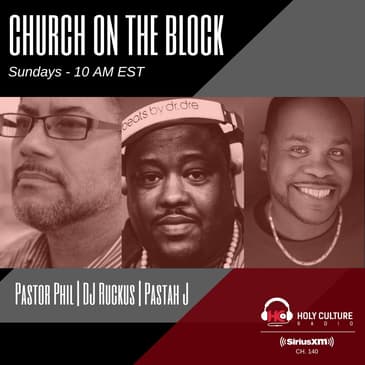
In this episode of Church on the Block, hosts Pastor Phil and Pastah J, DJ Ruckus along with guest Dr. Daymond Glenn, explore the intersections of hip hop, race, faith, and justice. Dr. Glenn, founder of the Cultural Soul Project, discusses hip hop's intellectual value, its roots in the African American experience, and its role in expressing and shaping identity, particularly for marginalized communities. The conversation covers the commercialization of hip hop, the importance of authenticity and self-knowledge for artists, and the church's role in addressing societal issues. They also discuss the prophetic potential of hip hop and the church in advocating for social change and envisioning a future filled with hope and love.
Learn more about your ad choices. Visit megaphone.fm/adchoices
[00:00:00] You're on Pastor Phil. Welcome to Church on the Block. Real talk about hip hop, church and
[00:00:18] the streets with my great co-host Pastor Jay and Ruck Boy on Holy Culture Radio. Sears XM.
[00:00:25] Good morning, good morning. What's up y'all? It's your boy Pastor Jay. We are here. You on the right
[00:00:35] place at the right time. You know what it is. Church on the Block. Real talk about hip hop, church and
[00:00:40] the streets right here on Holy Culture Radio. Sears XM. I want 40. We are so glad that y'all are back with us every
[00:00:47] Sunday morning for opportunity just to engage and to talk about what's going on on the streets in the church and with hip hop. Now you
[00:00:56] know I'm not by myself. You know what y'all hear my voice that means that Pastor Phil ain't on yet but you know my voice with me. Go ahead and introduce yourself tell them who you are.
[00:01:05] Yo, it was good people. It was a beautiful Sunday morning. So blessed to be here with you all ready to get these conversations cracking the day and
[00:01:12] man talk to our special guest today. Yeah, special special guest and I'm super excited. I got to introduce y'all
[00:01:21] to our guest today. Good guy. God just got to know really well and now we're building nothing beginning to some good
[00:01:28] trouble as Congressman John Millis will say. Yo, so my brother, Dr. Dema Glenn who is a pastor of the
[00:01:38] Coatry and Soul project but also an intelligent scholar and his own right you are in the main as well as just somebody that
[00:01:48] you need to know we're going to talk a little bit about hip hop today. But first let this man introduces so I ever he
[00:01:54] desires so y'all can get to know who we know. Go ahead, Dr. Introduce yourself. Yes sir. Yes sir. Hey, first of all DJ Ruckus and
[00:02:01] Pastor Jake. Thanks for having me on man. You guys are some strong brothers doing some great things man. It's just a
[00:02:06] great thing to be here. I'm so excited and I'm excited to be here. I'm excited to be here with you all today. First of all, I was
[00:02:11] hooked there. Yeah, yeah. So my name is Dr. Damon Glenn. I'm the founder and senior pastor of the Cultural Soul project. We're a
[00:02:19] new church in Portland, Oregon and I like to affectionately tell people our ministry exists at the intersection of race, faith,
[00:02:26] justice and another tagline is through the lens of the African American experience. We are remixing the church to curate a
[00:02:32] beloved community for people who have been shaped by life on the margins. So it's a blessing to be here to talk hip hop,
[00:02:37] to talk church. I'm always sneaking in blackness because that's why I'm centered at and I'm just ready to chop it up
[00:02:43] a show. The stuff man. That's good stuff. We appreciate you man. I think everybody who's been following our show and
[00:02:50] knows what we talk about, well, I understand why we had that. Damon on here because I mean look every day he talked about his
[00:02:58] church and his whole movement being about is what we talk about here in this show. Right? And so what we want to do is have a real
[00:03:05] critical and intelligent conversation about hip hop, about the church, about streets. But what we're going to do is we're
[00:03:16] going to start with this first section. We're going to start with just some intellectual conversation about hip hop
[00:03:22] and it's critical kind of usefulness in history and society today as a pastor and as a lotion and as an
[00:03:33] academic, what do you think Damon is the place of hip hop in the academy? And how have you used it in your
[00:03:44] work whether it was in the academy or in the church? Yeah, that's a great question. I've done both so before I came to
[00:03:52] ministry, excuse me for a time, I was a college administrator and college professor and actually created a course called
[00:03:59] Critical Hip-Hop Studies. And I love the word critical. My doctoral dissertation used critical theory as a
[00:04:05] lens by which to look at the college experiences of black male undergraduates, I private predominantly white
[00:04:12] undergraduates, I know that's a mouthful. We're not going to get into that but critical was really you know critical is
[00:04:18] really important because when I talk about critical, I talk about power dynamics. I talk about structures. I talk about
[00:04:23] identity. I talked about lived experience, lived reality cultural sensibilities that people draw upon and make sense of the world.
[00:04:29] So when I when I created this course, everything I do is critical because it's always going to look at systems,
[00:04:35] structures, power, identity, etc. But for me, you know hip hop is this really profound thing that that for me it's about we
[00:04:46] understand the cultural art form right so we understand cultural art form but when we go deeper underneath the cultural art
[00:04:52] form it's really about how do we make sense of meaning being in purpose? How do we make sense of meaning being in purpose?
[00:04:58] And that connects a lot to the church and when we talk more deeply about the church I'm going to get into that.
[00:05:02] But how do we make sense of meaning being in purpose? But also this is the key part past past J and DJ Ruckus is where I'm concerned about
[00:05:12] how do we negotiate and formulate identity within various social, structural and psychological forms of marginalization.
[00:05:22] And so for me, man that's why I pick up this conversation about hip hop. It's the lived experience, it's the lived realities. How are people making sense of meaning being in purpose?
[00:05:31] How are marginalized folks making sense of meaning being in purpose within their location? How are we formulating and negotiating identity?
[00:05:38] But also how are we just having some fun? How are we having some respite from some of the challenges that disproportionately affect people in intercity urban America
[00:05:47] and folks at large? But for me, hip hop is how do we make sense of meaning being in purpose? How do we formulate the negotiate identity?
[00:05:55] But also how does the art form provide valuable social commentary and social critique on a lot of the issues that are happening in our society?
[00:06:03] And if you look at hip hop from a historical standpoint it's really easy to come at it from kind of those intellectual frameworks that are articulated.
[00:06:11] Because if you understand how hip hop was birthed, you know, understand it was birthed out of struggle. It was birthed from the Bronx.
[00:06:18] It wasn't just birthed accidentally. There were policies and systems at play that disproportionately relegated certain people to the margins.
[00:06:29] And through those circumstances and through that reality and through those challenges, this art form emerged in birth out of that.
[00:06:39] And so for me I'll kind of slow it down and hear more from you all but for me when I think about system structures, power, identity, meaning being in purpose and all those things, man, that's where hip hop begins.
[00:06:51] And then the things around authenticity that connects with identity and all those kinds of things, you know, that emerges.
[00:06:57] But when I think about hip hop, those are some of the things that I think I start talking about.
[00:07:01] So this is see, we told y'all we was about to have an intellectual conversation this morning. I hope y'all got your coffee.
[00:07:09] I hope you sitting there with your the source out and your dictionary ready to get it in with this brilliant black man who was representing hip hop faiths, raise, call your power dynamics all the great things.
[00:07:22] So I'm the, I want to ask some pretty, what's the word I want to use?
[00:07:29] I'll say some agitating questions in a second but that I think they won't be agitating for you because they're dealt with you think about all the time.
[00:07:36] But one of the things that you just talked about was this idea of hip hop being burst out of the margins and that they're being all of these power dynamics and structural injustices at play which birthed this culture that has grown to be the most prominent and impactful culture in the world today.
[00:07:57] Here's what I love to talk just a little bit about. So we know that it comes out of the Bronx and we know that the Bronx at that time is overwhelmingly African American there are sprinkles of, I definitely I don't want to throw out the teen on Latino Latino brothers.
[00:08:11] This is either way that would definitely part of what was happening during that time but we know it's an overwhelmingly African American culture.
[00:08:17] And so here's the first little kind of ruffle here. One of my favorite books of hip hop is Bacari Katwana book while white kids love hip hop.
[00:08:29] Yeah, yeah, I have that book.
[00:08:31] And I know you you're very clear about seeing that like this is also rooted in blackness for you.
[00:08:37] All right, I want I want you just to talk a little bit about why amplifying blackness as a part of this narrative around power dynamics, marginalization and hip hop is so important for you.
[00:08:51] I know it has to do with your own personal story of your personal location but other reasons why you feel like blackness is to be amplified as you talk about marginalization and and where hip hop can't.
[00:09:04] Yeah, I mean absolutely so I think first things first I was talking to somebody about this today specifically when you're talking about I would say blackness as a whole but let's just kind of talk about it within an urban inner city urban context.
[00:09:17] I think when people talk about blackness and experiences of black people particularly in urban America, it's always through the lens of pathology or nihilism right it's always through the issues that that that black folks at and it's not even a.
[00:09:32] The conversations disingenuous in the sense that you're not looking at the issues as it means by which to help folks address the challenges that they may be confronting you are usually victim blame and saying the reason why.
[00:09:46] These folks have these issues is because of x y and z or one two and three and I think for me the reason why I like to talk about hip hop so much in center blackness is because blackness is so complicated it's so multi contextual with so multi faceted so beautiful there's so much joy this there's so much imagination there's so much possibility in it but oftentimes when blackness gets discussed,
[00:10:11] market it or talked about in the mainstream it's very narrow and it should usually do that lens like I said pathology and unfortunately dysfunction and so for me not only do I want to center blackness because I don't think blackness is centered in most mainstream institutions of structures unless it's pathologized or or imagined through kind of a particular racist lens.
[00:10:33] I like to center blackness to talk about the beauty the joy and the possibilities of it and I think when you look at hip hop at its best right hip hop in its prophetic form as I like to articulate hip hop at its at its highest moment in its most progressive form man there's so much ingenuity there's so much black beauty there's so much black imagination there's so much black possibility there's so much in there and that is the stuff.
[00:11:03] Oh my goodness that is the stuff that I drop on in my ministry to help transform lives and put people in relationship with God so their souls can be you know transformed as well so for me and hip hop I got a center blackness because when I center blackness I'm center myself and as a person from the Pacific Northwest Portland Oregon often times you know I don't mean no I mean no you can't you know it's so no but I'm just saying as a black person from Portland Oregon in a position
[00:11:33] in the Pacific Northwest now would actually say even though I would even look at it as a microcosm you know unfortunately people wrong blackness to be society seduces you into as Cornell West would say being well adjusted to the status quo as opposed to maladjusted to the status quo
[00:11:53] and and and unfortunately blackness can get lost and swept under the rug because people are trying to assimilate to some baseline that doesn't really reflect their lived experience and liberalities.
[00:12:03] And so for me I want to let people know when I I tell people this all the time when I was a vice president of a college I used to tell people this everybody I'm not a vice president who was black I'm a black vice president right let's keep it clear I'm not a vice president who was black I am a black vice president
[00:12:22] and what I mean by that is my lived experience my lived reality and the cultural sensibilities that I draw upon that make sense of the world is through a black cultural lens
[00:12:30] and that is the lens by which I look at my vice president ship you know that's the lens by which I do my work.
[00:12:36] And so hip hop helps me do that and for me the study of hip hop the embracing of hip hop me being you know part of hip hop it helps me keep my blackness center.
[00:12:48] That's good bro and you know we we don't shy away on this show from like centering blackness either like it right now when we had a last year we had a whole section or like can she preach you know can she pass to talking about women and we didn't shy away that we were talking about black women right like that's all we had on our show.
[00:13:09] But what we want to help people recognize here who maybe listen into us who come from a different cultural background different race or whatever the case may be is that you can't talk about hip hop without talking about the black experience and that's what I love that you you center that's what you're people realize because people want hip hop but don't want the black experience that comes with it they don't want to talk about marginalization they don't want to talk about reparations they don't want to talk about you know all the things that come up.
[00:13:39] Come with that conversation is when a consumer culture so I appreciate you for for the ways that you you censor the narrative of blackness as well as promote this this idea of what what it looks like to critically talk about hip hop.
[00:13:54] So we only got to like a few minutes left in this first section here I do want to say this or what you're thinking about this before we go into this next section and I want everybody to know that past the field has joined us past the field with us has to feel you only building.
[00:14:07] See yeah yeah yeah.
[00:14:11] Yo yeah yeah that's why dropping bombs you only drop an intellectual bond feel as usual but so that like I want you to think about this man you drop so you drop the name there you know Cornell West and I was on your website early
[00:14:26] And I see you like posing a Cornell West and talking to my Lee like.
[00:14:29] Yeah that's what something but like one of my favorite books is when they wrote together called the rich and the rest of us yeah I tried to love that book yeah and so I love for us to die all the little about about the intersections of race and class you know talking about poverty a little bit how that next to hip hop will be go back.
[00:14:49] So if you could be thinking about that that can be dope because we're going to come in this next section we're going to talk a little bit about not just hip hop but we're going to talk about hip hop in the church.
[00:14:58] So got merged you know all you I mean but you already do that you talk about race faith hip hop culture right like you talk about all this stuff so let's figure out how we can do that.
[00:15:08] All right Phil we glad you joined us man you know I always been here just in the cut in the note on the wall and against the wall said what's going on.
[00:15:21] And you be boy stance I got you man right since.
[00:15:25] I was on the down well y'all hey we're going to be right back you do not want to miss this next part as we talk with Dr. Glenn continually now it's in the move in the hip hop and the church and we also talk a little bit about intersections of of not only race but also you know class so join us come to go on a well will be right back
[00:15:46] they'll get that bacon before it burn and come on back and join us we out church the box see you have a few minutes.
[00:15:59] Yo we are back I snuck in a family what's going on church on the block real talk about hip hop the church and the streets channel 140 serious except holy culture radio.
[00:16:09] What toss it back to Jay man re in a deep discussion with the doc Dr. G Lee and I can see the build a man grateful for you to be what it's man so so
[00:16:19] bless we can conclude the first section with these questions about hip hop and the church we're going into this section with hip hop and the church issues of race and interplay with hip hop and all that but man yeah
[00:16:35] what is your what is your word on on this and this movement been moved me for a long time but some time it was in flows
[00:16:49] with the I mean I think yeah whether real hip hop.
[00:16:53] It wouldn't use the word like Christian hip hop you'll be talking about faith in hip hop so I think that's a better way to narrate it we talk about the plan you know we got
[00:17:00] we have to make sure we're using proper terms will be talking about right what was the words you said again Jay let's say it would be wouldn't be Christian hip hop we're talking about
[00:17:09] season.
[00:17:09] right and that may and faith in hip hop faith in hip hop yeah that's one of its intersections rather we have to use the right language for
[00:17:17] that but doctor yeah but that we just handed it off to you man we're talking now this interplay with so you race this interplay
[00:17:25] would swing class but they also when you intersect faith yeah what is that into this conversation man yeah yeah so I'm actually glad you asked
[00:17:34] that question because there was something I left off the table and and and the first section and that is oftentimes when
[00:17:41] when people hear about the cultural soil project which is you know the church I pastor in Portland I talk about
[00:17:49] you know we do all work through the lens of the African American experience and oftentimes African American and black I use interchangeably but
[00:17:55] I talk about African American from the context of inner city urban America in in how blackness was was was functioning in urban America but I say all that to say this
[00:18:06] when I talk about using blackness as a lens the church uses blackness as a lens I'm really talking about a dialectic and I use blackness as a metaphor right
[00:18:15] so on the one hand blackness is what it is it's a lived experience it is a it is a lived experience in a live reality and a particular cultural lens that a group of people
[00:18:26] who have had certain experiences they look at the world but I also use blackness as a metaphor for all folks who have been shaped by life on the margins
[00:18:36] and the reason why I can do that and that's not just an intellectual play or some word game I can do that because I think the best of the black tradition when you think about
[00:18:47] the civil rights movement and what King was about in particular we have always used our struggle at the at the highest point to connect it with justice for everybody.
[00:19:02] That's why King said injustice anywhere is a threat to justice everywhere and I think that one of the high moments of the prophetic black movement specifically within the civil rights was not just saying we're doing civil rights for black folks now that was
[00:19:17] centered and we were definitely using our experiences for civil rights and going after that but it was also about how do we look at justice for everybody so I did want to bring that in when you talk about race and then of course faith and etc.
[00:19:31] So when you talk about poverty and those kind of things in hip hop it's easy for me to make the connection because looking at hip hop through the lens of the black experience or the African American experience
[00:19:44] and then I'm saying blackness is a metaphor and it's a dialectic where I'm saying blackness is also anyone who has been shaped by life on the margins.
[00:19:54] It's an easy pivot to talk about poverty it's an easy pivot to talk about class is it easy pivot to talk about people have been relegated to the margins because of lack of opportunity and resources right so hip hop for me I started you know kind of through that lens but also the you can't talk about hip hop and poverty or hip hop in class without talking about the commercialization of hip hop
[00:20:21] and how certain people profit and how certain narratives profit over others and so what ends up happening is you got this industry that totally takes the struggles and the challenges of inner city urban living unfortunately that can be attached to
[00:20:42] you know poverty or low income or lack of resources I would like to say then they offer you kind of an identity or a narrative to perpetuate even if it's not authentic to your story and those folks who are vulnerable and who have lack of resources it's in their mind and easy out for out of their circumstance of poverty or lack of resources to be something that they're not so you can perpetuate this image be an individual
[00:21:12] who have been marginalized and has has lack of resources by perpetuating this commercialized version or commercialized narrative if hip hop that is not even true to your story and I think that's one area where I think hip hop rap music in particular gets hijacked and so yeah I'm always putting these things together brothers as I'm thinking about the word
[00:21:33] yeah I mean I know that there may be a few MCs faith MCs to thinking that that particular way when they come to the microphone yeah I mean it's not it's not like that is an normal effort in my work just think through how am I how am I moving the culture and a faith way
[00:21:57] towards there's another narrative out of you don't just listen to the one that I'm trying to come back what's happening so what would you say is is needed or how it was like the right where what would you say is with impact the culture
[00:22:23] you know faith MCs the cultural role to bring that out in the art form like like like artistic look what's what's the what's the
[00:22:34] we thought about like this grabs MCs disciple them walk with them in a more holistic artistic way because if catch
[00:22:41] already being a cypher taught in one particular way you know they're going to maintain a particular style of particular
[00:22:48] cultural narrative through their rhyme right and theological perspective as well and then they they maybe even suppressing what they really feel it is not
[00:23:00] until Cassie in the 30s as MCs they realize man Joe it's hard out here for a pin I mean I need to run about that right there that's how
[00:23:11] mess versus yeah yeah yeah Jesus go on bring you home Jesus go you know and in that particular dynamic something that happened I'm like let's
[00:23:20] can't shoot the beginning you know me yeah yeah so I may approach this question brother feel maybe differently than you all as
[00:23:29] host and and this is just because of my experience and how I approach it but so I believe and this is my perspective and it's
[00:23:38] subjective but I think it has some relevance to me when you look at the core of hip hop specifically rhyming
[00:23:46] before you even get into content you got to have some skills right hip hop is a skill for rhyming it is a skill based art
[00:23:54] for right and so I try to tell people I don't care if you're talking about trapping I don't care if you
[00:24:01] talking about God I don't care if you're talking about community empowerment and development
[00:24:06] if you are bringing it into the art form of hip hop i.e rap music and you don't have skills it's going to limit
[00:24:15] it's going to limit I believe who your music can touch now certain people would say no no doc you wrong you
[00:24:23] wrong because there's all these trap music and and and these guys ain't they ain't wrapping about nothing
[00:24:29] they didn't came back I disagree I disagree now now don't vote me off the island y'all
[00:24:36] I want you to find the way you go I don't do go ahead stay with me I actually think future is a good
[00:24:42] wrapper now y'all may disagree with me because you're probably thinking about his content I think
[00:24:47] his content is problematic I got that but I think if you look at it in the space of what trap music
[00:24:54] is futures a beast I mean there's a reason why future is you know I'm using future as a metaphor for
[00:25:00] certain artists who are popular and rock is war that's why it's mine now now listen I'm talking
[00:25:08] to pastors and I'm talking to brothers of faith I'm just being honest I'm having an intellectual
[00:25:13] conversation on the art form right right right you can have an amazing art form that doesn't
[00:25:19] revolutionary art form doesn't mean that is revolutionary content right and sometimes people
[00:25:23] can flake those you can have a revolutionary art form but not have revolutionary content
[00:25:28] right I'm saying as an art form if you start breaking wrap down in different categories and say
[00:25:34] there is an art form to you know trap music and trap wrappers I'm saying that whatever that is
[00:25:43] future has figured that out right his cadence is right right like you don't even um right so
[00:25:50] I would say to any of my kids all other trap wrappers have tried to sound like
[00:25:55] try to sound like them exactly exactly and here's another thing I can listen to trap music
[00:26:02] I but listen I can listen you can give me some trap music and we're not talking about content
[00:26:07] we're talking about cadence flow all that comes yeah earths I know the difference I know the
[00:26:12] difference between good trap music and bad trap music I can listen it doesn't all sound the same
[00:26:17] to me now the beats and everything you know the sonic in the 808 it kind of has a sound but I'm
[00:26:22] talking about lyric like cadence of rap there's a difference to me and I can listen to some trap
[00:26:27] music and go yo this dude is it this dude is a beast and like I'm like no this dude ain't got it so
[00:26:32] I say all that to any MC if you are a MC whose primary content is about faith or MC who's primary
[00:26:39] content is about whatever I would probably tell people um the first thing that you need to have
[00:26:46] as you need to you need to have bars you need to be able to spit and I think if you can do that
[00:26:51] aesthetic practice and you're able to spit I think it opens up the possibilities for folks to
[00:26:56] listen to what you have to say you know what I mean and so that's what I would say brother feel so
[00:27:01] it's not you're getting to your 30s and now your content is trying to change because there's
[00:27:06] due to I know that started off at 18 and 19 rapping about a particular experience then their life
[00:27:11] changed in that 30s they're rhyming about something different but I'm like okay that's great stay
[00:27:16] with me y'all don't vote me off the island that's all great but if you was a whack rapper in your 18
[00:27:21] and you ain't never got your weight up you know what I'm saying and you still a whack rapper in your
[00:27:26] 30s the content you gonna be judged differently man even if you're saying some positive stuff
[00:27:32] about you know I like some sort of I got you that's all I say it's it's always you know I believe
[00:27:37] like you say it's always about like the skill you bring to the table in in some regards right though
[00:27:43] but I'm just saying there is some observation of some kind of like like you know different artists
[00:27:50] artists of faith they're rhyming and what they were totally different and and and he has skills
[00:27:55] and and it was rhyming some totally different over here that mainly over here we was worn
[00:28:01] this dip but something happened in between that time and that he appeared which is great I mean
[00:28:07] they're rhyming some dip and they got and they got skills I'm just saying I would have desired
[00:28:13] that same maturity and I don't know what what happened in between that time right but it seems
[00:28:17] like a perpetual cycle I hope it's not a bad thing though like mugs like like Craig go off on
[00:28:25] anomaly and everybody's like oh that's the way we gotta go and we gotta be and and that
[00:28:30] that's kind of what I'm when I'm saying like like you know whatever he went through to come up with
[00:28:35] to to say I gotta be around about this I've been dogged out by these cats and I gotta I gotta say
[00:28:39] now this is where where I really feel and all I'm saying is that they're you know the desire
[00:28:46] of folks being an artist who's seen the movement of the culture because hip hop is where you are
[00:28:51] to do and able to see I mean speak this into the culture yeah we got you know we got police
[00:28:57] issues going back and forth yeah yeah I got some skills let me run about that versus I see
[00:29:02] this going back and forth let me pop and pop like pop and pop no like like yeah I get it right so
[00:29:08] so let me let me jump into that so I hear two things one is if the mainstream has created a lane
[00:29:17] for MCs to make profit right and cats are coming into the game and they're lacking resources
[00:29:25] it's an easy pivot to jump on whatever the mainstream is giving you so you can get you know you
[00:29:31] can get your money right that's number one and so some certain cats are just saying we pop in
[00:29:37] perks you know we drop in mildly we do not it because it seems like that's what selling right so
[00:29:42] you got it you got it cyber that then you got other cats who maybe that's actually what they're doing
[00:29:47] maybe they are actually just popping perks right you know what I mean and maybe they are dropping a lot
[00:29:52] of Mollie and they they doing Xanix etc so so they're wrapping about that I would say this and
[00:29:58] and some people in your audience may not may not be a fan of this artist I'm just dropping artists to
[00:30:04] as a way to make larger points so to me Jay Z Jay Z has the most perfect bookend albums in the history
[00:30:13] of hip hop reasonable doubt and 44 we reasonable doubt you know reasonable doubt and 44 and they show
[00:30:22] the maturity it shows the maturity right right it shows that maturation but oftentimes to get from
[00:30:29] reasonable doubt which is you know you know tells about him drug dealing said yeah just just
[00:30:36] hustling to really you know talking about how you know you know this you know the story of OJ and
[00:30:43] and on 44 of what he should have bought instead of you know the the craft material things that
[00:30:49] that made no sense oftentimes to get that level of maturation people need to have different
[00:30:55] experiences right and so even though I'm critical of problematic content I'm also mindful of what
[00:31:04] are the systems and the structures that are creating the reality that folks are living in that's
[00:31:09] making them share that particular type of content and so I feel like it's a hard ask or at least
[00:31:16] a little bit of intellectually disingenuous to ask a person to give you different content but
[00:31:23] their circumstances in their reality doesn't give them the experience for their content to evolve
[00:31:28] in certain ways and so like I said I slice this in so many different ways so I would say change the
[00:31:36] the the institutions and the structures that commodify a particular image that people perpetuate
[00:31:41] and and buy into because they think that's how they can make money and change the system
[00:31:47] and the structures to give black folks in the hood different experiences and different circumstances
[00:31:52] so they can talk about different things brother Phil you know but if you are some cat that's older
[00:31:58] in your way dropping you you know you you talking about popping perks and you talking about dropping
[00:32:04] Molly and that's just not your experience and you thinking that's what it's going to be to get money
[00:32:09] man that's not authentic that ain't hip hop and I don't accept that you know and I appreciate that
[00:32:14] because I I agree man like it is like I mean I think that's what it is with me you know
[00:32:20] now I've been in LC for a minute and I know my content changed over the years right like but it
[00:32:26] was about maturation you know man it was about what I was experiencing not only in my general life
[00:32:32] but also in my ministry as I was as I am in oh and so to look to expect people to have that kind of
[00:32:40] I guess that to be ready and prepared to have the the depth of knowledge that they'll have as a 40 year old
[00:32:48] MC and a 25 year old MC I think is also you know it's almost chaotic but yeah it's also just not
[00:32:56] genuine but I'm gonna say I'm different since I'm never ever gonna be a fan just like you
[00:33:03] of the line that's right if you're not being 100 then ain't it why not what how broke you
[00:33:10] are right like don't sell our souls like that's part of who will pop is now when you do it and people
[00:33:16] call you white don't be mad yeah yeah absolutely that's real like like like no like on eight mile
[00:33:24] if the brothers from a world free whatever they was who would listen yes if they just would have said
[00:33:31] I went to school in the summer my mom yeah it was at free of playing video game
[00:33:39] him would have done the same would have done the same but no he got you because you know you know
[00:33:45] but Claire didn't his real name Claire right anyway and I have no separate about you
[00:33:53] hey let me let me just say this I know we're we're closing on time and I'll try to make this really
[00:33:57] quick you know every you know Andre 3000's one of my one of my favorite rappers of all time yeah
[00:34:02] and when he when he dropped that you know it's flew to album you know a month or two ago
[00:34:06] he was getting interviewed and Andre really just he you know he was talking about why he doesn't
[00:34:10] want to rap anymore and he was like he doesn't have too much to say and he was like what what
[00:34:15] do people want to hear me talk about me getting a colonoscopy you know and you know that's literally
[00:34:20] what he said and you know what I may have been one of the only people that was like yeah talk about
[00:34:25] the importance of getting a colonoscopy but do it in it but do it in an artistic way where like black
[00:34:32] men can can can focus on health in ways that maybe they don't I think there are so many things you
[00:34:37] can talk about and and that hip hop can evolve with the artist so anyway I think hip hop candy ball
[00:34:44] Jay Z proved it on 444 and if you're creative enough you got bars you got style you got the aesthetic
[00:34:49] practice you can make anything work within hip hop in the content go we got a drop my drop okay my
[00:34:55] drop he right oh this is cold we're gonna keep coming at when we coming back we're gonna talk
[00:35:00] about the block I love it they put it Andre 3000 on this day we'd be right back searching the
[00:35:05] block right here a stereo sick sale channel one second back man we back you on the right channel
[00:35:21] that's right church in the block real talk about hip hop the church of the streets man we are here
[00:35:26] man having a great discussion with dr. Glenn and and I hope that you're seeing maybe you never saw
[00:35:34] the intellectual realities of hip hop and the depths of it and someone explaining the cultural
[00:35:41] dynamics of hip hop and its impact man so right now we're talking about the streets real talk about
[00:35:48] hip hop church and the streets and the streets are all about being real you know being relevant being
[00:35:56] respectful there was the streets got to have that just that realist there and you know straight no
[00:36:04] chaser you know and that's why I can I can frustrated with MCs who were faith who tibto about
[00:36:12] being there real I watched something I don't know necessarily know how to find a chemo on
[00:36:18] Instagram but it was it was it was uh busy doing something um and there's some some other rappers that
[00:36:25] were there they were like like like well-known artists and they heard him he was rambling about real
[00:36:30] stuff and he you know said a few curse words in it but he was bringing some I was like I never
[00:36:35] heard people do this like wow and um you said if I wrap about this you want me to do this and wrap
[00:36:42] about this it was like bringing it out but like like like some cats would make come from a real background
[00:36:49] I don't know if they jump ship and think that they can't rhyme about that real background and
[00:36:54] it don't always have to come from a real background you just gotta be real so artists of faith man
[00:36:58] sometimes they just how they want to they want to separate God from separate their life from God
[00:37:03] or something or or the real issue that they go on there or maybe they just don't know maybe
[00:37:08] they ain't read a newspaper maybe they don't even know that that uh was happening politically in this
[00:37:13] crazy situation that even happening around us now with different people winning the nomination for
[00:37:19] certain things um you know and a kind of takes a of that but I'll just don't know how how you
[00:37:27] know because you got other cats they're gonna come out with the street they're gonna they
[00:37:31] and they're gonna speak to the streets on fun stuff boom you know the way you know yeah they're
[00:37:36] gonna come with some with some relevant stuff to the streets uh but we just seem to be intimidated
[00:37:41] about it where you say Dr. Moore you know so when I think about hip hop everybody I'm assuming your
[00:37:48] listeners understand the four corners of hip hop always talk about rap graffiti DJ and and break
[00:37:54] dancing uh what not but there's this unofficial fifth element of hip hop and that's that's knowledge
[00:38:01] now I think maybe Keras one or someone came up with the knowledge itself and we talk a lot about
[00:38:07] hip hop and authenticity I think authenticity and knowledge itself are intertwined in the sense that
[00:38:16] I think we as hip hop folks need to pay more attention to knowledge itself and I created this
[00:38:22] this theoretical framework on the theorist rank theorist and I always try to theorize and come
[00:38:27] up with what frameworks to understand and respond to complex cultural phenomena and I want to share
[00:38:33] a couple just things from this knowledge itself right uh that I think we artists and people who are
[00:38:39] part of hip hop so this knowledge itself is always this existential question and I started off
[00:38:45] earlier today talk about insertion meaning being in purpose right so that's knowledge itself this
[00:38:48] existential question of being a search of meaning being in purpose but the question here are a few
[00:38:53] questions I want folks to think about MCs people are part of hip hop who am I and who do I seek to
[00:39:00] become who am I and who do I seek to become another question is why am I here whatever that whatever
[00:39:09] here is to you and I interpret that but why am I here but here's the other part what am I supposed
[00:39:14] to do why I'm here and and and then when you look at your circumstances particularly the challenges
[00:39:22] that you that you may disproportionately be confronting that existential question of why is this
[00:39:27] happening to me right why is this happening to me and here's the profound one how would I be judged
[00:39:35] by how I respond to my predicament right so that kind of gets into the faith that gets into the
[00:39:41] stuff on the ground but I don't know if people are doing that knowledge itself that existential work
[00:39:47] through hip hop because when you do that you start asking yourself all sorts of questions and then
[00:39:53] that should manifest in materialized into your art and then that's where it starts to get more
[00:40:00] complicated and it can start to be more real and it can start to be authentic so how do I respond
[00:40:06] I'll respond to the fifth element of hip hop knowledge of self and asking yourself existential
[00:40:13] questions and then I talked about it earlier how am I flowing and negotiating my identity within
[00:40:19] these various contexts of social structural and psychological marginalization so well how do I
[00:40:25] respond that's my response knowledge of self keeps yourself in line by I am a fraud that was a great
[00:40:35] line in this spot you know that that that I will work at a fun no man that's what I'm saying it's
[00:40:43] not fun well why would I do that like you know say it right but you want to do it because you love
[00:40:51] hip hop right and you and you're actually connecting to the historical origins of the art form right
[00:40:58] you if you really love hip hop right you really love the art you really love the culture you really
[00:41:03] love the people you gotta do that work man and I think it's part and parcel of it and I think
[00:41:09] the people who aren't doing their work they're cheating the art form they're cheating it right they're
[00:41:13] cheating it and and and when you cheat the art form your stuff becomes formulaic right and and it's
[00:41:20] not gonna last long and if you look at the best of hip hop the best songs the best art that was produced
[00:41:27] you can play that anytime and it's gonna be relevant because it was speaking to a reality it was
[00:41:35] speaking to this existential reality that people were working with so that's why man I love hip
[00:41:42] hop I'm a fan of hip hop I'm a I'm part of hip hop I am hip hop I live hip hop but when I look at
[00:41:47] some of the best stuff if hip hop I can go back to certain albums certain songs it doesn't matter
[00:41:53] when they were I can listen to midnight marauders by tribe called Quicks anytime right I mean it's
[00:42:00] some of the most beautiful stuff ever created right you know and so you know yeah it's hard but
[00:42:07] you know anything that's worth that that's that's worth living for that's worth fighting for that's
[00:42:12] worth you know all that kind of stuff and man it's it's hard work so don't don't cheat yourself don't
[00:42:18] cheat the work because it has the capacity to help you not only evolve but there's some transformative
[00:42:23] aspects if you're looking at the prophetic and the progress of slums that I think it really
[00:42:26] helped our society become better yeah you you I think this is an important conversation too when we
[00:42:33] think about the faith institution they you chose to be a part of establishing yeah but the cultural
[00:42:39] soul project because I think at the center of it is this conversation about whether or not the
[00:42:46] conversation is just this religious conversation about like religious you know preservation do I
[00:42:55] just want to preserve myself for some other worldly existence outside of what I deal with now you
[00:43:01] know so I deal with this poverty I deal with this racism whatever blah but then there's some place
[00:43:06] far away where I'll essentially not have to deal with anymore yeah I love that like you literally
[00:43:12] say on there like if if the the religious institution I'm connected to is not addressing the issues
[00:43:19] that I'm facing in this body so not just my soul that's right those in case they're wish the soul
[00:43:24] rests then it's not really you know a fakeness it's not it's not holistically taking care of my
[00:43:30] needs and so when I think about that with you you know contrasting or either connecting it to
[00:43:35] hip hop I'm starting to ask myself this question basically you're moving us from this like
[00:43:41] um I just want to I want to use my religious connection or my faith connection as something that
[00:43:47] keeps me safe and preserves me into something that's actually a tool of eradicating the issues that
[00:43:53] I see around me in the systems yes so then the question becomes if I'm talking about eradicating
[00:44:01] um and challenging and confronting things yeah then I also got to confront the institution
[00:44:06] that I suppose to be training us or working with us to do that yes so now as we talk about
[00:44:13] the streets hip hop and the church like all of the twine it now starts to make sense how you could
[00:44:20] lie in the sections of those things right because what I have some little land is faith you know
[00:44:26] the main racism uh hip hop you know injustice like how are you merging those things but now the more
[00:44:33] you talk the more people can see that if you don't if you don't have all those merge then you
[00:44:39] don't even have a real true faith focus because you can't do the work of knowledge itself that you
[00:44:44] talking about right and and past the j i would and for the listeners out there you have to do that
[00:44:51] stuff within the context of propheticism you have to do that work within the context of being prophetic
[00:44:57] and one of the things we talk about out our church is to be prophetic means to respond to your
[00:45:05] uh uh predicament or contemporary moment in terms of what it can and should be
[00:45:12] in terms of what it can and should be and not allowing those present circumstances to dictate or
[00:45:18] inform your responses to it and so you have to look at this and look at your situation
[00:45:23] in terms of the possibilities of what you want it to be and that to me so allows not just with
[00:45:30] with with hip hop the you know the progressive forms of hip hop but to me it's about the church
[00:45:36] and that's why I've wanted the you know the core element of our church we have a lot of core elements
[00:45:40] but it's the prophetic gospel of Christ how are you trying to respond to your conditions and your
[00:45:46] predicament in terms of what it can and should be speaking light speaking hope speaking love
[00:45:52] speaking possibilities and think about brother Phil and pastor Jay and DJ Rutgers if artists did
[00:45:58] that in their content it's okay um you know uh i'm borrowing this from a hurt Al Sharpton say
[00:46:05] this a long time ago he goes everybody and hip hop talks about i'm just keeping it real i'm just
[00:46:10] holding up the mirror and he was like a mirror is not only trying to give you your reflection
[00:46:14] but it's also trying to tell you what you see so you can correct certain things as well and make it
[00:46:19] more presentable and make it better and so that's the prophetic piece to say what can what it has
[00:46:25] the possibility to to be and how can we speak about that and speak life into our art and into our work
[00:46:31] yeah you know Frank Thomas is dope this is good um Frank Thomas in his book uh preaching dangerous
[00:46:37] servers when he talks about moral imagination and um i teach a class uh and Jay has as well as
[00:46:45] state bill prison um and one of the brothers now i'm like i tell these guys all the time look
[00:46:50] I should be sitting y'all should be teaching what the heck am I doing up here y'all right y'all
[00:46:55] yeah i mean why is it not part hiring y'all um so the thing is the brother just said we in his
[00:47:02] critical conversation we had about change and shift and culture he talked about folks don't have
[00:47:08] um that just another imagination he didn't say moral imagine he's had another phrase ever but
[00:47:14] i say that because if we are you know looking at the streets and his mc's and looking at streets as
[00:47:20] preachers this should be a moral imagination of what um uh uh castle are missing the skip we got
[00:47:29] cash rhyming they may be rhyming as a quote unquote reporter they tell them out the girl in the
[00:47:33] chick and the beat is hot and everything's cold and it may be some truth in us that's about
[00:47:38] they split about the street that's that's true get your apps come back by blah blah and
[00:47:43] but yet there's not a moral imagination of what change can really look like right of what
[00:47:47] health can really look like what what life can really look like so that area of catch rhyming
[00:47:52] but because to me oftentimes what it looks like is the four spiritual laws right it goes into uh
[00:47:59] the that that shaping of what um the call to gods to to Christ would look like and though there's
[00:48:05] lots of room for that space but the first cat listening to you is not going to be what they're
[00:48:11] gonna absorb towards a change of to from from the stuff on the street they're gonna know you're
[00:48:17] gonna share my life when i when i'm going to i mean i think the fact of being not being
[00:48:23] incarnational um as artists in that space you know cause cause those challenges you know so that's
[00:48:29] great doctor Glenn i just want to ask you real quick yeah can you tell people how to get connected
[00:48:34] to you man working there for you on social media websites anything like that before field
[00:48:39] boxes bars well let folks know how to catch up oh right on first of all thank you all for
[00:48:42] having me everyone check it out you can find my church at the cultural soul project dot com the
[00:48:51] cultural soul project dot com you can check us out on instagram at the cultural soul project and
[00:48:57] you can go to our youtube page and watch some of our videos and uh yes the youtube pages the cultural
[00:49:03] soul project so the cultural soul project for everything that cultural soul project dot com let us
[00:49:08] know what's up that's what's up that's what's up appreciate you joining us man all right feel
[00:49:13] this all you know man there was a dual wealthy cat business dude looking for limousine driver he was
[00:49:18] like man i need to get somebody who can drive these cars taking me around where i gotta go so
[00:49:23] he's interviewing people right interview is one person and he says man we drive on a cliff we drive on
[00:49:28] tight roll how close can you get me to the edge dude was like i get you like man a foot from the
[00:49:35] edge Joe okay thank you it's another driver uh interview is a person by their background i said man
[00:49:42] we closer edge we we want to occur we want a big mountain um and when there's no matter
[00:49:46] how close can you uh get me to the edge he said man i get you an inch from the edge you know
[00:49:51] get your inch from the edge that okay thank you finally interview the last person and he was like
[00:49:56] man i'm driving says the same thing you know how close can you get me to the edge he said i
[00:50:00] ain't getting you closer to edge at all i'm getting you far away from the edge as possible so you can
[00:50:05] be as safe as far as that you are other drivers added twisted they thought the closer i get to the
[00:50:11] edge more dynamic you think i am as a driver this brother said no i gotta get home safe you gotta get
[00:50:17] home safe right and i walk with the lord oftentimes man um it is it is or the line of walk with all
[00:50:25] is that challenge of of how close to the edge are you gonna live how close to the edge uh are you
[00:50:32] are you away from god god says no come and draw close to me draw close to me draw nine unto me
[00:50:40] i'll keep you away from the edge and i will show you life and life more abundantly you know this
[00:50:44] pacifil church on the block passage DJ ruckus dr. Glenn back at you next week nine a.m holy
[00:50:52] culture radio series xm channel one forty peace we out thank you for listening to church on the
[00:50:58] block real talk about hip hop the church and the streets we're back here same time same day next week come
[00:51:04] with us