#MSAD #MaleSurvivor #MSAD2024 #MaleSurvivorAwarenessDay #MaleSurvivorAwarenessDay2024 #1in6 #MenToo #BoysToo #MeToo #MenHealing #DVAM #MenYouAreNotAlone
Due to Spotify’s video policy, the video version is only available to view within the Spotify app, though it is also available on YouTube & Facebook. This is the first of a 2-part live Zoom event in honor of Male Survivor Awareness Day
Link to FULL SHOW NOTES is here
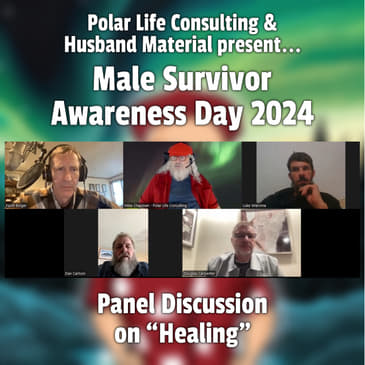
Back in 2022, MenHealing, MaleSurvivor and other groups who help men heal from sexual trauma set aside October 25th each year as Male Survivor Awareness Day to coincide with the month of October’s Domestic Violence Awareness Month. While they planned their own annual events, Polar Life Consulting and Husband Material have honored this day by hosting their own faith-friendly event each year. This year we came up with a theme: “Healing”:
How can/do survivors find healing?
What has worked and what has not worked?
What healing options are available?
What can non-survivors do to help survivors heal?
How does one find a therapist?
The goal for this event (and the “Day” in total) was to help non-survivors understand and work with survivors to help support them on their healing journeys. A 2nd goal of our specific event was to help people understand better the concept of healing and what survivors can do to help find healing and how non-survivors can help. Due to the length, I am dividing it into 2 audio podcast episodes, Video episode is also available on my YouTube channel.
More about the panelists:
Previous podcast interviews with each panelist (links to Spotify - show notes within each episode have social media & other contact information, if any, for each guest):
Links to our past Male Survivor Awareness Day events:
MSAD 2022
Husband Material Video Podcast (links to YouTube)
Husband Material Audio Podcast (links to Spotify)
Episode 5 - PLC/Healing for Male Survivor Podcast - Part 1 (links to Spotify)
Episode 6 - PLC/Healing for Male Survivor Podcast - Part 2 (links to Spotify)
Episode 7 - PLC/Healing for Male Survivor Podcast - Part 3 (links to Spotify)
MSAD 2023 - “Disclosure”
Husband Material Video Podcast (links to YouTube)
Husband Material Audio Podcast (links to Spotify)
Episode 9 - PLC/Healing for Male Survivor Podcast - Part 1 (links to Spotify)
Episode 10 - PLC/Healing for Male Survivor Podcast - Part 2 (links to Spotify)
Episode 11 - PLC/Healing for Male Survivor Podcast - Part 3 (links to Spotify)
Links mentioned during the episode (and other helpful links on this topic):
Previous podcast episode mentioned (links to Spotify):
Other Links:
Secret Shame: A Survivor's Guide To Understanding Male Sexual Abuse And Male Sexual Development - book by Dr. Doug Carpenter (Amazon paid link)
Other recent books on Male childhood sexual abuse/assault (Amazon paid links):
Men Too: Unspoken Truths About Male Sexual Abuse Dr. Kelli Palfy
Echoes: The Stories of Men Overcoming Sexual Trauma by Robert H. Marshall, Jr.
Toy Cars by Nathan Spiteri (Nathan has been interviewed by both Mike & Kevin)
[00:00:03] Welcome to the Healing for Male Survivors podcast. This is a podcast for male survivors of sexual abuse and assault, whether as a child or as an adult. Know that you are not alone and the abuse was not your fault. My name is Mike Chapman. I'm a certified recovery life coach and also a survivor. Let's find hope and healing together.
[00:00:28] And welcome to the special Male Survivor Awareness Day 2024 with All Their Life Consulting and Husband Material and part of the Healing for Male Survivors podcast.
[00:00:44] And I am your host, Mike Chapman. And I'm here with me with four of my previous guests that have shared their stories on my Healing for Male Survivors podcast.
[00:01:01] And I'm going to have each of them introduce themselves shortly. We also have a live audience here for live audience members. If you have any questions, please put that in chat and we will get to those as soon as we can.
[00:01:16] And we will honor anonymity. So we will only say your name or whatever name you prefer to use if you add that with your questions and comments manually typed in.
[00:01:29] So to start, I'm going to go in the order I have it on my zoom screen. So we're going to start with Kevin who's over here, I guess over here. Kevin.
[00:01:40] Kevin. Hello, my name is Kevin Bolger and I am the one of the hosts of No Longer Ashamed for survivors of childhood sexual abuse. And our podcast has been going since 2020. And Mike Chapman was actually our first guest on that show.
[00:02:00] Yes. Episode 10. Yes. And Luke was shortly after that. Yes. And we've also had Doug on several times.
[00:02:08] Yes. And yeah, I am a survivor of childhood sexual abuse. I was abused at a very early age. And then I was also groomed and abused as a preteen. Yeah, we do. We've been doing our podcast. I do it with my friend Lori Hardy.
[00:02:27] And we try to include men and women and come from both perspectives because I think it's important to recognize the not only the issues that men and women have, but also the degrees of differences that are there as well, because it's often very different for men to be a survivor.
[00:02:49] And it's often very hard for men to come out as survivors, considering especially with all the Me Too that's been happening and how that has been so heavily recognized, but it's still under-recognized, I believe, for men as survivors.
[00:03:05] Right. And I should add a little bit about myself that I am also a survivor of childhood sexual abuse by my father from age, basically pre-toddler all the way through age five.
[00:03:21] And then he sexually trafficked me to other men until age eight.
[00:03:29] And I'm currently, I have my own podcast, obviously, and also a husband material coach and certified recovery life coach, helping men heal from childhood trauma, including sexual trauma, with my own coaching group, Polar Life Consulting.
[00:03:47] And now we will go to Dan.
[00:03:52] Yeah, my name is Dan Carlson, and I am a survivor of childhood sexual abuse and separately physical, mental and emotional abuse.
[00:04:01] I came to a place where I decided I was not hiding anymore.
[00:04:06] So I have exposed a lot of what's gone on in my life in the last 62 years to family, to friends, to my church.
[00:04:15] They're now on national forums like Mike's childhood sexual abuse survivor deals, potentially internationally.
[00:04:22] I have talked about this, but I believe that the biggest problem that we have in our society right now is that we can't talk about what's happened to us as men.
[00:04:33] We haven't been able to in the past.
[00:04:35] So my goal now is to expose the fact that so many people around us, as many as 70% of the people around us, even in church, are struggling with sexual, unwanted sexual behavior, thoughts and feelings that are a result of trauma that they've experienced in their life.
[00:04:55] And they feel completely alone like I did.
[00:04:57] And even if it causes me to be ridiculed or shunned or anger developed towards me, I'm going to talk about it to anybody who wants to hear.
[00:05:07] Right.
[00:05:08] Thank you, Dan.
[00:05:09] Thank you, Dan.
[00:05:09] Doug.
[00:05:10] Hey, everybody.
[00:05:11] I'm Dr. Doug Carpenter.
[00:05:13] I'm a clinical psychologist.
[00:05:14] I'm the owner of Insight Counseling Services.
[00:05:17] I'm also the clinical director for Husband Material.
[00:05:20] And I am the author of Childhood Trauma and the Non-Alpha Male and the author of Secret Shame, a survivor's guide for helping people understand male sexual development and male sexual abuse and the impact that it has on individuals.
[00:05:35] And the book also has a workbook for individuals who have experienced male sexual abuse and work through that.
[00:05:41] And the workbook is often used in a group format as well as individual therapy.
[00:05:47] I do a lot of individual therapy with men who are in recovery from childhood sexual abuse.
[00:05:54] So I'm happy to be here.
[00:05:56] Thank you.
[00:05:56] Thank you, Doug.
[00:05:58] And Luke.
[00:05:59] I'm Luke Wersma.
[00:06:01] I'm a survivor of childhood sex abuse.
[00:06:04] I'm currently on the leaderboard for SCSA.
[00:06:07] I am one of the leaders of the men's meetings.
[00:06:10] And that's SCSA.org.org.
[00:06:14] Excellent.
[00:06:14] And each of these men have been on my podcast before sharing their stories.
[00:06:19] And in the show notes, I will have links to those and all the links.
[00:06:25] And you can go to those individual episodes and get all of their contact information as well if they had any that they wanted to share.
[00:06:32] So this year we chose the theme of healing.
[00:06:36] And so first question, it's a biggie.
[00:06:40] Very general.
[00:06:41] How can and do survivors find healing?
[00:06:45] So I'm going to start with the expert, Doug Carpenter, who is a survivor but works with men.
[00:06:52] And he literally wrote the book for male sexual abuse survivors.
[00:06:57] And I actually use it in my own coaching practice, his book and workbook.
[00:07:01] So, Doug, what would you say in how can survivors find healing?
[00:07:08] Well, I think there's several different options.
[00:07:11] Mainly the way I see survivors is naturally they find my book or website or they come to me for therapy and go through the process that way.
[00:07:21] But I think there are so many resources with the internet now of how people can find therapists or find someone to help.
[00:07:30] Naturally, there are lots of different podcasts like Mike's and Kevin's and Husband Material has put out some podcasts.
[00:07:37] So, you know, just Googling podcasts around this topic, you will find resources that are available to you and podcasts that you can listen to.
[00:07:47] And I think it's really important for people to listen to those podcasts and recognize that they're not alone,
[00:07:53] that there are other people out there that have their story or a similar story.
[00:07:58] And then that gives them the courage to make that contact.
[00:08:01] There are also other websites like malesurvivor.org, onein6.org.
[00:08:07] I'm sure Mike can probably add a bunch of those in the chat with this podcast.
[00:08:11] If you're also looking for a therapist, you know, a great resource is Psychology Today.
[00:08:16] And you can put in your zip code and you can type in there that you're looking for a therapist who has some kind of either certification or background in working with male.
[00:08:28] Sexual abuse trauma.
[00:08:29] I wouldn't say that there are probably a lot out there.
[00:08:33] You'll see a lot of people who specialize in trauma therapy, but you may want to ask some specific questions about are they used to dealing with male survivors?
[00:08:42] Are they familiar with the intricacies and the differences of sexual abuse between men and women?
[00:08:50] And find somebody who's really dealt in this topic in treating it before you just pick anybody with a trauma background.
[00:08:58] Again, there are a few books written on the topic.
[00:09:02] Some of those books are starting to get rather old at this point.
[00:09:05] My book, there's a couple other books that are out right now that you can read and begin to understand what happened to you and what other people who have experienced this go through.
[00:09:18] I don't like using the word victim.
[00:09:20] I don't like to call ourselves victims.
[00:09:21] I try to stay away from that word.
[00:09:24] You know, we're all survivors.
[00:09:26] We've survived this and we're trying to move forward in our lives.
[00:09:30] So, you know, I'm definitely open to the other panelists chiming in about other ways that they know and believe that men can find someone to help them heal.
[00:09:40] Well, let me go back.
[00:09:41] I know we lost Dan.
[00:09:43] I think he was having some tech issues.
[00:09:44] He should be back soon.
[00:09:45] Real quick of the hands of panelists other than Doug.
[00:09:48] Sorry to know the answer for Doug.
[00:09:49] Who has found a therapist and gone to therapist?
[00:09:52] Yes.
[00:09:53] Okay.
[00:09:53] Well, I know Doug has.
[00:09:55] How did you find your current therapist?
[00:10:00] And I'll start for me.
[00:10:02] I went to a Christian therapist, but we and male survivor.
[00:10:06] They said, yeah, you want someone who's trauma informed PTSD specialist.
[00:10:09] Couldn't find one that was Christian that was in my area that would take my insurance.
[00:10:15] And so we found someone who took my insurance, was trauma informed, and he was wonderful.
[00:10:24] Not Christian, but very, very wonderful.
[00:10:26] But that's how we found him going through my insurance, see what my insurance paid for.
[00:10:30] So if you have insurance, go through the directory and say, and you can contact, okay, sometimes you have to do your own screening.
[00:10:36] Do you deal with trauma?
[00:10:38] Do you deal with childhood trauma?
[00:10:39] Do you deal with childhood sexual trauma?
[00:10:41] Do you deal with PTSD?
[00:10:42] And what methods do they use?
[00:10:45] And kind of screen those as you go.
[00:10:47] Come up with a list of questions.
[00:10:49] Because some say, oh, of course I will.
[00:10:50] Well, what do you do?
[00:10:51] Oh, talk therapy.
[00:10:53] Well, okay.
[00:10:55] That's good and can be helpful.
[00:10:56] But there's other ways of treating trauma as well.
[00:10:59] And so you want to make sure they know what they're doing.
[00:11:03] Sometimes you just have to try it for a couple weeks and it's like, nope, not a good fit.
[00:11:06] Time to move on.
[00:11:07] And that's okay.
[00:11:09] Don't hesitate to find a therapist and interview them.
[00:11:13] Just say, can I have a 15-minute phone call with you and interview you about what I'm seeking, what I'm looking for, what techniques that you use.
[00:11:21] Welcome back, Dan.
[00:11:22] Dan's back in.
[00:11:23] Doug, please continue.
[00:11:25] You know, one thing when I worked on this issue for myself, I looked for an EMDR therapist who was used to treating people with trauma.
[00:11:35] And that was very helpful to me.
[00:11:37] Another area that I really have been finding great success with is using brain spotting.
[00:11:44] It's a newer technique.
[00:11:46] So that is something that you might look for, a brain spotting therapist who works with trauma.
[00:11:53] So those are a couple of things that you could search out.
[00:11:57] And just like Mike mentioned too, that you can always go through your insurance and look online at the individuals that your insurance covers.
[00:12:05] And then you could go look those names up on Psychology Today.
[00:12:08] And a vast majority of clinicians have a profile on there where you can read about a little bit about their philosophy and the treatments that they offer.
[00:12:17] So that's another good place.
[00:12:19] Thank you, Doug.
[00:12:20] I know Doug and I have both gone through brain spotting training, and we are brain spotting providers now as well.
[00:12:28] I was one of the few that did brain spotting at the retreat.
[00:12:33] And that was, it was like EMDR, but much better focused than EMDR.
[00:12:39] Yeah, it tends to be a more condensed, I'm going to say faster way to get to the trauma and begin working on it than EMDR.
[00:12:49] The EMDR has a longer process and a longer setup.
[00:12:52] And so I personally have found brain spotting to be a little more effective and a more, let's say a better way to get to the deeper emotions that are involved.
[00:13:06] Right.
[00:13:07] And it sounds, from what I have not gone through EMDR myself, but from what I understand, that brain spotting is much less re-traumatizing than EMDR.
[00:13:18] Many people who have gone through EMDR, oftentimes they are wiped for the rest of the day.
[00:13:23] It's just so draining to go through a session.
[00:13:27] Brain spotting, not as much.
[00:13:29] Dan?
[00:13:29] Oh, yeah.
[00:13:30] What I noticed was that EMDR is employed in brain spotting, but it's done through your ears.
[00:13:37] So you have what's called a...
[00:13:40] Bilateral stimulation.
[00:13:41] Yeah.
[00:13:42] It's a tremolo.
[00:13:43] So they take the sound back and forth between the two ears.
[00:13:48] And that was amazing because I had a much harder time staying on the EMDR visual focus.
[00:13:56] I had a really hard time staying with that, whereas it's automatic.
[00:14:00] Brain spotting was birthed out of the EMDR process.
[00:14:04] And you're exactly right that it does use bilateral stimulation through sound while you do the brain spotting.
[00:14:10] So it does combine those techniques and I think is very effective.
[00:14:14] I got Drew to send me the audio file of the brain spotting EMDR music that we were using.
[00:14:21] And I've been using that myself.
[00:14:23] Yeah, there's a lot of examples of that on YouTube as well.
[00:14:26] On YouTube.
[00:14:27] That bilateral stimulation music.
[00:14:30] You guys are jumping ahead.
[00:14:31] Let me go back to finding a therapist.
[00:14:34] Kevin, how did you find your current therapist?
[00:14:36] I don't have a current therapist.
[00:14:38] The most recent therapist you've used.
[00:14:41] The original therapist was my only therapist.
[00:14:44] And that was over 30 years ago.
[00:14:47] Oh, wow.
[00:14:48] Back then, there wasn't necessarily trauma specialists or they didn't advertise that.
[00:14:56] I basically found someone because it was someone I could afford.
[00:15:01] I had to find someone that had a sliding scale at that time because I couldn't afford anything else.
[00:15:06] And I didn't have health insurance that covered that.
[00:15:09] And I was just fortunate enough to find someone that I worked very well with.
[00:15:14] And through him, I also found out about group therapy, which was a very new thing for men at that time.
[00:15:22] There was very little about male survivors back then.
[00:15:26] It was a very new thing when I first was going to therapy.
[00:15:30] But the group therapy proved to be really effective.
[00:15:34] And I think it was because just finding out that I wasn't alone and I shared a lot of issues with these other men.
[00:15:41] We had very similar issues and were able to talk about how we handled them and ways of managing our issues together.
[00:15:51] And I think one of the main things about the group therapy was just building trust with men because my perpetrator was a male, the first perpetrator.
[00:16:00] And so I had very severe trust issues with men.
[00:16:04] And so being able to find a way to build trust with men was really important for me.
[00:16:11] Yeah, that brings another question.
[00:16:14] Show of hands, who's had only female therapists as your therapist?
[00:16:19] Okay, two of you.
[00:16:20] And who has had only male therapists?
[00:16:24] Raise your hand.
[00:16:25] Just Doug.
[00:16:25] And Kevin, yours is?
[00:16:27] I've had both.
[00:16:28] You've had both.
[00:16:28] And I've had both.
[00:16:30] And Luke, you've had both?
[00:16:32] Okay.
[00:16:32] Did Luke have a comment earlier?
[00:16:33] Yes.
[00:16:34] And Luke, you wanted to add something?
[00:16:38] So yeah, so it took me 10 years to find a therapist.
[00:16:41] The first therapist I went to was a Christian therapist.
[00:16:44] He actually pretty much blamed me for what had happened.
[00:16:48] As soon as he did that, I got up in my mind.
[00:16:51] I'm not going to let him blame me for this.
[00:16:54] You've gone to other therapists since then, correct?
[00:16:57] No, it took me some time.
[00:16:59] Took me some struggles as well, going through alcohol, drug abuse, and found the therapist I am now.
[00:17:06] And she's amazing.
[00:17:07] Right now, the CBT does talk therapy, but she's getting trained in EMDR as well.
[00:17:15] Right.
[00:17:16] So I can do that.
[00:17:17] And that's cognitive behavioral therapy.
[00:17:20] And EMDR is eye movement, desensitization, and reprocessing.
[00:17:27] Reprocessing.
[00:17:28] Yeah.
[00:17:28] All right.
[00:17:28] Got it.
[00:17:29] Yeah.
[00:17:30] I think Luke brings up an important point in all that is that a lot of times when men enter treatment for sexual abuse,
[00:17:40] it's because some other issue like drugs, alcohol, legal issues have brought them to a place of either being incarcerated
[00:17:48] or in some kind of program around substance abuse or some other problematic behavior where then they have built some kind of therapeutic relationship
[00:17:59] and trust with someone that they can then disclose their sexual abuse.
[00:18:05] I mean, men tend to act out in anger and in just self-destructive ways.
[00:18:10] And that's usually what actually brings them into treatment.
[00:18:13] You know, I'm glad to see that in our world today that more men are stepping forward and talking about male sexual abuse.
[00:18:20] And, you know, some people are just opting on their own to come to therapy and discuss that.
[00:18:25] Mike knows this well, but in my book, I talk about that the research shows that it takes about 25 years for a man to come forward and say this happened to me.
[00:18:35] Right.
[00:18:36] That's a long time to hold on to that trauma and all those secrets.
[00:18:40] And a lot of men do a lot of unhealthy things to themselves to try to not remember.
[00:18:47] Right.
[00:18:47] And we talked about that.
[00:18:48] That was actually the theme last year of our Male Survivor Awareness Day event was on disclosure.
[00:18:53] And why does it take men so long to disclose?
[00:18:56] Links to both past episodes of this event will be in the show notes as well.
[00:19:02] Dan, what was it like to get your own therapist?
[00:19:05] How did that go?
[00:19:06] So what did you do to find someone?
[00:19:10] Well, it was mid-September of 2019.
[00:19:15] And I was in complete crisis at that point.
[00:19:19] I was using binaural beats.
[00:19:21] I was looking into all kinds of esoteric ways to get in touch with my subconscious, which I felt I was at odds with.
[00:19:29] I finally was talking to the pastor after service at the back of the church.
[00:19:34] And I started to tell him about these things I've been doing because I feel like I'm working at odds with myself.
[00:19:41] I had done some air conditioning work for him a couple of times at his house.
[00:19:45] So he had been talking to me while I was working and I was apparently telling him stuff.
[00:19:50] So he said to me that day, he said, yeah, and I've talked to you a few times and I've been doing this a long time.
[00:19:57] You're just going to have to kind of take my word for it.
[00:19:59] But you need to see a therapist that specializes in trauma.
[00:20:02] Really blew my mind.
[00:20:03] I was standing there looking at him, wondering what the hell he was talking about.
[00:20:07] And at the same time, I burst into tears and didn't stop crying for four hours.
[00:20:13] He had actually a gal working out of our church offices who also was a church member, but her services weren't provided through the church.
[00:20:23] It was a trauma therapist who herself had been trafficked by her father at one point.
[00:20:28] So that's how I wandered into that deal.
[00:20:31] And I saw her for about two years at the same time that I had jumped into acting out.
[00:20:36] At the end of that period of time, she said that I needed a EMDR and she referred me to a practice that did it.
[00:20:43] And that's how I ended up with my current therapist.
[00:20:46] Wonderful.
[00:20:47] Chad asks, is it beneficial to pursue more details about very early abuse?
[00:20:55] His experience was about at four years old based on one vivid flashback.
[00:20:59] Or is it best to just accept that, yes, that's likely what did happen, even though there's so many unknowns?
[00:21:08] Do you recommend digging for the unknowns or let them lie undisturbed?
[00:21:15] Good question.
[00:21:17] I know.
[00:21:18] So for me, yeah, similarly, it's very common to have repressed memories with abuse, especially in early childhood.
[00:21:29] For me, yeah, I didn't even remember until I was 30.
[00:21:32] But then even more stuff came out in 2019 when I was 54.
[00:21:37] A lot of stuff still hasn't been disclosed, still hasn't come out.
[00:21:40] Yeah, I'm kind of about having that.
[00:21:42] I think if my body and my brain feels it's safe and it's important for me to know, it's going to come out.
[00:21:49] Because those parts of me inside that are holding those secrets, it will come out when it needs to come out.
[00:21:55] And God knows as well, if it needs to come out, it'll come out.
[00:21:58] Yeah, I think this is really important.
[00:22:01] This is a huge question that I get in therapy a lot.
[00:22:05] Number one, you have to be careful with this because you don't want to create false memories.
[00:22:13] Exactly.
[00:22:14] You know, you don't want to dig around and stuff and speculate or let someone else tell you, oh, yeah, for sure you were abused.
[00:22:22] You know, no, they don't know that.
[00:22:24] This is where the therapist that you see has to be really skilled to not ask you any type of leading questions.
[00:22:32] You know, this is one reason why I think EMDR and brain spotting and some of these techniques, IFS, which is called internal family systems.
[00:22:42] These different therapies are good because you can easily work inside of those to explore issues like this without leading.
[00:22:50] The therapist is skilled enough to ask you, OK, what are you feeling?
[00:22:54] What sensations are you experiencing?
[00:22:56] Where's that in your body?
[00:22:57] What do you think that's saying to you?
[00:22:59] Do you have any sense of the origins of that?
[00:23:04] It's not leading because you can't have a therapist who leads you into a certain line of questioning.
[00:23:10] This is something like memories just emerged.
[00:23:13] It's interesting.
[00:23:14] I was journaling last week and in the midst of journaling, I remembered an incident that I had not pulled into my conscious memory for many, many, many, many, many years.
[00:23:27] And I have told my story.
[00:23:29] I don't know how many times and that has never been a part of my story.
[00:23:33] But in the midst of just journaling, it jumped out at me and I remembered it.
[00:23:38] And I went and told my wife, I'm like, you know what?
[00:23:41] I just had a memory, a vivid memory.
[00:23:43] I know who was with, where I was, what we were doing.
[00:23:47] Like it all came back to me.
[00:23:48] And, you know, that's a strange experience when it happens.
[00:23:52] But nobody was leading me.
[00:23:55] You know, that wasn't created in my mind.
[00:23:57] It just came forward on its own.
[00:24:00] You know, and sometimes that will happen.
[00:24:02] Other times, you know, you might have to do some processes and therapy to examine that.
[00:24:08] But you don't, I don't like the word dig around in it because I don't want us to create any kind of false memory.
[00:24:15] Dan and then Luke.
[00:24:17] I got to go, is what I'm trying to say.
[00:24:20] Oh, well, thank you, Dan.
[00:24:21] Thank you for having me.
[00:24:23] Thank you for being a part, Dan.
[00:24:25] Luke was going to respond.
[00:24:27] Yeah.
[00:24:27] Yeah.
[00:24:28] I agree with Doug.
[00:24:30] I don't like the whole idea of digging around or what you said, having a therapist need you into something.
[00:24:39] And I had a similar experience myself.
[00:24:41] I was at work when I had a memory just pop into my head.
[00:24:45] And it was, you know, I didn't realize that I was grown at 11.
[00:24:50] And then when it popped in my head right away, anger, you know, was there.
[00:24:55] You know, there's still a lot of things with me, too.
[00:24:58] They did.
[00:24:58] They're just not out yet.
[00:25:01] I just don't know them yet.
[00:25:03] There's a lot of disassociation.
[00:25:05] Right.
[00:25:06] Even though it happened at 16.
[00:25:09] You know, that's a tough question.
[00:25:13] Right.
[00:25:13] But even in your case, Luke, it's like your brain was ready to disclose, hey, all this was grooming that happened at 11.
[00:25:23] And it's all related.
[00:25:24] And it's like your brain knew, okay, we need to know this now so we can process this now.
[00:25:30] Yeah.
[00:25:31] Yep.
[00:25:31] And it seems like.
[00:25:33] I think it's just letting your body determine when you're ready to process that experience.
[00:25:40] And learning to listen to your body as well.
[00:25:45] And I don't think you can rush.
[00:25:47] Right.
[00:25:47] Exactly.
[00:25:48] I don't think you can rush that.
[00:25:49] You know, I agree with Luke that it's something that just, you know, you need to listen to your body and listen to what it's trying to tell you.
[00:25:58] And it will come forward when it when your mind knows it can handle it.
[00:26:03] Right.
[00:26:04] Exactly.
[00:26:05] Kevin, anything to add?
[00:26:06] Yeah.
[00:26:06] I know for me, I still have repressed memories, even though we're talking over 45 years now.
[00:26:14] And one of the issues I had in the past was was night terrors.
[00:26:18] Even now, I think my mind is protecting myself by keeping them repressed because I don't know that for sure.
[00:26:28] But I'm just assuming that because the trauma that I experienced when I what I do remember, I remember up to a point and then it just blacks out.
[00:26:37] I don't have anything else there except running away, getting away from there.
[00:26:41] Even recently, I've had revelations about that.
[00:26:45] I think you were there, Mike, because we were talking about grooming on my podcast.
[00:26:50] And and I realized I was groomed at that time.
[00:26:53] And I never recognized that because that memory had been so deeply repressed.
[00:26:58] But I think it's important to be careful.
[00:27:01] That's, I think, a very good thing to be aware of is that I know for me, the night terrors were a long recurring issue for me.
[00:27:10] And I had insomnia for a long time because of it.
[00:27:14] So it's good to be careful and explore it in a comfortable and safe manner rather than push and try to force it.
[00:27:24] But I know Lori would say when she was first, she had repressed memories.
[00:27:29] And when they came out, she wanted to just dig in as far as possible and get them all out as much as possible.
[00:27:38] And that caused her a lot of not trauma, but just strife because she was trying so hard to get to those memories.
[00:27:47] And it was just becoming an issue, just trying to find them.
[00:27:51] Right.
[00:27:52] So I think it's it's good to do it in a way that is natural, that isn't forced.
[00:27:58] Yeah.
[00:27:58] Though I know in my case, at least there was, I guess, like a hankering.
[00:28:04] There's like this, this it's like you have like a boil or is it and it's like not quite too ahead yet.
[00:28:10] But, you know, it's coming there.
[00:28:11] That's what it was with discovering I've been trafficked.
[00:28:15] I knew I had this huge memory block and this nagging sensation in my brain.
[00:28:21] This is important.
[00:28:22] This is important.
[00:28:23] Deal with this now.
[00:28:25] And I was already reopening all my trauma and was already seeing a therapist by this time.
[00:28:31] But my brain is like, this is important.
[00:28:33] Look into this.
[00:28:34] And so I journaled and so forth.
[00:28:37] And then, yeah, it was, oh, this huge troop bomb that I had done trafficked.
[00:28:42] It was like I always refer to movies, Close Encounters, Richard Dreyfuss's encounter with a UFO and then having this vision of Devil's Tower and then building it out of mashed potatoes and then building it into a room with mud and so forth.
[00:29:00] Because he had just this obsession with this image that he had to get out.
[00:29:08] He couldn't satisfy it until he made that model.
[00:29:11] And I felt that same compulsion that I had to discover what this was.
[00:29:17] Didn't really have that before.
[00:29:18] But I got to this point.
[00:29:20] Yes, I really needed to know.
[00:29:22] It's like every fiber of my being was pursuing that.
[00:29:25] Luke?
[00:29:26] Yeah, another thought I had with this was you really have to be careful because if it did happen, I'm not saying it didn't, but if it did happen, it could trigger you.
[00:29:38] Right.
[00:29:39] It could definitely be a really bad experience to just be triggered.
[00:29:46] Like that could lead to, what is it called?
[00:29:49] Trigger tornadoes?
[00:29:51] Yes.
[00:29:52] Yes, trigger tornado.
[00:29:53] Yes.
[00:29:53] Yeah, exactly.
[00:29:55] Yeah, I was totally devastated when I did learn the truth.
[00:29:57] It was the next important milestone in my healing journey, for sure.
[00:30:03] And we will continue and conclude this discussion in part two of Male Survivor Awareness Day 2024.
[00:30:13] See you then.
[00:30:16] If you would like to learn more about my coaching with Polar Live Consulting, where I provide one-on-one coaching and group coaching, both with a focus on healing for male survivors, reach out to me at polarlifeconsulting.com.
[00:30:31] That is polar spelled P-O-L-A-R.
[00:30:34] I would love to hear from you.
[00:30:36] I want to hear your story.
[00:30:38] If you would like your story featured on this podcast, contact me via my website.
[00:30:43] If you like this podcast, please rate and review because that's how other people can find me, and I really want to spread this message of healing and hope to others.
[00:30:52] And remember, you are not alone.
[00:30:55] Healing is possible, and the abuse was not your fault.
[00:30:59] Let me repeat that.
[00:31:01] The abuse was not your fault.
[00:31:04] See you next time on the Healing for Male Survivors podcast.