
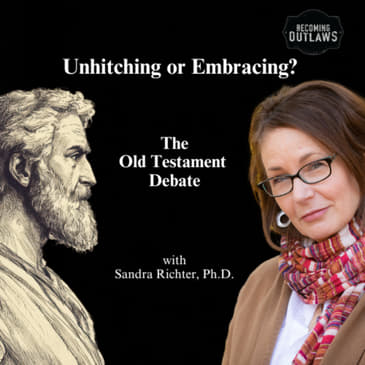
In this episode of Becoming Outlaws, we welcome Dr. Sandra Richter, a renowned Old Testament scholar and author, to discuss the crucial role of the Old Testament in forming the foundations of Christian faith.
The conversation delves into the ongoing debate around whether Christians should maintain a strong connection to the Old Testament, touching on contemporary perspectives like those of Andy Stanley, who suggests “unhitching” from it.
Dr. Richter also shares insights from her latest installment in the Epic of Eden series, Deborah, highlighting the complexities of gender roles in Scripture. She explores how modern Western society often misinterprets the roles of women in the Bible, emphasizing the importance of understanding the cultural context and original audience of these ancient texts.
https://www.amazon.com/stores/author/B00OEHYZFGhttps://seedbed.com/author/sandrarichter/
[00:00:16] The common Christian person is not always a positive reaction. It's like forcing someone to do homework they don't want to do. Genealogies and endless dates, battles and all of this.
[00:00:31] Or they may like the storylines. Maybe they just heard them as a kid growing up, David and Goliath, Daniel and the Lions, Dan, and all of that.
[00:00:39] They may try one year to read through the Bible and they're going to get through that and supposedly get to the good stuff.
[00:00:45] Well, there's even a movement going around, not to name names but one of the pastors sounds like Andy and it ends with Stanley mentions that you should unhitch yourself from the Old Testament.
[00:01:01] When I hear that, I know it angry often but it actually that really roused me up because let me just give you a couple thoughts. I have plenty of them just going to give you two.
[00:01:12] If you're doing a math equation, let's say Einstein level math equation and you have to fill out an equation on a board on a chalkboard.
[00:01:19] And it was so intense and detailed and beautiful, frankly, that it took the length of a football field. If you ever had one of those teachers that wouldn't let you just show the answer but you had to show the work that got you there.
[00:01:34] The foundation that creates the answer. You take away the Old Testament, you lose the whole equation, you lose the beauty of the answer.
[00:01:44] Let me give you one that's a little more rooted right out of the Bible is the same people who think we should just focus on Jesus, the New Testament. The Old Testament is irrelevant because it's a law. We're not doing the political law anymore.
[00:01:59] Answer me this. So we need to follow Jesus teach what he taught and such. So right after the resurrection of Christ, what was one of his first sermons if not the first.
[00:02:08] Could it could have taken hours? He's walking on a road with two guys disguises himself and he walks up and he hears their conversation and they're talking about the death of the one they thought was Messiah. He's like, hey, what you're talking about now look what you mean what we're talking about what are you from Mars everybody knows what we're talking about we thought from.
[00:02:30] Well, you know, I'm going to say the Old Testament they didn't have an Old Testament then it was just a scripture that this guy was it this guy was the Messiah but he died.
[00:02:40] In Jesus basically calls them dumbdums in a very nice spiritual way because he starts with Moses the penitook first five books of the Bible.
[00:02:50] And then goes through all of the prophets the whole rest of the Old Testament and he preaches to them how it taught about himself.
[00:02:59] In how it taught about the coming suffering Messiah, the death and the resurrection.
[00:03:04] And that's how he taught the gospel to unhitch ourselves from that.
[00:03:11] I just can't do nor would I recommend anyone that says you should which is why I'm really grateful for the work of today's guests.
[00:03:21] Dr. Sandra Richter, she's an Old Testament scholar who takes the academia level Old Testament knowledge and brings it down to the lay person like you and me.
[00:03:31] You might be familiar with her series the epic of Eden a Christian entry into the Old Testament her latest installment is on the book of Deborah, which we'll get to today.
[00:03:42] And she is the Robert H. Gundry, chair of the Book of Studies at Westmont College in Santa Barbara.
[00:03:49] She earned a PhD in Hebrew Bible from Harvard University of Masters and theological studies from Gordon Convole, theological Seminary.
[00:03:59] And if that wasn't press, if I like this that she's on the translation committee for the NIV.
[00:04:04] That's always been my go to the NIV and she spent many years bringing student groups to Israel to study historical geography and field archaeology and it really is an honor to have you on today, Dr.
[00:04:17] It is.
[00:04:18] Yeah, it's an honor to be here, can thanks so much for the invitation.
[00:04:23] Yeah, as a little fired up there.
[00:04:25] Hey, I actually have presented.
[00:04:28] I think two or three times formally on what I hope Andy is embarrassed about at this point of the unhitching of the Old Testament.
[00:04:42] Oh my gosh, especially when you think about what you just mentioned in your introduction that the only Bible, the New Testament Saints had was the Old Testament.
[00:04:53] But we're going to put that aside now because although it was good enough for Jesus and Paul and Peter and James.
[00:05:03] Yeah, it was good enough from in the most of the New Testament is explaining the Old Testament.
[00:05:08] So I don't even understand and I usually don't name names, but he put himself out there.
[00:05:12] He put it in a block so what are you going to do?
[00:05:14] Oh my goodness.
[00:05:15] And I do in fact, I was just speaking on it.
[00:05:19] I was at the new room conference with C. Bed just this past week and someone asked me about it in the Q&A and I absolutely understand the struggle for you know the typical lay person and the typical pastor in making this what I call a cross cultural experience.
[00:05:42] And that's the one that was available and engaging for 21st century audience. Yeah, it's hard work.
[00:05:52] And that's why we make the big box because what we do as ministers of gospel is an easy.
[00:06:01] But it still has to be done.
[00:06:03] I came alive to the Old Testament. I would say so I as soon as I could read, I was reading scripture.
[00:06:10] It was just part of our whole soul, part of our culture and my house.
[00:06:16] And you know, like I mentioned, you get the children's Bible or the kind of comic book version of some of the stories and whatnot.
[00:06:26] But it became real and fascinating to me and wanting to teach it to other people when I began to realize what Hebrew says that
[00:06:37] I started to see that the Old Testament is like God's painting.
[00:06:43] So if he was an artist and he were to paint the salvation plan, he would do it like no other.
[00:06:51] He did it with people's lives. He took thousands of years to do it.
[00:06:55] There's this tapestry of generations and peoples and dramas and stories that tells the salvation plan down to the materials in a tabernacle
[00:07:10] and what they're made of and the colors they have or the amount of flower you put in a meal in the Old Testament,
[00:07:20] I would never could have symbolic meaning towards a coming Messiah and different things in the festivals all tell a story.
[00:07:26] And that none of it is there by accident or for just reference of historical purposes that it leads to an ultimate conclusion which you know.
[00:07:40] In Revelation is the same kind of stuff you see in the Old Testament that they like to dismiss, which is unbridled judgment.
[00:07:51] Well and the Old Testament is full of so much grace and so many second chances and so much mercy.
[00:07:57] You know it gets caricature does a book about judgment but can we point out that in Genesis 3, the Almighty does not squash Adam and Eve like a bug.
[00:08:09] He instead triggers the most complex rescue plan of all time. You know can we point out that the people who are enslaved in Egypt walk free out of the eastern fortifications of the greatest empire of all time without one thing being asked of them until they reach Mount Sinai.
[00:08:30] So you know this business that the Old Testament is all judgment in law is just a week reading of what's actually in the Old Testament.
[00:08:41] And you're right about chapter 3 in Genesis and I'd like to step it back farther that scripture says before the foundations of the world.
[00:08:50] The lamb was slain that he was already thinking grace before the fall.
[00:08:54] Yeah, that there was already a rescue plan in the place.
[00:08:58] Right. Yeah. Amen.
[00:09:01] Amen. All right we're done. That's a good podcast.
[00:09:04] I've got to ask a question here on my load.
[00:09:07] Hey. The whole outlaw thing you know I've never gotten to be on an outlaw podcast so tell me about that. Tell me more.
[00:09:19] Talk about the podcast. Well, you know I'll give you examples every time I have somebody on here I consider them at some degree and outlaw if you're in a believer you're not in some venue or another.
[00:09:32] So last week I had Johnny van Zant he's the lead singer of Leonard Skinner.
[00:09:38] Yeah, so our and in this year I've a you know Harvard level of PhD so my I guess very greatly but we all have the same thing in common.
[00:09:48] And in my view outlaws in different ways so in his.
[00:09:53] I went and I saw them in concert after he was on the program and it's a great show they sound great.
[00:09:59] Tattoos all up and down long hair like the 70s music.
[00:10:03] But up his arm tattoos are John 3 16 and he's got Bible verses and messages all over that man and he couldn't be a more devoted.
[00:10:13] Believe her.
[00:10:15] And he's out there living cult.
[00:10:18] I'd say counter culture.
[00:10:21] He's not just he didn't go and get tattoos removed and cut his hair and try to find it through some volunteer spot in the church.
[00:10:29] He's still from the van Zant family which are legendary rock and roll Hall of Famers.
[00:10:35] Yeah, he'll doing what he does because that's the gifting he has and he doesn't back down on his faith that's an outlaw in our society.
[00:10:46] That's that's what this program is and then I have then I have you who I also so I really enjoy having Southern rock people if you can't tell I got to get tired everything back here mama tried that's old mirror yogurt.
[00:10:58] But then I love having you because I like to have the intellectual stimulation and try to bring it to the lay person and excitement that it's not just locked in academia and turning the questions back to you.
[00:11:13] Yeah, I've been around academia enough to know it can be stuffy.
[00:11:17] Tweets suits with patches on and smoking a pipe at our talking about.
[00:11:23] Just just a much fair say a call is that where you're trying to go without being rude.
[00:11:27] I was going to say I can't even think of the word in such a common word where you're just.
[00:11:34] I'm categorizing people into a group so not everybody is like that in academia, but where they have just discussions among themselves that nobody else would understand even just you smarter than the other one you strike me as somebody that seems like should be.
[00:11:52] There's teaching with a spirit presence and then there's just teaching information I guess is the whole about what I was trying to get to.
[00:12:00] And you seem to be the first one at the ladder.
[00:12:04] Thank you that is an expressly high compliment.
[00:12:11] And how would I explain that?
[00:12:16] I don't think it necessarily has to with where you came from it's it's.
[00:12:21] Who who you've decided you're going to be and honestly most people who are in the academy in Bible and theology.
[00:12:33] Most of them come from pretty robust.
[00:12:40] Faith oriented roots or they never would have gotten into it in the first place so most of them are coming from some sort of faith background that triggered their interest in the first place.
[00:12:53] But like pretty much every other discipline out there once you get into the higher echelons the business of being intellectually respectable and politically savvy and appropriately network.
[00:13:13] Make some of the ministry aspects of what we can and should be doing as academics dangerous and so here's where the outlaw comes in.
[00:13:26] I don't care.
[00:13:29] No, I do care and I paid a price for it.
[00:13:34] Stereotyping is the word I couldn't think of that was.
[00:13:38] I'm going to start with the first thing I can do.
[00:13:39] So this is my calling and I operate as comfortably in the academy as I do in the church.
[00:13:52] But I firmly believe that if I can't move what I have thought to learn and spent 16 hours a day chain to a library.
[00:14:07] I'm going to be a little bit more careful to get my brain around and embed into my cognitive capacities.
[00:14:14] If I can't move that into the church effectively what good do am I so that's how I see this and I'm also deeply deeply grateful deeply grateful that the Holy Spirit has allowed me to keep moving that material into the church.
[00:14:34] So you'd ask me about becoming outlaws.
[00:14:36] So the term becoming outlaws for me also it's could be different than you're not maybe functioning normally like maybe other academics would or all of them.
[00:14:47] It could be partly is the conversion experience or what the.
[00:14:52] So becoming a lot really for me is becoming Christian as well.
[00:14:55] What did that look like for you that brought was there a conversion point or was there something where there's a different way to go.
[00:15:02] So you're at some point your faith was just more solid and you felt called to a ministry of academia.
[00:15:09] Yeah, so maybe maybe that would explain a little bit more of who I am there it was indeed a conversion moment and radical powerful.
[00:15:21] It was in my late teens and I had been raised in the Catholic church that a Catholic kid in Jewish neighborhood.
[00:15:30] So I honestly didn't even know the Protestant world was out there and.
[00:15:36] I had been a church almost every day of my life, but I'd never heard the gospel and so I wanted across the street one day to this little Jesus movement coffee house that was.
[00:15:47] Happening in the basement of an Episcopal church and can we pause for just a moment there, Sandra.
[00:15:55] For the people that so we have all kinds of people listening.
[00:15:57] This is a Christian based show I make that clear, but we have non believers. We have a new age people I have people listening.
[00:16:05] A lot of Christian people listening we have Catholic people listening.
[00:16:08] How would we explain to a Catholic person listening.
[00:16:13] To be able to say I've been a church every day, but I hadn't really heard the gospel what what what what that mean.
[00:16:20] Yeah, well it happens in a lot of churches not just Catholic churches.
[00:16:25] You can sit in a Methodist church all your life and never hear the gospel you can.
[00:16:31] You can sit in a Piscopal church all your life and never hear the gospel you can sit in a Baptist church and hear the gospel but never see the gospel.
[00:16:39] That sort of thing can happen as well.
[00:16:41] So for me I came from good French Canadian roots, which means we're about as Catholic as I come and I literally I think I spent almost every Sunday of my life in mass.
[00:16:59] I was a Catholic school all of those things, but in the parishes that I was involved in there was never a priest or a CCD teacher or anyone else who would ever said to me hey, Sandy Richter.
[00:17:18] Jesus actually knows who you are.
[00:17:22] He actually loves who you are.
[00:17:25] He has given you particular gifts that he wants to develop into Cypher and he's got a calling for you.
[00:17:33] To me how I summarize that over and over and there's still people who comment on the program they don't get it is I try to there's a difference between the religion of Christianity which can take many forms as you're talking about many churches.
[00:17:46] The next role Christianity that Jesus spoke about is that you must be born again like personally experienced Christ.
[00:17:56] Well in that personal encounter is not only what transformed my life it's what saved my life I was well on my way to becoming a statistic.
[00:18:07] I come from a really dicey family story.
[00:18:10] My dad actually threw me out when I became a Christian so I was homeless at you know 16 and a half.
[00:18:19] That's the another layer of the explanation of outlaw.
[00:18:22] Yeah, yeah.
[00:18:23] And you follow Christ you get excluded out of circles.
[00:18:26] Absolutely and it can be it can be very threatening to folks who want to control you control your your cognition your thoughts your values all that sort of thing.
[00:18:43] So yeah in my life conversion was incredibly radical and I remember pretty much every moment of that afternoon like it happened yesterday.
[00:18:58] And in addition to being radical I will often describe it as though it was the moment when Jesus pulled a plug on an infection so I'm thinking of lancing a boil or some sort of infection.
[00:19:15] And hours of the most wonderful weeping I've ever done in my life as that wound in that infection was washed clean so a radical shift in my life again in my late teens and that initially led me into ministry.
[00:19:36] And the ministry kept evolving and the particular gifts that God had given me included an academic mind.
[00:19:45] And so as I moved forward and pursued more training and you know mentorship for what I was trying to do in the church and I worked in team challenge for a while.
[00:19:59] That's when those those gifts of teaching and research became more and more apparent and God just sort of kept moving me toward that ultimate ambition being the academy.
[00:20:13] Yeah, I love that about your story because there seems to be a divide between an academic channel and then let's say someone that came upon your path a conversion team challenge that's what the assembly.
[00:20:28] And then they can mainline to nomination background and then they tend to stay there and it's not a bad thing and there's ministry there and you help change lives but then to move into a world of academia I just wish more I wish more of the denominations.
[00:20:46] Would push that as a path of ministry and maybe the R. more I just I didn't used to see it anyway.
[00:20:53] You know it's funny wherever you find yourself mentors tend to recreate themselves right so if you're if you're hanging out among the ministerial world.
[00:21:05] You're going to see folks moving toward pastoral ministry because that's what they've seen and that's who the people they admire are becoming.
[00:21:15] When I was a seminary pro all of my best students wanted to become professors and I used to have to sit them down and you know do the eyeball that I've all thing saying look.
[00:21:24] The church needs excellent people the church needs good intellects so just because you're earning a's and you're loving your book learning does not mean that your calling is to move into the academy.
[00:21:37] Your calling might be to go back into the church and and raise the bar so you know I think both of Rina's tend to reproduce themselves and this this cross pollinization is is essential to the health.
[00:21:53] Of the church bottom line the Holy Spirit is the Lord of the church and he gets to choose who gets what gifts our job is to recognize those gifts to cycle those gifts and deploy them not necessarily to recreate ourselves.
[00:22:10] Agreed.
[00:22:11] So your latest.
[00:22:15] Installment of your series is on Deborah.
[00:22:20] So assuming that there could be just a lot of Deborah experts 100% of people right now listening could just be experts on the book of Deborah.
[00:22:28] I'm going to guess not.
[00:22:31] And so we start by just like an overview of the story.
[00:22:35] Yeah.
[00:22:35] I love this part and then we could back up and dig in a little bit.
[00:22:39] Absolutely.
[00:22:40] So you'll notice that the title is pretty complex right the epic of Eden Deborah unlikely heroes and the book of judges forget not all in there right.
[00:22:49] So as you know my epic of Eden work is is all about the epic of Eden how do we how do we track gods people from Eden to the new Jerusalem how do we put our Bibles together and and realize that their stories are story and our story is their story.
[00:23:06] So that's the big umbrella and then the smaller umbrella is the book of judges itself which actually for a guy who runs a podcast named outlaws you should spend half of your life in the book of judges.
[00:23:19] Because it's all about outlaws.
[00:23:22] That's right.
[00:23:22] It's everybody right.
[00:23:25] I'll compare it in the curriculum to the wild west of Israel's story where the good guys and the bad guys both learned their gunslinging skills from the cattle wrestlers and you know.
[00:23:39] Good guys and bad guys are just a few inches apart in the judges.
[00:23:45] And what are judges so we're not talking judge duty here.
[00:23:47] Yes, thank you for asking that question. Okay, so it's kind of it's really an unfortunate word in English.
[00:23:55] If you take it back through Hebrew and in KD and it makes more sense.
[00:23:59] All we hear is litigation when we hear the word judge but in Israel's story a judge had a dual function and the first function was military.
[00:24:12] Israel is still in its tribal league stage. So there's no monarchy, there's no centralized government.
[00:24:19] If you don't have a centralized government, you don't have taxes if you don't have taxes, you don't have a professional army.
[00:24:24] So how do you fight your battles?
[00:24:26] And the answer is, muster, you know, you you farmers turned warriors, volunteer, weakened warriors, right?
[00:24:35] So the first task of a judge is to have enough gravitas, enough personal charisma, enough empowering of a Holy Spirit that when that judge goes from one tribal region to the next and says,
[00:24:51] I need 3000 from nothally, I need 5000 from Ruben, I need 2000 from Judah that those fighting men respond.
[00:25:01] So his first task is to muster the army and to muster it in the name of whatever battle Yahweh has called him toward.
[00:25:11] And then his second task is to serve as commander and chief and get that battle one.
[00:25:18] Once that battle is won, and now we're dropping back into the old covenant, right? This is not the new covenant, you'll covenant.
[00:25:24] And the battle is going to be throughout the book of judges always for territory that has already been promised Israel.
[00:25:34] It lies within the 12 tribal, um, Nakhala, the inherited territories.
[00:25:43] But the Canaanites, the Amalicites, the Mulvites and Midianites have all infringed on that territory and stolen some of Israel's tribal inheritance from them.
[00:25:53] So the battle is always going to be to push the Canaanites back where they belong, put Israel back where she belongs.
[00:26:01] And then what will happen is the judge will move into this kind of Margaret Fathcher, Ruth Bader Ginsburg role, which is more the judge Judy thing.
[00:26:14] So this is pretty, it's hard for us to imagine not having a president or if we think historically having a king. So it's pretty that.
[00:26:23] Yes, but it's the closest you could get to it, right? That there, it's if there was a theocracy who manages, it seems to me like an administrative position for God's people.
[00:26:38] First of all, I just love the fact that you just use the word theocracy.
[00:26:43] That was a burden. That's an excellent word and it's key to understanding so much of who Israel is and so much of how the old covenant relates to the new covenant, which people mess up all the time.
[00:26:54] So just for definition, say, theocracy, the O's, Crattail is when God literally rules the country and that's the huge difference, the like ground shifting difference between the old covenant and the new.
[00:27:10] Under Israel's time in the land under the Mosiah covenant, Yahweh literally sits and thrown above the cherubian in his palace, which we call the temple and he rules the country.
[00:27:27] And he rules the country through three administrative offices once the monarchy emerges, so it's its profit priest in king. We've heard those turns before. Before the king, it's going to be profit priest and judge.
[00:27:42] And as you said, it is this pre-centralized tribal Federation. So what's happening with Israel is they're all in their 12 tribal districts.
[00:27:53] They've all got their own elders, their own patriarchy, their own leaders, their own little personal clan, battalion and they live very separate lives.
[00:28:06] And they like it that way because these are grumbly people, their hotheads, they are. And so living those 12 separate lives is how most of life continues.
[00:28:22] But three times a year, they gather at the tavernacle slash temple that unifies them and their allegiance to their god and to each other. And in time of national threat they will gather combine their armies and go after the bad guy.
[00:28:40] You know what's interesting to me about the judges is, well one is the pattern of people are following god and they're not a judge has to come along and kind of get them straightened out. Then they're following god then they're not.
[00:28:56] And it seems to me we don't know much about the judges or even can name them, except if it's ridiculous like Samson some story that is so oddball we still don't see him as a leader of Israel.
[00:29:15] And if Deborah has talked about from my experience, she's not talked about it seems to be in women's Bible study groups or something there seems to be a lack of here's a I hate to say gender gets involved because it just inevitably you have to talk about it when you shouldn't have to talk about it because god raises a leader who gets a job done there's another female in the story who gets a job done and it's.
[00:29:45] A more of an amazing story than kind of the dumb dumb Samson and it just seems to be under the rug or like I said in women's Bible study groups.
[00:29:54] Yeah, we we relegated to only women study Deborah which is quite a slap in the face to the revealed narrative of the people of god gifted to us in the Old Testament.
[00:30:09] Yeah, so the cycle let's talk about that for a second we got 12 cycles in the book of judges 12 I wonder where they came up with that.
[00:30:19] 12 representative stories it's not all of the judges but they've been selected by our book co authors under the inspiration though we spirit they're going to illustrate to us the period of the judges and they start off strong.
[00:30:34] The first judge he's exemplary does everything right after him comes echoed shamgar in Deborah who are all they all do very well very different characters you know one of them is Tony Stark one of them is the whole one of them is Captain America, but.
[00:30:52] But they are all fairly unambiguous characters and then the cycle starts cycling right so they don't go to anti heroes you're talking about superheroes and you mentioned like the wild west so those would be considered what we would say anti heroes right there's these guys that.
[00:31:11] We can't say they're good guys even other judges, but they're not the bad guys they're more.
[00:31:17] Good than they are bad yeah and what happens in judges as you said we got we got 12 cycles where the people are following god then they're not then god disciplines them with foreign oppression and then sends the judge right and then we have a season of obedience and we go right back to the count the cycle 12 times.
[00:31:34] The first four of those maybe even five of those we look at the person has been raised up and we say okay that's a pretty good human being you know that that's a that's a super hero maybe again a little a little ambiguous like a Tony Stark a little bit can be used.
[00:31:55] But but not an anti hero, but then we start getting into avi mellic and githyan and Samson and we're like oh my goodness these are heroes and I think that would be more what you mean by anti yeah.
[00:32:10] And I don't mean to keep stopping on your story, but when the so 12 as use a symbol of the own three scripture do you think that 12 here were actual 12 or do they tell us about 12.
[00:32:23] To keep that line going and what just what we need to know.
[00:32:26] Yeah, I think that each of these characters is an actual historical character and even the critical scholars you know goes critical as you want are going to argue that there are 12 heroic tales that have been encapsulated into Israel's national history so.
[00:32:46] Do you rule span the right amount of time for 12 people or no okay got it so they are represented so the characters are historical.
[00:32:57] The narratives depends on who you're talking to you know how amplified they might be.
[00:33:05] I'm going to argue that you know I'm a firm believer in biblical history, so all the we certainly need to read it critically you know we're not.
[00:33:15] We read our own history critically we can read their history critically as well but what they are is their represented to.
[00:33:25] And so how many how many how many decades even how many centuries these 12 stories might encapsulate.
[00:33:38] That I can't give a definitive answer on so that remain not being anomaly as far as gender.
[00:33:43] Oh right exactly exactly not only might she not be the only woman.
[00:33:52] What was I going to say oh this cycles I point this out in the curriculum we've got 12 were used to that right 12 disciples 12 tribes these are the people others love to stylize their numbers three seven 10 12 40 those are numbers right.
[00:34:11] So if we're going to get someone who is specifically an anomaly and the biblical writers want to draw attention to that anomaly they're going to get dropped in one of those slides three seven 10 or 12 just like e-nick gets dropped in slot number seven in the genealogies of the book of Genesis right.
[00:34:33] Divers in slot four.
[00:34:37] There's nothing special about slot four.
[00:34:41] She is not an affirmative action higher.
[00:34:44] She is not the biblical writers effort to make sure they fulfilled the DEI requirements of their institution.
[00:34:55] She is instead a representative judge of that era of is a light history and the other thing that is so.
[00:35:09] Attention drawing about ever is we're told from the get go that she runs this country for 14 years.
[00:35:19] That's another one of our stylized numbers so if it's 38 or 47 that's not going to call the history of the story into question, but it's a full generation.
[00:35:29] Yeah, and as you think about a woman who is married to Lapa Dote who's probably a military man who is named mother in Israel.
[00:35:37] That means this young woman picks up the mantle of leadership somewhere in her early to mid 20s that's as late as we can go.
[00:35:47] And if you live during that lifetime it's very possible that's the only ruler of Israel you ever knew.
[00:35:53] Yes, yeah and they're each the judges are regional like we'll have a judge we can have overlapping judges.
[00:36:01] You know one down south one to the east one up north but she's got the Benjamin plane she's got Ephraim.
[00:36:10] So during the settlement period and we talk archaeology in this curriculum as well because again as you've said my job is to bring the spoils of my academic study and put it on a lower shelf so lay people can read it.
[00:36:23] The set of people in trucker hats can understand what you're talking about yes they can yes they can affect truckers probably would so understand this story.
[00:36:33] So this is the settlement period.
[00:36:36] We know where Israel is and we know it based on the archaeological remains of their architecture they're cooking where their tools all that sort of thing.
[00:36:46] She is right in the core of the country.
[00:36:50] So Israel likes settlement at this point is reaching from just south of the Jesraal down to Judah she's right in the middle and she's got a circuit she's got a nightmare.
[00:37:00] So she's traveling from city to city to city to handle the supreme court.
[00:37:09] Interactions of of this nation so she's interacting with multiple tribes she is well known she's on a night internet circuit and she has been doing it for a very long time.
[00:37:21] And it is at this particular crisis moment when it's time to fight for the Jesraal which in the United States of America would be like fighting for the Midwest.
[00:37:32] It's the bread basket of the country and it's also where the major trade route goes through.
[00:37:40] So if we don't control the Jesraal, we can't feed our people and be we are not making a dime off of the trade that's moving through our land bridge.
[00:37:51] So fighting for the Jesraal is incredibly important economically societally politically you name it, but on top of that it's incredibly hard.
[00:38:01] Because both Egypt and Mesopotamia and the Canaanite local city lords everyone wants the Jesraal.
[00:38:11] So when Deborah finally stands up and says, okay we are done with 20 years of oppression we are done with outsiders in sleeping our people to work our land for their profit and we're going to fight for it.
[00:38:28] Everyone turns to her and says, ma'am we have so much respect for you but we don't have a snowballs chance and she said and is there a problem.
[00:38:42] I love her.
[00:38:47] For we dive more into the actual story line.
[00:38:52] I want to stick just like three to five more minutes on gender because I feel like it's necessary even though I feel like it shouldn't be necessary.
[00:39:01] We've made books in curriculum out of you know women in the Old Testament or women in this are that the scripture when they tell these stories they don't make a point of it it just is.
[00:39:11] Which means it seems to me that the writers in that time it just was this wasn't like hey here's a story about how God actually used a woman can you.
[00:39:20] Oh my god, like you know he talked there a donkey once now he talked through a woman it doesn't come across as that kind of story it just comes across as God uses people.
[00:39:31] Yeah, and.
[00:39:34] Now I would just think God uses people and first all thank you for saying that but he uses people who say yes he uses people who say yes and the most influential wealthy tallest best looking most.
[00:39:50] And I think you know it's a society we appropriate people often don't say yes.
[00:39:55] Right.
[00:39:56] Yeah, and a lot of us culturally and in churches are going to have a lot to account for for suppressing people's callings I feel and.
[00:40:06] I want to say and I think you feel the same that people listening to this is I for one do not agree with interpreting scripture to our current culture or changing how we feel at wish it said based on.
[00:40:22] I think we have a culture it has nothing to do with it.
[00:40:24] I feel this way on this topic and a couple others that we I think we just got the scripture wrong but what we're talking about is right out of scripture.
[00:40:33] And I know you can but in just a short amount of time because I don't want to go down.
[00:40:50] I think that's a lot of the time I wish you got to read scripture and context and most people don't and most people aren't thought to because people teaching them don't know it in context which is why the work you do is so important.
[00:41:01] But in a brief amount of time could you just because I think that's where the core but you can accept a bra if your mindset is stuck on a couple things Paul said which weren't untrue but could you unravel those for people.
[00:41:13] Yeah, absolutely thanks for asking me to do that.
[00:41:15] I actually just like four days ago.
[00:41:20] Filmed a lecture on a biblical theology of women in ministry and we just filmed it with CPED they're editing it now and it's some.
[00:41:30] I think that's a very important point soon once they make it prettier it will it will it'll be available and I'll probably put the script of it up on sub stack or whatever so that you know people can spend more time with it.
[00:41:43] As we as we where I typically start with this is reminding people that although the 21st century limits and marginalizes women.
[00:41:55] Reality is that the 10th century BC 11th 12th century BC when Deborah is operating when holda the profit is operating that they're their cultures were far more restrictive to women in ministry than ours are.
[00:42:14] And for Deborah to step out of domestic space and to step into public space and to manage the Supreme Court justice rule of the mosaic covenant in a very tribal traditional patriarchal patrilocal,
[00:42:35] society is talking about radical talk about an outlaw and the fact that her society is not only willing to bend to her authority but this one's even bigger.
[00:42:47] That the biblical writers are willing to record it.
[00:42:52] Pause over that. Who writes history and the answer is the elite right history the people up power right history the people who win right history.
[00:43:03] And yet the biblical text is celebrating 40 years of this woman's leadership both as judge and commander and chief on that speaks volumes to us.
[00:43:15] Then the fact that the profit in the Old Testament the most respected role of Israel's theocracy the one who steps into David's courtroom and says David, you slept with another man's wife.
[00:43:28] You got her pregnant and you're always going to pull you off the throne and that profit does that in front of his servants and his enlisted men in his own throne room.
[00:43:38] And that profit doesn't die.
[00:43:40] Okay volumes.
[00:43:42] So we've got women in the prophetical. We've got women in the judge role when Josiah rediscovers the book of the law he's got Jeremiah in his back pocket and he asks,
[00:43:55] who the, not Jeremiah what do I do about this book. So we can see that there is a deep recognition of God's ability to call and power and deploy women throughout an old covenant where women should never have been seen.
[00:44:12] And if you've ever visited a Muslim country you have noticed in public spaces, if you see a woman all you see is her dyrka.
[00:44:22] You know and yet diverse stepping forward. Okay. So we step into the new covenant and the declaration is neither June or Greek slave nor free male or female right both in salvation and justification and in the infilling of the Holy Spirit and what is that great declaration and acts chapter two
[00:44:41] this Peter tells us in the inaugural address of the church. This is what was promised in days of old that the Holy Spirit will come upon us the Holy Spirit will infill every believer not just the theocratic offices and your sons and your daughters shall prophesy.
[00:45:03] Right. So then Paul says don't do it and women don't speak in church so how does that line up? Okay, so the way I typically set this up is I look at I ask the question or what are the normative texts and you've already touched on this. What are the texts that apply to every every believer of every time in every location.
[00:45:21] So you can call them normative or you could call them covenantal and we've seen the neither June or Greek slave or free male nor female repeated over and over and over again. Paul does it Peter does it James does it that in the new covenant every human being made in the image of God is able to be called justified empowered and deployed.
[00:45:43] And then we see evidence of it right. We see women disciples we see women as the first witnesses of the resurrection we see a pregnant 15 year old and an infertile post men of puzzle cousin female as the first people who are believed willing to believe in the incarnation.
[00:46:01] Do we think the biblical authors are doing this by mistake that they're constantly pulling these women forward in these critical junctions of the great story and of course it's not by mistake of course it's intentional.
[00:46:14] So what you're after is two passages first to meet the chapter 2 verse 12. I do not allow a woman to teach or hold authority over a man and this is Paul speaking to Timothy about the Ephesian church and then first Corinthians 1434 and 35 which is Paul speaking to the Corinthians about the church of Corinth.
[00:46:42] And we're like, oh wow. Okay women cannot teach her hold authority over a man and then we do all these calistemics to decide when boys become men so that we don't have to fire all our Sunday school teachers right.
[00:46:55] So you can teach up until they're 12 and then you have to stop or maybe 13 if you go by the Jewish model.
[00:47:03] But here's here's the rub and I know you already know the rub is that this Paul who is saying to Timothy at Ephesus I don't allow a woman to teach is busy traveling with persona who is teaching and she's teaching a follows what the baptism of the Holy Spirit is all about.
[00:47:22] And this Paul who says I don't allow women to hold authority over man is greeting junior great among the apostles and them in 16.
[00:47:32] This Paul is celebrating Phoebe who is carrying the letter to Rome and oh my gosh, who's our who's our deacon is that Phoebe as well.
[00:47:47] So either Paul is having you know just a brief little psychotic moment here where he's completely contradicting himself or as people who have a high view of scripture we have we have to come up with a better explanation.
[00:48:01] Or culture and context matters.
[00:48:05] And then Paul why why Paul why confuse us that's my only frustration.
[00:48:11] Well, and I just like I said I just filmed this lecture so I just did a deep dive on the Ephesian church and I don't know if you've ever toured the archaeological remains of Ephesus it's an amazing city beautiful.
[00:48:26] It was you know absolutely the crossroads of an empire in its day which is one reason Paul focuses so much attention on it.
[00:48:35] Priscilla and Aquila talk there for a long time.
[00:48:39] There are two influences going on in the city of Ephesus that have run the Ephesian church off the rails and one of them is the Artemis cult.
[00:48:50] And all your perceived Jackson fans out there know all about Artemis right she is the eternally virgin, huntress goddess who requires for servants to be eternally virgin as well.
[00:49:05] Maybe not eternally but while they serve her the partner we are virgins and she's got all sorts of female rituals that can only be deployed by women and.
[00:49:19] Virgin women as well and she's fierce so that if you have mess up that virgin status you might wind up a sacrificial victim in a cult okay.
[00:49:30] So the Temple of Artemis is one of the seven wonders of the world Ephesus names itself the guardian of the Temple of Artemis you don't mess with Artemis in Ephesus.
[00:49:42] So that's one major influence and what is the problem post dealing with he's got young widows and by young he probably means 25 or younger.
[00:49:54] Who are refusing to remarry wonder where that's coming from.
[00:49:58] And in their refusal to remarry they are instead becoming groupies of these traveling teachers who are promoting this idea of ongoing.
[00:50:11] And a virginity to serve at least in some aspect the Artemis cult so in other words heresy is moving to the church and it's moving to the church with these young women and that's all over the epistal.
[00:50:25] So that's one influence the other influence is what Lynn Coic would name prodo nostism it's not full blown narcissism yet this isn't early heresy the early church were all matter is evil but it is prodo nostism and what will come to fruition of this particular heresy.
[00:50:46] One thing that will come out of it is the idea that it is the feminine element that is the source of all creation in other words did Adam come first or Eve come first.
[00:50:57] And in the syncretism between prodo nostism and a biblical text Eve comes first and Eve according to prodo nostism in her deep wisdom.
[00:51:09] Chose to Eve from the knowledge of good and evil so that she could teach in a form Adam and deliver him from his lack of nuance and wisdom regarding the real the realities of this world.
[00:51:24] So prodo nostism is pushing Eve forward as the first to be created and as the wise one because she ate from the knowledge of good evil and how she educated Adam and delivered him him from the foolishness of God's commands.
[00:51:39] So you can hear this in pause response and his response is no guys Adam was actually created first let me pull you back into your story.
[00:51:49] And Eve was wanted to see it does pull know that Adam was to see two of course he does but he's targeting a very particular heresy.
[00:51:58] So what he's saying at the church of Ephesus is right now for the next six months until we get this cleaned up I am not allowing a woman to teach sit down shut up until you get your your doctrine right and and then we can only assume he would have redeployed these women.
[00:52:18] Just like he deployed Priscilla and junior and Phoebe and Lydia and all these other women.
[00:52:25] I mean for us it would have been so great if you would have said I'm saying that because of this heresy but he didn't have to because they all knew what he was talking about.
[00:52:35] Because it's a letter it's not a book for the ages God meant it to be a book for the ages but he's writing a letter to those people who know exactly what he's talking about.
[00:52:45] And on our end it's frustrating.
[00:52:47] You asked about this podcast one thing is I'm not supported or backed by certain denomination but this is why because.
[00:52:56] I want to talk only about the Bible and I don't want to be locked into what we don't believe that about gender in the church or whatever the topic is I want people just to.
[00:53:06] Feel free to listen to conversations that they may not have had before and if you find out what you believe is scripturally accurate then the guest is wrong and then move on with your life you're good.
[00:53:18] But you may not be, you know so we can talk about gender or or creation or or hell or whatever other topics I do find and I don't know if you grew this I have found over my life and if I stayed with my pure denominational upbringing thinking.
[00:53:32] I feel like I would still agree with about 85% of it.
[00:53:38] And others I would still believe that if that's all ever if I didn't study on my own or listen to to others.
[00:53:46] In the parts that I end up disagreeing with where always the things inside that is I study personally I felt like that's not God's nature.
[00:53:53] That doesn't what Paul saying I know it's scripture.
[00:53:59] But in the way I'm reading it in my western civilized mind thinking he's writing it to my church and my people that doesn't sound like God's nature and almost nine out of ten times when I do the homework I find out.
[00:54:13] With the real answer which does line up with gods.
[00:54:16] Yeah, and that that that gut reaction because you actually know the person who stands behind these texts I e the creator who is called your name and say your life.
[00:54:28] That these these passages make sense.
[00:54:32] So if we were to take the letter two Timothy from Paul and ask it the formative directional questions the answers would be.
[00:54:46] If someone has gotten caught up in false doctrine in false teaching if they're having a negative influence on the vulnerable in your church community.
[00:54:56] I don't care who they are your job as pastor or district superintendent of whatever your authority position is is to pull them out of their teaching position until they get their act together.
[00:55:12] And that that is in many ways an equally challenging message because you know we all know that the gospel can be distilled into be nice and Jesus.
[00:55:26] Right, and you know this business of actually disciplining someone with an eye to redemption but disciplining someone because what they're doing teaching promoting isn't.
[00:55:37] Especially if they're good, tie there.
[00:55:40] Yeah, yeah, that is my gosh, that's a really good point or their famous you know are their famous.
[00:55:48] And they have a big platform and we can't you know we can't risk losing that network so we're just going to dodge we could go down so many things like don't treat anybody different when they come into it to special and then we give people special seats of just it's ridiculous kind of where we're at speaking of that.
[00:56:06] I usually don't go down and just criticize but I'm going to a little bit because it'll lead us back so I just heard in the last couple weeks a sermon.
[00:56:14] And I'll stick to that I usually don't name names, but it was a nationally kind of renowned pastor who's big these days and he was talking about Deborah actually.
[00:56:21] But it only in context and I hate when they do this when some minister has a topic that they want to joke.
[00:56:28] Drag a point across but these jump around scripture and a doldly looking for a way to back up their topic even if the topic is true and they miss represent the story or the actual meaning of the original story.
[00:56:42] So this one happened to be you know right where I'm going is this one happened to be on the masculinity of men these days or the lack of and he brought in the Deborah story and.
[00:56:54] For the reasoning being one of the other characters in that story, we're all.
[00:57:00] Was a masculine and he would only go to battle which doesn't make sense to me if the woman Deborah would go with him what man would do that and of course my first thought was that's not the story and what good is one more person going to do unless they are the Hulk it doesn't air for the woman or female.
[00:57:19] I'm not going to go without you is not going to change the battle outcome.
[00:57:24] I knew that story to be false.
[00:57:27] But back into the Deborah story so she's a judge there is a big battle coming which is very serious they look like they're going to lose.
[00:57:36] The other side has lots of chariots which in that day if you didn't have chariots, you probably shouldn't even go out there.
[00:57:45] Well not in the Valley of Jose Real, that's for sure because that's tank um chariots were the tanks of the ancient world so mobile artillery unit.
[00:57:56] So all the vets listening to you right now are like oh yeah what can you do with the mobile artillery unit you can.
[00:58:06] Slotter an infantry throw them into chaos so that by the time your infantry moves forward they have lost their positioning they've lost their battle strategy and you have a tremendous advantage.
[00:58:19] So that's what cissora has got he's got the mobile artillery units and our team has only got an infantry.
[00:58:30] And how does Deborah play into the story?
[00:58:32] Yeah well the story that you're telling about Barack somehow being a coward.
[00:58:39] Let's just start with scripture.
[00:58:43] Yeah.
[00:58:43] Judges five celebrates Barack for his profound courage and the biblical author under the inspiration level spirit announces that our man Barack deserves every purple heart,
[00:58:59] every you know every metal of courage that exists so whoever's going to call me coward first of all means to stand in opposition to the inspired authors of the biblical text.
[00:59:12] So that would be number one number two.
[00:59:16] We're being tough today.
[00:59:17] Yeah yeah what can I say?
[00:59:20] I'm on the outlaw pound kipkak.
[00:59:21] Oh sorry.
[00:59:22] I know.
[00:59:24] I'm allowed to be a gunslinger today.
[00:59:27] Okay so the other issue is that we have so painted Deborah's story with our own biases.
[00:59:36] So let's strip the gender office for just a moment.
[00:59:40] We have got a prophet who is also a judge which is very rare.
[00:59:45] Which is very rare.
[00:59:46] Samuels the only other one and so Samuel actually is going to repeat this same story.
[00:59:51] So I don't want to keep interrupting you, but to emphasize points you're already making but on this one is if you were going to have an anecdotal for some reason a female in that didn't really belong had to fit us but in history and biblical history because there wasn't a man to step up.
[01:00:07] A man's man.
[01:00:09] You would not make this woman a prophet as well.
[01:00:11] Yeah yes and give her 40 years of administrative influence because in the lifespan was what?
[01:00:19] Maybe 1665.
[01:00:22] Yeah.
[01:00:23] Everyone's well of someone would be on that but I have excavated more than one cemetery where everyone there wasn't a person over 45 in that cemetery.
[01:00:32] So the fact that she rains for 40 years is highly significant and there's only a handful of other judges that also rain for 40 years and they're the exemplary judges.
[01:00:43] So octaneal has got 40 years and Deborah's got 40 years.
[01:00:47] Okay so she's exemplary on all these fronts.
[01:00:52] So again, strip gender off of it.
[01:00:54] Let's go with another commander in chief who might not be physically the best choice to be on the battlefield.
[01:01:04] Oh let's go with Moses.
[01:01:07] Okay so the man's in his 70s by this point in time and he is the commander in chief do we really want to risk him on the battlefield?
[01:01:14] And the answer is no.
[01:01:16] So what is he going to do?
[01:01:17] He's going to turn to Joshua his commander in chief and he's going to say okay Joshua, you see the amalgacides?
[01:01:23] I know that we are outgunned outman, outnumbered out planned but we're charging.
[01:01:28] And Joshua is going to say yes sir.
[01:01:31] You tell me when sir and Moses is going to say okay I'm going up on this mountain.
[01:01:34] I'm going to stand up here and watch.
[01:01:37] And you are going to charge in.
[01:01:39] I will tell you exactly when to drop the flag.
[01:01:41] Are you ready Josh?
[01:01:42] There's like yes sir.
[01:01:44] So Moses drops the flag.
[01:01:46] Joshua leads the troops in.
[01:01:47] It's chaos on the battlefield which every vet out there will tell us it's always chaos on the battlefield.
[01:01:54] So where is Moses?
[01:01:56] Is Moses down on the field?
[01:01:57] No he is up on a mountain and every man on the field who is risking his life in the name of the Galway knows that if
[01:02:07] the yellow is in this we're going to win because the battle belongs to the Lord.
[01:02:11] So we're going to have Moses up high and as long as his hands are raised everybody knows we're winning but of course his hands get tired.
[01:02:19] So Aaron and horror come and they hold up his hands and they put a rock under his behind so he can sit up there with his hands raised.
[01:02:28] And every young man on the field can see that the prophet of God is with us keep on fighting.
[01:02:36] The exact same thing is going to happen between Samuel and Saul even though Samuel knows what to do with the weapon and the same thing's going to happen between David and Samuel.
[01:02:48] And honestly I would anticipate the same thing is happening between Hezokai and Isaiah in other words it is not at all unusual.
[01:02:56] When you even say you could go as far as you see you got an old man like Moses he can't help you on the battlefield but when you see him it reminds you guys on our side that when you see even in the arc of the covenant.
[01:03:09] It reminds you guys on our side if so like you said strip away gender if you have the judge out there you know that God's on our side.
[01:03:18] Yes and so the covenant in particular she is she offers technically if we go back to you know higher critical treatments what she offers Barack when he shows him under her palm you know the palm tree of Deborah down on the on down and Ephraim.
[01:03:33] So first of all the man crosses enemy lines and travels 50 60 miles to show up in her office and she says okay Barack you're my claim commander from the tribe of not to link which is not a big tribe okay.
[01:03:47] You're going to muster the troops and we're gonna fight and his only answer is yes ma'am, but I need you with me because this is going to be a hard sell.
[01:03:57] And she says of course I'm going with you that's her first response but you need to know oh you know ancient warrior that you're not going to get to deliver the death blow.
[01:04:10] You're not going to be David standing on Goliath's chest pulling Goliath sword and cutting off his head that that moment is going to go to a woman.
[01:04:20] Now everyone listening to the story thinks it's going to be Deborah in fact the guy who's preaching probably thinks the honor of that passage is going to Deborah but you and I know that's not true.
[01:04:30] It's going to be a stay at home house wife married to a turncoat who's going to kill the warlord with a frying pan that's what's coming and it's a crazy end of the story.
[01:04:42] So the prophet is speaks it so that we all know that hey Goliath actually in this so she travels up with Barack she is in the war camp with him just like Samuel is in Saul's war camp over and over again just like Samuel is in David's war camp over and over again.
[01:05:00] And then at the moment that the Holy Spirit speaks Deborah turns to Barack and says now and he says yes ma'am there is nothing unusual about this exchange of office and authority.
[01:05:12] But because of our bias we hate Barack who can I remind us all charges down off of Mount aboard knowing he's going to die knowing that all 10,000 men who've been faithful enough to answer the call are going to die with him.
[01:05:29] Because there is no way that this infantry a farmers turned warriors can actually win a battle against sister unless.
[01:05:38] Yeah, I don't want to go down to other paths but just basically how we read scripture. How do we not read scripture with our own preconceived notions like I go nuts every time I hear somebody say.
[01:05:57] They refer to the disciple Thomas is doubting Thomas this is just a side example because everybody doubted we all thought he was you know being on the cross he was being justly executed and he's just versus before said I'll go and die with you.
[01:06:17] And none of them believe the women when they came back not one disciple and because he was bold enough even brave enough to say.
[01:06:27] Even like loved him enough to say if we ever cared for somebody that died you don't want to believe just everything you even see or hear you want to feel this person are if they came back from the dead to me it a love story it's not a story of like unbelievable.
[01:06:45] I think that's a side thing I just get fresh to my hear that because we hear that because we've been taught that and we think that's his name like his first name is doubting his last name Thomas.
[01:06:54] So when it comes to Deborah or these women in the new testament or they're the first ones.
[01:07:03] The first one's to tell teach men about the gospel we overlook that from our preconceived bias and then we go right to the verses we talked about in Paul.
[01:07:15] How do we not do that though.
[01:07:23] Well, probably one of my central life ambitions in what I do in the church and I have a mantra it is real people who lived in real places and we're struggling with real faith.
[01:07:38] I truly believe that as we re animate the backdrop.
[01:07:45] As we teach the 21st century student of the Bible about the culture in the history and the economy and the socio economic setting of these people like we let them be real characters who lived in real places.
[01:08:01] Then all of a sudden they're struggles with faith and with their own discipleship and with these great battles like the battle for the Jesrille.
[01:08:13] Once once the background is reanimated then the personalities are reanimated as well and we can see ourselves in these characters and as a result we are not only encouraged but were disciple been disciplined by these characters lives.
[01:08:30] I am convinced that when Barack went charging down off that mountain he's easily equivalent of Erdogan standing in front of the black gate at more door.
[01:08:45] I'm going to die but I'm going to go down swinging because I believe in the kingdom.
[01:08:51] I'm convinced that was you know, Barack's perspective he is hoping and leaving for a miracle but he's ready to go down with the ship as well.
[01:09:00] I couldn't see that. I couldn't understand that. I couldn't be challenged by that.
[01:09:10] If I didn't understand the military strategy about if I if I couldn't put it on a map, if I didn't know the difference between a volunteer muster force and a professional army with ironclad chariots.
[01:09:23] That's the sort of stuff I do in my curriculum. Let me animate this for you. Let me take my education offered to you and now step into the story and see yourself be you man or woman as Deborah, see yourself be you man or woman as Barack, see yourself as one of those 10,000 men squatting in the darkness,
[01:09:52] sharpening your blade. I've said yes because I believe in the prophet and I believe in Barack but I'm scared.
[01:10:04] These are these are our inheritance. These are the great stories that matter they shape us and they give us courage to be the church, but if we don't know these stories, where are we going to be strengthened to be the church?
[01:10:20] Where would you like the people to get your materials? Do you have a website you want them to go to or is it simply Amazon do you have a preference?
[01:10:27] Yeah, I am launching a website one of my computer science students is making that happen.
[01:10:33] But the easiest place to get all this stuff is Amazon for sure and I'm an Amazon author and you can follow me through Amazon and you can drop a little review which I wouldn't mind.
[01:10:46] But you can also go to Harper Collins who is producing these curriciums at this point. You can go to seetbed.com if you're from the Wesleyan tribe you've heard of them.
[01:10:59] They also are distributing and helping produce these. I've got a public facing Facebook page Sandra Lynn Richter not hard to find and there's no friendship thing got a little subs back.
[01:11:19] And I'm sure other people will and it's just a taste of hopefully get some excited to get to think about what's this on hitching stuff and just getting the new testament in your materials is definitely a way to do that. Thanks again.
[01:11:42] Thanks for watching.