
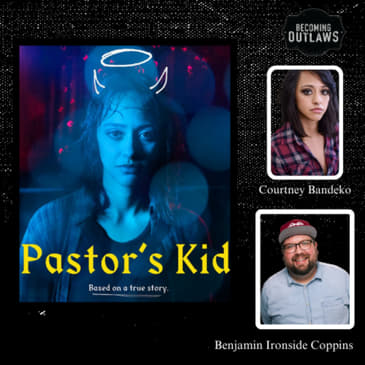
Actress Courtney Bandeko & filmmaker Benjamin Ironside Koppin discuss the new Art House film, 'Pastor's Kid.' An open discussion on how were all broken people on a journey of healing.
[00:00:00] and the world was. He said, come follow me. We will all walk so I sense and then becoming allies. Welcome to Becoming Outlaws. I have a different one today. Another movie, excited to show you.
[00:00:17] Two guests. We have the director and an actress in it. It's a new art house movie called Pastors Kid and before we talk to them, let's watch a trailer. There are more human being baptized today. Because I love Jesus Christ.
[00:00:30] We just wanted to get away from everything. Then the other day we talked on the phone and it's like, bring everything right back. And I look kind of too care for when she was drunk out of her mind. I was a good, a Christian girl.
[00:01:03] Good, I knew with a mess. For me, so please. Where was all this like caring when I was seven? Yeah, I didn't get to have a child who gives you a screw in around.
[00:01:16] So, no, you don't get to have a girl or good parent. No, I'm not letting you do that. They may not have seen who I am. Being a Pastors Kid and living the way that you do. How do you feel about God? Christianity. It's both actually.
[00:01:33] My mom just invited me on a free church trip to Sri Lanka. Yeah. Anyone in your positions can take a minute to process that. And if you need to go on a trip with your mom, you owe it to yourself. Like, go!
[00:01:54] There's the trailer and of course, if you're listening, you didn't see it, but you heard it. The director is Benjamin Ironside Coppán. He's a award-winning director, cinematographer. And this film, by the way, is based on a true story which we'll talk about.
[00:02:31] The actress is Courtney Banda Goe. Isn't accomplished actress? She's known for playing the character Finch on the CW show Legacy as well as other things. And like I said, it's the lead in this and I'm very happy to have them both on. Thanks for having me.
[00:02:48] Thanks for having us. We're excited. Ben, my first question is your middle name. Where does that come from? I'm inside. So we're a Scott Schoesch family. That came from our clan. But have you ever heard of there was a Theologian named H.A. Ironside? Our Henry Ironside?
[00:03:04] I have not. Anyway, see as a ton of commentaries and things, he was notably one of Billy Graham's mentors back in the day. And so they tell stories of how he would go into bars at like saloons and stuff back in the old days
[00:03:17] and he'd play hymns in the bars to try to minister to people. And so that's where we get our Ironside name. So even as we're making these kind of raw, this more raw,
[00:03:27] R-rayed faith film, it's kind of doing something similar to what he would do back in the old days as the way I see it. So, wow, I didn't say, yeah, I kind of thought that was made up a little bit.
[00:03:36] So what is art house? What's an art house film? We've been talking about that. That's kind of the Christian art house term is what we've been putting on pastors. Kids simply because to try to help people not expect to go into a similar movie as a fireproof
[00:03:50] or a God's not dead. And that can be in the way we shot the film, very handheld, natural light, little more gritty. It's in the pacing of the movie where it's more of a day in the life of film.
[00:04:00] You know, it's not a traditional structure with plot moving everything for but what we talk about is It's basically as if a documentary crew was dropped into the life of this woman for a handful of days
[00:04:10] and we are watching traumas and triggers happen throughout her everyday life as things being brought up. And then the third thing I like to say is the movie's just a little weird in some ways.
[00:04:21] As we just, we play with it being a little bit more artistic and expressing things, leaving questions instead of forcing ideas. So that for us is what Christian art house means. It's just overall the pacing and tone of the film is different.
[00:04:34] And I think when people go in with that mindset, we found that people really enjoy it. But when people go in expecting a Kirk Cameron type movie, that's not what this is. So we're just trying to make that clear ahead of time.
[00:04:46] Yeah, Courtney, what's the storyline for this? Well, it's I think it's one spiritual journey of a, I don't want to give too much away as one spiritual journey of, you know, a girl's lost her way running away.
[00:05:03] And then, you know, she's, you know, and then a character who comes upon across roads and then has a decision to make.
[00:05:12] And then, and then that's it. And that's really it. So, and then the thing about these little these little films is I love that they can have they can just say one very simple thing at the end.
[00:05:24] And that, and then you're talking about what you're referring to, but it's like church movies, faith films. You consider to Christian film. I consider, I look at it. It's an art film, but it's more like, I don't know if it's just a film about.
[00:05:44] People and people hurt and people struggle with faith. And sometimes we just want to cosmetic up, you know, you can expect a family film if you want. And that's nice, but sometimes we use word Christian.
[00:05:58] It's like, sometimes they church was like the first social media before where you go there and people would try to act as, you know, present a life that maybe isn't really at home like social media does.
[00:06:12] Right. Right. Now that's really good point. Yeah. Where like this film is real. It's what really people go through. It's what parents deal with their teenage kids and then.
[00:06:23] And maybe being embarrassed to bring them to church or whatever. This is just a real story to me, and it's more than a Christian film. It's just a film about life.
[00:06:33] That's what we've, it's been so hard to try to put it in a category because when you say the term Christian film automatically think faith and family.
[00:06:40] And I'll be honest with you, like we haven't gotten a ton of criticism, but that's been one of the criticism just in random comments. We've only had a handful where they're like, you know, how, how can you be a Christian and make a film that I can't take my whole family to see was a comment.
[00:06:53] And I, I've let out said, like, you know, sadly the majority of stories in our world are our RAID stories. I would say almost everybody story is an RAID story. And so that's been very interesting for us trying to coin this term of Christian art house.
[00:07:07] It's just trying to differentiate ourselves a little bit. I think for so long, like even you're saying faith and family when it comes to media have been paired together.
[00:07:15] And what we're kind of trying to do with it with this film is say we can still have faith in family content. That's great. But can we also have space for us to tell stories in an authentic realistic way.
[00:07:25] Thankfully with things like the chosen and Jesus revolution and Father Stu if you see any of those. I feel like they're starting to push forward and push the boundaries a little bit. And ours, I hope is the next step in some of that.
[00:07:37] Yeah, I would say if faith film is the big umbrella genre.
[00:07:42] I wonder if there can just be a branching off now that there's faith in family and those films are wonderful. And you know, they're popular for a reason they do very well. I think they accomplish many, many great things.
[00:07:57] And then, but I just feel like there's a whole facet of the community that's just unrepresented and unseen. By the lack of this other branch of hey, I think there's space with under the umbrella of faith film to say,
[00:08:13] Hey, there's these other stories that can and quite frankly should be told in more real way in a more pragmatic way.
[00:08:23] That really just the way I see it honors everybody's arraided past doesn't glorify it, but if we want to celebrate who we are today, we have to incorporate who we were yesterday.
[00:08:37] And not to glorify it, but it just says, hey, you have so much permission to just own your life.
[00:08:46] And that's sort of, you know, my hope that people leave this movie saying thinking one thing. It's like, hey, it's okay for me to have lived a life, you know?
[00:08:57] Well, and what's so interesting too is as we've been showing the film around to different groups, you know, I thought in my head, you know, we're trying to make a film that can kind of bridge the gap right between
[00:09:08] Like a Christian demographic in general audiences, we want to make a film that everyone could relate to or everyone could connect to. And one that I wasn't expecting was the film was screened to a group of older conservative Christian women in the Midwest.
[00:09:22] And you know, we let them know ahead of time, hey, it's got language in it, it's got this in it like this is why we did it we made that clear.
[00:09:29] And it was so cool is that the reviews we got back from that were basically these women saying like I knew one of these people are in college or I experienced some of this in college or I went through this.
[00:09:40] And like you're saying, it's in the church we put on this face and we put on this front and and you know, if you see can be in the small group, breaking me in this group, and you never talk about who you were before you knew Christ or what you went through.
[00:09:50] And so that's where my hope is with this film that people, you know, even the conservative Christian women people that wouldn't normally step into this if they can go and do it and say God use this story I can share my story now or I can feel open to share some of the things that I went through and I just wasn't expecting that honestly would be right.
[00:10:07] And I think that's quite beautiful. I mean, and can we really connect if we're all just pretending to be something you know or if we can we really connect in a real way of pretending or if we're can we can really connect in a real way if we're all living a watered down version of our self and and hiding really everything that makes us who we are.
[00:10:28] You know, I think there's it's a deeper way to fellowship in that way. Yeah, yeah and we keep talking about our rated past.
[00:10:38] It's a way to put our lives we're rating it by a cinema system like when I still live our rated x rated or you know now you become a believer and I'm not living a G rated life. I don't know if anybody else is but.
[00:10:53] It's you know, I think about other kind of movies that don't get pigeonholed like great dramas about people that happen to be Jewish or stories that have a Mormon character and it and they don't get categorized into a Jewish genre.
[00:11:07] A Mormon genre, but if there happens to be a Christian and it we've got to put him in faith in film and then put all of those g rated criteria around it.
[00:11:17] Yeah or it's Ted flanders from the Simpsons kind of character in the movies where it's it's a ridicule. Yep, and not real.
[00:11:25] Yeah, and that's a lot of clanders out there is like going into it to our intention was like how do and we try to express this to people but that's where there's this whole disconnect is like.
[00:11:33] It's if it's it was a normal movie just like a normal movie that you would see that talks about faith and they're like well, and I know just like just like a normal movie about faith and people do we're just having trouble connecting that. A normal concept.
[00:11:47] Yeah, and it's so funny that you bring up flanders from the Simpsons just because that's exactly what we try to not do is make these. One dimensional archetypes in movie that you know everybody's very three dimensional everybody sort of you know because even if you want to.
[00:12:03] Brand somebody's a villain and you know put it in a box then they come out with out of a field you know not being that way. Which could be frustrating. You know it's all life as I think and that whole expectation of like the.
[00:12:20] It's not so much like okay, so it's going to be a Christian film this got to be you can't say this word or that word I like to get back to the root of things and like.
[00:12:30] Well, nobody lives that way but Jesus came for those that needed help he didn't come for the healthy you know he's like it's the sick that need a doctor.
[00:12:40] But then once we kind of go to church we clean up nice and pretend nobody needs a doctor right everyone's broken and. Some way or another and you don't get healing if you don't admit something broken.
[00:12:56] And so I enjoy that about your movie I mean you're not going to come out jumping and skipping and that you just watch the Disney movie but you felt like you're saying there people that could relate is.
[00:13:11] If it's not you it's somebody and it's some level it's everybody everybody struggles with something. Right, you know.
[00:13:19] Well that's you know, no no, please go to that that's really beautiful that you said because so funny you're saying that because that that was our we know we were hope what we wanted to do is we didn't want to tell.
[00:13:31] We we didn't want to be prescriptive you know we didn't want at the end of the movie to say do this and X will happen because then it takes a lot of the responsibility off of you know or none of no.
[00:13:46] Then it takes away your your like power to make a decision for yourself you know so really it's it's not you know I don't know if you're following.
[00:13:58] Yeah, for sure even you see so much Christian content that beats people over the head with messaging and what they wanted to be and you need to do this thing and that could either be.
[00:14:07] You know through a political side or through a Christian side, but you see this stuff kind of forced on people and so it starts to taste like I'm not saying all but just some can sometimes tastes like propaganda like things are trying to be so up down your throat.
[00:14:18] And we want to be very intentional about letting the audience draw their own conclusions from things and leaving space for questions or even how you're talking about like.
[00:14:27] Even if you didn't go through this exact thing having enough space in the film that you could put your things into the film and kind of work through that a little bit.
[00:14:35] As opposed to just being you know hey this is exactly what to do this exactly what to believe it's you know we're allowing space for the whole experience move and work on some of those things yeah and as far as preachers kid.
[00:14:49] You're probably aware but when I was doing a little homework on this well watch in the movie and whatnot, right we're in across the Wickel peda actually has a page dedicated to the preachers kid syndrome. Really?
[00:15:01] Yeah and it gives a historical thing about where the term comes from and what preachers kid means and it's anywhere they say anywhere from someone who's.
[00:15:12] It doesn't have to be a pastor they had it as far as lay a T anyone who's like really if you're kid that grew up with parents and have responsibility in the church. You could fall under this syndrome and then they explain it out which is the pressure.
[00:15:26] The pressure to do what we're talking about to look. And kind of pretend to be a certain way and look a certain way and talk a certain way.
[00:15:35] And with the struggles you're actually having in your own life your own school like every kid does but you're really not allowed to show those or admit that you have them.
[00:15:43] And they either and one of the things is a super high rate I think they gave a percentage I don't know of those that actually end up like what you're watching in the movie as people just going off the deep end. Just totally religion out the window.
[00:15:58] And running running running running running running running running running running running running running running. That's okay. Oh yeah, no just but to finish the sentence running because you think that's easier. Right.
[00:16:11] And even it's so interesting you bring up that idea of them not being able to share things or putting on this front because something even Courtney and I were talking about and Courtney you can express this a little bit more was.
[00:16:20] Her just in her performance being intentional about around people she presented one one version of herself and then when we're alone with her she presents another kind of aspect of her character. Yeah. Yeah, no I mean. I'm pleased.
[00:16:36] I was going to say at some level we still all do. You're never shake that. Yeah, no and I said that so it's so funny that you pick up on this whole pretence that we that we feel like we need to put on and who.
[00:16:49] It's just so funny I wonder who who decided that we should do that pretend to be a thing that none of us actually are and why do we do that towards ourselves. So really just isolate us.
[00:17:00] It should so I've been thinking about that a lot lately the more we have these conversations and. And then yeah, Ben to touch on what you were talking about as I remember making a very clear.
[00:17:10] You know as I was breaking down the script me a very you know technique in a technical way. Saying okay this character we never see her emotional around other people it's always it's just a really illustrate how how many times do we are we a mess by ourselves.
[00:17:28] And then we step out and put on a happy face for the world how many times do we do that and then it's just you know just we and then as on the other side of it.
[00:17:40] I hope it's just we just we can really understand that we don't know what so what he's dealing with we don't know what somebody's carrying and then this this slice of life and Ben I love that you did it this way, this slice of life, and so we get to see her.
[00:17:56] Do all of those things we get to see her in these moments of privacy where she's by herself wrestling with these things and then and then around a friends. As if nothing is going on.
[00:18:09] When you study and the script and try to learn the character and what the characters feeling and did ever move for you or even now is.
[00:18:19] Or something engaged you a bit just being around that culture other than learning like the Christian culture did it impact you in any way that's changing for you as opposed to move on to the next script and that was.
[00:18:33] No no it's so funny you can't you can do something like this and not be changed I think you know and I think that's one of the wonderful things about being an actor is you get to go into these worlds and evolve and grow and and it was in a way that I never really saw because.
[00:18:49] I said this to you've been a you know is a go that I said you know I I came with a lot of cynicism and I said you know if I'm going to play somebody who it is devout but struggling I needed dismantle all of that.
[00:19:04] And it was so easy to do and I'll tell this story and the big there were a lot of moments early on when I was.
[00:19:12] I was doing the research and getting to know the world and I went to Mariners church where Ben knows Taylor who this movie is based on.
[00:19:24] And just walking in for the first time and it's 1500 people on their feet to this glorious music and I was so shocked I wasn't expecting to be rock to my core so deeply by that and it was just it was one of my biggest ways in.
[00:19:44] Because it's just something that's irrefutable and you know you that's something that experience you carry with you you just can't not you know and then you know I'm still a fan of prison worship music to this day.
[00:19:56] It's it's just beautiful just because you know it's art it's people singing from the bottom of themselves in the name and Jesus Christ and you just.
[00:20:06] It's just irrefutable is the word you just can't deny it it's it's it's truth it's love it's just this universal thing that we're all looking for.
[00:20:16] Every person and I don't know your app but I'll tell you that I did grow in church in that world around a lot of net flanders and.
[00:20:26] And I was never a net flander's I'm still not a net flander's I hope but at the same time I never if it was all about they upbringing I had in church which was fine it had its benefits I wouldn't be involved today or any interest at all it's a nice place to be around and you learn some things and meet some nice people.
[00:20:46] But really it's the reality of the faith being true and that you do find something there sometimes you sense it in worship but if the message is impactful in life changing and.
[00:20:59] The real disciples before the net flanders church arose thousands years later they were the main apostle was cursing in the new testament some of the first disciples were prostitutes I mean they were not net flanders they were us.
[00:21:16] They were rough they were blue collar they were real people just like your movie if you showed the disciples unedited just raw with a video camera it would.
[00:21:26] The far surpass the edginess of your film right right now I love that's even one thing is when people talk about the language I'm like there's language in the Bible guys some of the disciples like cursing the Bible I know we don't have the exact word.
[00:21:40] I'm just like that's where it's you know we're trying to show reality and I think that for me the conviction was one of my I filmed my friend story at Mariners church and I had no idea that was her journey.
[00:21:53] And then we sat down and we needed a video desperately for Easter and so we sat her down film story and she did my friend for a year or two years and I I filmed a story like holy cow had no idea this was your story.
[00:22:04] And I remember editing it and just sobbing while I was editing it because I felt like it touched on so many aspects of like we have all felt burned by a Christian or hurt by the church and some degree in some way.
[00:22:14] You know the idea of running from God and wanting to do my own thing and then just the reality of God chasing after her and why love is her like an animal spoiled too much but if her spiritual moment you know she basically shares shared this idea that you know I realized.
[00:22:28] that God loved me so much you would chase me halfway around the world to know I was loved and so when I we heard that story me asked if we could turn her story into a film.
[00:22:38] To me it felt dishonest to try to clean it up it felt like we were doing a disservice to the power of God stepping into the darkness for her.
[00:22:48] And so that's where even with us our rating is we just felt very convicted to try to do this in the most honest and realistic way that we could.
[00:22:57] Gosh, and that still moves me all these years later it still moves me that just because I love that we got to this that you don't have to be perfect and then are worthy of love. You are worthy of it now in perfect as you are right now.
[00:23:18] Yeah and in the expectation of expecting people be g rated right when they come to faith, you know we got to let people be people and let it grow we're all at different places.
[00:23:30] There's a room so much room so much permission to be human and that's not in itself it is so difficult we can give ourselves a lot of breaks. And there's a conformity in this is an.
[00:23:43] We're not talking about free reign to go and be misbehaved it's just a freedom to grow and there's a level of in the conformity I'm not ripping on the church I go to church I'd like to it's an important thing but.
[00:23:56] The conformity sometimes that you feel like it's supposed to be whether it's a film is supposed to be this way or you're supposed to dress this way. It takes away from the individuality of.
[00:24:10] God created everybody different and sometimes we say well Christianity looks like this and this is probably for both of your time but there was a Christian he's still around but his name Steve Taylor he was a Christian music artist and he was popular.
[00:24:25] When I was younger any of of Papua song called like want to be a clone any was talking about as soon as you go down that church aisle.
[00:24:32] Suddenly you've got to look like everybody else behind you you got to dress like everybody in the pew and you look the same you walk the same. And when in nature even look how different everything is.
[00:24:46] And how every snowflakes different you know how much more should we be different and not just. We can all be in the same kingdom and have a connection to each other from the same faith but we should all be different and then.
[00:25:02] And enjoy the difference in people and not try to make them like us. Well that's even the analogy of the body of Christ. I so fits that where it's like you know I always joke that I'm the toenail on the body of Christ.
[00:25:17] Some people are this and some people are that and God has convictions on different people's lives for different things and.
[00:25:23] Ministries that they're called to do and and honestly in pastures kid that's one of the things I love about the story is that when she sort of has maybe a positive spiritual experience and trying to be careful.
[00:25:33] And it's not within the church she grew up in it's not in kind of a branch of Christianity she knows she has to get out of the country and get to a different culture.
[00:25:42] And in that culture she's seeing a different side of this faith that she grew up in and I think that that can be really beautiful sometimes is. I think sometimes in our western church we get so used to our denomination or our box or are this or that.
[00:25:55] And I think that's a great chance to go to Egypt and see what the church is like an Egypt and I was a wreck the entire time in Egypt seeing how Christians interact their expectation for God and prayer.
[00:26:05] And that's something that I hope we communicate in the film is that even there's one time they're like praying in a group and they bring Riley over and she's kind of staying there with her eyes open a little bit as everyone's like praying but there's something so honest in that moment of her being like, what do I do with this you know how do I wrestle with this so.
[00:26:24] I was random but I brought a friend to church once when I was younger from high school he had never been in his life and.
[00:26:30] People in our church would raise their hands and worship or whatever and it's seriously bothered him and he finally asked me why will somebody not answer their questions. That's amazing. You know the one thing that really stood out to me.
[00:26:50] I wouldn't have thought about it when I saw the film but it reflects the film but it was in the testimony video. Is the church and see my pain. That that hurts like.
[00:27:06] Even in your normal life not just the church just to overlook people's pain which we do all the time. You know we have the surface how you doing doing great in the kind of stays. Yeah. Yeah.
[00:27:20] Well, and even if someone doesn't find it if the church doesn't look I mean who else is going to. Right.
[00:27:26] I think for me too with that line it really opened my eyes this idea we see we you know we often have people come up from to the pulpit and share these beautiful testimonies right of like redemption.
[00:27:35] Things they went through addiction all this stuff and that could be very powerful right for the church to hear but it opened my eyes to are we.
[00:27:42] Missing out in the peripheral of how did this effect their family had this effect their kids had this effect their spouse had this effect their mom. You know was there as a mom and praying for them for a long time you know it's like.
[00:27:52] There's so much that goes on with an each testimony that this touch you know these things touch and so even in the story past this kid when she's talking about everyone's praising my mom.
[00:28:02] For being this amazing conversion story and no one cares about the years of pain that I went through you know as she was getting to that point.
[00:28:10] And that's what really hit me about you know and and I honestly feel like that's the church trying to be hypocritical or trying to you know but nothing false.
[00:28:18] But it's just you know can we can we start to have eyes that are more open to some of these things and and care or ask the question how are you really doing even though this big change has happened, you know.
[00:28:28] So yeah no so so a couple yeah I mean. A couple phrases have popped out like not trying to rip on the church not trying to do any that no I actually don't think what that's what any of this conversation is I actually.
[00:28:42] I think we we celebrate very much the power of the Christian community and you know what it can do in the potential for it to change.
[00:28:53] You know lives and to for it to empower people to go out there themselves to be called to make make positive change is just really I think the whole conversation is just hey we can do this better.
[00:29:05] You know and I think that there's you know a lot of people are very receptive to like to notes. I think like hey hey did you know this is happening hey did you know people are feeling this way and then in pretty sure if they knew.
[00:29:20] You know they would oh my goodness you know there's so much there's a door wait now to walk through. And you know I just think there's just such opportunity there.
[00:29:36] Well even with the film I think the hope for us is that if this film can connect with people in these stories like I just you know I've been overwhelmed by and I've said we've had a couple of comments be.
[00:29:47] A little frustrated the language and I would say you know maybe four like nothing crazy but the overwhelming response from people has been.
[00:29:55] This is reality this is what's going on in real life it's a time we need to tell these types of stories these things need to be out there.
[00:30:02] And so the beauty for me is like if this film can connect if it can succeed in some way or or even just open to people's eyes from something that was missed that there are so many stories while working at marriage church I filmed over 200 testimony should he has.
[00:30:14] I'm just like that one would be a powerful movie that one would be a powerful already moving that one be it but the problem is we water down these stories and so they feel.
[00:30:24] A little more cliche or was it hallmarky you know and again and I think it's okay that they can have there's a space for those types of films.
[00:30:31] I just my heart of hearts is like I think people are ready for reality and they're ready to talk about these things and see real true stories. I'm hungry for it really now that we're seeing it so exciting. Yeah there is a lot of it.
[00:30:47] We thought maybe there was. But you clean up people's stories too much with the the Christian watch cloth and you lose the story and you lose the relatability. I don't know and it's impact. It's impact. No hundred percent.
[00:31:06] We're going to well let me ask you where do you guys where do you see this coming out March 15th where can people find it. So we'll be in theaters March 15th 16th and 17th is that main weekend.
[00:31:18] We have 30 theaters across the country between 20 and 30 theaters across the country. Most of them AMCs so you can go to pastorsonkid.com and see our fan dango they should be up our time should be up next to Wednesday for theaters.
[00:31:32] And so the the whole push is that if we can get people to the theater that weekend and sell out tickets and do really well they will expand our film to more and more areas.
[00:31:41] So that's the goal is if we can fit that you know hit that first weekend March 15th really hard.
[00:31:46] And spread word of mouth the joke that I've been saying is church lady bring your heath and college student to come see this movie and then heath and college student bring your church lady mom or grandma to this movie and sit down and watch it together and then get food afterwards and talk about it.
[00:32:02] So that's been kind of my little joke going around but yeah March 15th is our weekend it'll be all around the country so hit it up if you want to check out a fake film that's done a little differently.
[00:32:14] Yeah, alright I appreciate your time Ben and Courtney it's great talking to you. Wow thank you so much.
[00:32:20] Ben I'm going to close out with this with the actual testimony of a ramie wonder name is a Taylor Taylor whose testimony is what the movie's based after all right thanks again guys. Thank you.
[00:32:37] My parents got divorced when I was really young and after that my mom and I moved around a lot and she got remarried again and then divorced again when my mom became a foster.
[00:32:49] Everyone loved her and who she was I had seen a mom who made mistakes and I have been hurt because of those mistakes and I felt alone and understand how she could be.
[00:33:06] I was amazed for who she was if I wasn't if my pain wasn't being acknowledged my mom had moved on with her life and so I was stuck in the pain and hurt and everything that had happened to me and I was a kid but I wanted to do everything I could to make the church not choose me to make.
[00:33:26] My mom not choose me and to make my family not choose me and so in high school that looked like skipping class and drinking and hurting the party got worse and eventually I found myself in the middle of drug deals and God was nowhere to me.
[00:33:46] I didn't see God because God didn't see my pain and the church didn't see my pain when it was little and so I didn't even think that I could turn to God or Jesus.
[00:33:56] And there was a point where I thought I was never going to talk to my mom again and then she called me one day and asked me to go on a trip with her and so I went.
[00:34:04] I was on the other side of the world and I still felt alone in my no one care and the pastor was praying and he started praying for a girl from the United States who had been running from God's call on her life.
[00:34:19] She should turn back to God and we've everything behind him all of them and as soon as he started speaking, the heart started pounding and I knew it was me.
[00:34:29] And I think for the first time I learned that God was God who loved me so much that he would chase me halfway across the world to make sure that I was left.
[00:34:42] I had to decide if I really had to live in my pain and be that person that I had been or if I was going to follow Jesus and believe that he could heal me.
[00:34:58] And that I wasn't I'm mistakes and that he saw me as more than that and I chose to believe that Jesus could give me a new heart and heal the pain of my child.
[00:35:09] He saw me and he saw my pain and he loved me and after following me across the world and make sure that I knew that.