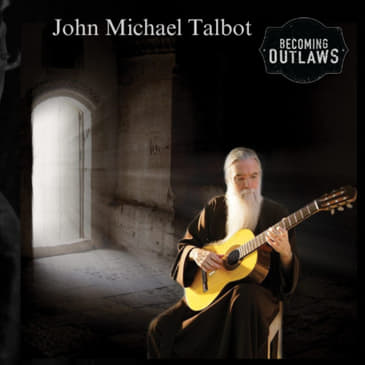
John Michael Talbot a pioneer in Contemporary Catholic Christian Music, reflects on his journey from the early days with Mason Proffit to embracing the monastic life. He discusses the origins of contemporary Christian music within the charismatic movement and shares his near-death experience, offering a glimpse into Heaven.
Talbot, known as the "Godfather of Contemporary Christian Music," recently released his 59th album and 38th book, titled 'Late Have I Loved You.' He currently resides in the Little Portion Hermitage in Arkansas, where he founded and leads the Catholic community, The Brothers and Sisters of Charity.
[00:00:00] and the movie outlaws, he said, young, tell me. With a full walks of life sense, a man with a coming outlaws. John Michael Talbot, he's a multi-platinum selling Grammy, dove award-winning contemporary Catholic Christian music pioneer. He has just released his 59th album, 5-9.
[00:00:25] Late have I loved you, along with his 38th book with the same title. John Michael lives and he leads the monastic life in the little portion Hermitage in Arkansas, where he's the founder and general minister of the Catholic-based community, the brothers and sisters of charity.
[00:00:43] And welcome my friend. Well, thank you, Ken. It's good to be with you today. I really appreciate you coming on. I'm excited. So, I know that late have I loved you, has different meeting than this, and kind of feel that way lately about Mason prophet. Huh.
[00:01:03] I came to it recently just by doing a little homework on you. I didn't know that part of your career, so what was Mason prophet for the youngsters? Well, Mason prophet was part of the first kind of the first cutting-edge groups of country rock bands.
[00:01:27] And really was the birds, polco, the flying burrito brothers. Us, and then there were some others that came after. And it was a whole new genre that was really the birds with a one to pioneered it. And it was bringing together country music and rock music.
[00:01:50] Yeah, there's my older brother Terry. That's cool. And it was a lot of fun. That's me playing the band Jo and my brother is playing the strat. That's Timmy playing the bass. That's the creeper with the finder and he also played harp.
[00:02:12] All right. I want to play this a little sampler for those people who haven't heard Mason prophet. And now we're blue hanging in the victory that's all we need. And all through hanging in the victory that's all we need.
[00:02:41] John Michael, so that molded that kind of music for those who found faith. It sprouted the Jesus music which then turned into what we call contemporary Christian music. So you were on the forefront of that. Did you find faith during that time with Mason prophet?
[00:03:01] I did. In 1971 I was basically, I had seen the futility of it all and there was a lot of futility because everybody else around was not happy. You know, they had everything I thought I wanted but they weren't happy.
[00:03:23] So I started reading about everything I could read about religion and philosophy. I was reading a revised standard Bible. My grandmother had given me those red letters were jumping out.
[00:03:37] But I didn't have a personal encounter with a living God. So I said, God, who are you? He is she or an Ed? I don't have a dog in the hunt. I just want to know.
[00:03:49] And after about a year of praying like that while we were on the road, I had an encounter with Jesus in a hotel room out in the Midwest somewhere with Christ. And I didn't understand theology but I knew I was a Christian. I knew I was loved.
[00:04:12] I knew my sins were forgiven and my rock and roll sins were stacking up. And so that changed and that was about 1971.
[00:04:24] That was during the band and then the band fell apart. I grew organic vegetables out of an organic farm for a while and painted houses and then Terry put the band back together as a Christian band. He had gone through a conversion.
[00:04:41] And we got involved in the early days of the Jesus movement, which was interesting. We didn't call it the Jesus Revolution. That's something that has just been recent since the film. We're met Lonnie Frisbee, but we knew Chuck Smith and Chuck Gerard.
[00:05:01] We knew all those guys mainly we knew Larry Norman and Randy Stonehill and those those folks. And you know bounced around with everyone on the West Coast and played tent revivals and played churches and all that stuff.
[00:05:20] And ended up trying to sign a record deal with Arista with Clive Davis. Clive said no, he wanted something a little bit more country rock and Terry wanted to do something a little bit more rock. And excuse me. And we ended up playing a road home productions.
[00:05:46] Festival in Colorado Springs in a guy named Billy Ray Hurn was there. He was the A and R director for Mer records, which was the contemporary label for word records. And he wanted to sign us.
[00:06:03] And we said, well, gee, sorry, but we're breaking up. So I said, well, gee, Billy Ray, would you want to sign me? I want to do a folk thing just me and my acoustic guitar.
[00:06:13] And he said, sure, send me a demo. So I sent him a demo and he says, well, bad news is I'm leaving my records. I'm going to start my own record label.
[00:06:24] And he ended up calling it Sparo. So I signed with him Terry signed with him Sparo was formed out in California. Five artists, 14 employees out of a warehouse and Kenoga Park. And this spares come a long way. Yeah, Sparo records was formed.
[00:06:44] And I ended up bouncing around going back and forth across the United States doing the whole Christian contemporary music circuit for two years with two records. And then I became a Catholic basically, I was real disheartened by the disunity I found in Christianity.
[00:07:06] And I started reading the early church fathers, meaning, climate of Rome, Ignatius of Antioch, the Dedicay, Eraniss of Lyon, Justin Martyr. And I was shocked to find the primitive expressions of what today we would call the Catholic faith there.
[00:07:31] But it was in a real organic form, a real organic form. And nothing real high-falutin like today, just real organic. Is that what drew you to St. Francis of a CC or know that? Francis, can I know that? I don't know what I'm saying.
[00:07:50] And Francis was this radical for Christ, but he was Catholic. And that blew me away. How could this guy more radical for Jesus than anybody had ever seen be that radical for Christ in the same time be a Roman Catholic? Wow, how does that work?
[00:08:11] And then all these monastic saints, and Anthony of the Desert and the Desert fathers. And yet they were Catholic. How could that work? How could they do that? So it blew me away.
[00:08:28] And about that time I heard a still small voice that said, John, I'm watching to become a Catholic. She's my first church, I love her most dearly.
[00:08:37] She's been sick and nearly died, but I want a healer and razor to new life, and I want you to be a part of her. So I saw it out of Francis, can priest, father Martin Walter, became my spiritual director.
[00:08:50] And in 1978 I became a Catholic, and I thought, well that's it, throw in the towel. You know, no self-respecting Jesus person is going to listen to me anymore. And I did one last record called the Lord Sucker, and I took it to Billy Ray at Sparrow.
[00:09:08] And I said, well here it is, and he says, well, no, but how am I going to sell a Catholic mass to a bunch of Southern Baptists? I said, I don't know. Yeah.
[00:09:17] And I said, well, put it out, and he says, okay, we'll put it out, but it's going to flop. And I said, I know. So they put it out, and it was the biggest selling record for Sparrow records that year.
[00:09:29] And then I went into a hermitage to disappear in the woods. And I put together another record called, come to the quiet. So it was really quiet. I mean, it was just me and the soldier, just me and my guitar.
[00:09:46] And I think they threw a string quartet on it, you know. I brought it to him. This is too quiet. People are going to get nervous. There's no, there's much space. I mean, they said, there's too much space in it. And I said, well, put it out.
[00:10:09] They said, well, we just had a big hit with you. We can lose some money. So we'll put it out. So they put that sold three times more. So that became the pattern. And so the more I went into solitude and silence, the more music I produced.
[00:10:27] And the more records I sold. So the industry model was you, you worked to produce music. And you go out and you do 150 concerts a year. And you sell records. So that's what that was the, that's what was drilled into the artists, right? Yeah.
[00:10:56] And I went into solitude and I went into silence. And I did that for a couple of decades, you know. And it, and I did two records a year for two decades. And it just continued to just flow, you know.
[00:11:21] You know, and a really interesting, John Michael is, you came up or are a part of, but you, that early CCM time was really, um, charismatic. Yeah. Just in the CCM days, how prevalent was that? I've had conversations with Michael Carter at times.
[00:11:38] And he would tell great spirit moving stories he had when you'd hang out with Keith Green. And it just seemed to be something going on in those days. Oh, here's your experience. It was palpable. I mean, all we had to do, look, the wave, the wave was flowing.
[00:11:58] All you had to do was get up on your surfboard and ride. You didn't have to force it. You didn't have to push it. You just had to ride it. You know, and if you missed a wave, the next one was coming. You know, it was so easy.
[00:12:20] It was a sovereign work of God. Within the Catholic Charismatic Renewal, which was huge. I mean, it was absolutely huge. It manifested differently than how it manifested in the Protestant world. Because we, we only got together like once a year in big conferences.
[00:12:44] You know, where there would be 70 to 80,000 people in in Arena. The rest of the time they were in small prayer groups and parishes all across America. So we didn't have big mega churches. We didn't have big charismatic mega churches or pentacostal mega churches.
[00:13:07] So it manifested in different ways. But it was the same outpouring of the Holy Spirit. It was phenomenal. I mean, I can remember and this goes back before I was Catholic. I played one coffee house in Pennsylvania. And I was a soloist. This was after my first record.
[00:13:35] And nobody showed up. There was more people on the stage than in the audience. Which was you. Me. And promoter, I said, well, what do I do? He says, well, let's open the windows and I want you to turn the PA system up loud. So I did.
[00:13:54] And by the end of the evening, the place was jam packed. And the Holy Spirit just filled the place. Because that's how things worked back then. It just is how things worked. Well, how prevalent is in the Catholic church?
[00:14:12] And how is it viewed by the broader Catholic church? I'm more at the charismatic. Well, I think right now the charismatic renewal in. The charismatic renewal in the United States is not real strong. Where it's strong is in Africa.
[00:14:39] And so and that's that's not entirely unlike what's happening in the Protestant world as I understand it. Now there are signs of a rebirth beginning to happen. But I personally think that we tried to dress the Holy Spirit up in a suit and a tie.
[00:15:04] And make the spirit respectable. And I think the spirit wanted to be in blue jeans with holes in the knees. Yeah. And I mean, how the the outpouring of the Holy Spirit started in Ducahn University in 1967.
[00:15:29] The whole history of the outpouring of the spirit in the Catholic church. It was very grassroots. It was a college campus phenomenon. I mean, the people that had happened to didn't know what was happening to them.
[00:15:47] They had to actually go seek counseling from guys like David Duplacé, you know, Mr. Pinacost and say, What happened to us? Are we losing our minds? Yeah. Yeah. And they know you're not losing your minds that you're okay. Yeah.
[00:16:05] And they literally wondered if they were experiencing just mass hysteria together. So I think we sometimes tried to dress it up too much. Now, I am heartened by what Pope Francis said recently and he says, He has commissioned the Catholic charismatic renewal.
[00:16:30] He says, I want the charismatic renewal to be for every Catholic, not just for charismatic Catholics. I want the outpouring of the Holy Spirit and the baptism of the Holy Spirit in particular to be for every Catholic in the church. And this is another key thing.
[00:16:51] This is very cool. I think the greatest sign of the baptism of the Holy Spirit is to smile. That's not what I was expecting, but yeah. Wasn't what I was expecting either. But I thought you this.
[00:17:09] I know some of the people in my own community who claim to be charismatic, who need to hear that. Just hey, guess what? Try smiling. Yeah. We we seeing him and reach scriptures about joy. And we look like we've not even know what that word means. Yeah.
[00:17:32] I sometimes tell our my Catholic audience as I say, you know, folks. If if somebody who wasn't Catholic were walking here, they'd look around and they say, I don't know what you guys have, but I don't want to catch it.
[00:17:47] I don't know if you consider it a near-death experience or a death experience or a vision. What happened? I don't know what it was. Can I, seven years ago, I was in the hospital and I know my guardian angel grabbed me under one arm, my left arm.
[00:18:08] I think the angel of death grabbed me under my right arm. I was so sick that I wanted to praise God and I couldn't think objective thoughts. It hurt to think objective thoughts. So all I could do was mumble in tongues, and I'm not talking pinacostal tongues.
[00:18:31] I'm talking like, just literally just mumble. But for me, I was praising God and they grabbed me and they lifted me up and they took me and they let me see paradise.
[00:18:53] And in that experience, I saw all my sins like I'd never seen him before and all of God's forgiveness and mercy. Like I had never seen it before. Like that, like an instant and all I could do in that instant was we.
[00:19:38] And when I had sufficiently experienced that these angels turn me around and brought me back to my hospital bed.
[00:19:59] And when I was discharged and got to go back to the monastery from then on, any time I prayed for a long time all I could do was we especially at Mass.
[00:20:28] We believe that the reality of Jesus, because the memorial, the classical understanding of a memorial is the thing being memorialized or the person being memorialized is present in the memorialization. That's a classical understanding. We lost that in humanism where it's OG. It's just a memory.
[00:21:01] But the classical understanding of a memorial is memorializing a person that present in the memorial.
[00:21:09] So Jesus is present in the memorial, so his life is death on the cross for me, his resurrection, his ascension, giving of the spirit from the Father is now and all I could do was we. How long ago was that? Seven years ago. Seven years ago.
[00:21:52] That's day with you like it just happened. It's it's wearing off, I must but still at Mass, it's intense. It's changed the way I experience the divine letter to you. Is it the overwhelming feeling of a deep understanding of grace?
[00:22:27] Just his presence. His presence is love for me. It takes what he did for me from the past and makes it something that is right now. I no longer say, gee, I wish I'd live back then.
[00:22:55] I am, I am back then. I am at the foot of the cross. I am at the empty tomb. I am on the Mount of Olives as he ascends. I am in the upper room when the spirit descends. Mass, I am there.
[00:23:20] And I think that's why Jesus instituted the Eucharist. So that every Christian at every Mass can be there. We don't have to wonder, we are there. That's why it's called a mystery. They mystery. It is a sacrament. It is sacred. So it's pretty profound.
[00:23:56] I think that's what St. Francis saw in the sacraments that enabled him to be such a radical for Christ, and yet at the same time such an obedient Catholic. I think that's what linked the two things in his being an outlaw as it were.
[00:24:29] We don't have an outlaw. You know what I like about all of all of those guys is St. Augustine or St. Francis. You might see symbolic emblems of them or paintings. They look very holy and righteous, and they are in stained glass, maybe with a halo.
[00:24:51] But these were guys that were in rock bands. They live in a rock and roll lifestyle. Like all of us at some point. They became an encountered Christ. And we became what we would call a saint.
[00:25:09] A real transformation. They didn't just grow up as a liturgical kid in the church and just learn these ways and pass it on. These people just like us if you take it back far enough. Yeah.
[00:25:21] That found a divine devotion for a reason or came to some kind of epiphany of grace. Oh, St. Augustine was, he was notorious sinner. Yeah. And then he became a heretic before he became a real orthodox. Yeah, he did it all. He did it all.
[00:25:41] See in the Catholic church instead of having different denominations we have different religious movements and different religious orders. That's the first thing my spiritual father told me. He says, oh, we have all the same stuff in the Catholic church. We just don't break from each other.
[00:26:00] We just call him religious orders. Right. Then it cool. So in closing, let's talk a little bit about, um, late have I loved you? Yeah. So I must, I'm assuming that comes from St. Augustine's confessions. Yes. And what do you read of that? I sketched that out.
[00:26:27] Probably goodness gracious. Nine or ten years ago and tried several musical settings, and it just never came together. It's a long, I have a long legal, you know, let's see. Can I get it in here? That's, it's a unlegal shed, legal pad sheet.
[00:26:49] And for some reason, it came together for this recording, and it put new music to it. And it seemed to work for this whole idea, you know? Here I am. I'll be 70 in May. And late have I loved you, O Lord.
[00:27:14] After I had this experience, I told many people, I've, you know, after I've done all this stuff in my life, I feel almost like a coin is, I'm not an a coin is, God knows. But I feel almost like saying, you know, burn it.
[00:27:34] It's just strong, you know? Everything I've done, it's not unimportant, but it's next to the experience of the Lord. It's next to nothing, you know? So late have I loved you, O Lord. I knew that in theory, but as an overwhelming experience,
[00:27:58] I've only, in recent years, really come to that appreciation, appreciation in the right word, come to this knowing. And all that lasts in the end, according to St. John of the Cross, I love that's all that matters, all that matters. Because God is love, the Cross is love,
[00:28:29] the incarnation is love, everything is God's love. So that's all that matters. And so late have I loved you, worked. And the next song, God's window, of course, the second Corinthians 8, we see us through a glass dimly.
[00:28:53] And then of course I added the last verse that we see the heavenly Jerusalem and I love this, with streets of gold as if transparent glass. And what does that mean? You know, so there's physicality to where we're going,
[00:29:14] but I is not seeing, eras, not heard, nor is it even dawned on our minds what awaits us. You know, what where we are going is un, you know, it hasn't, we haven't even dunk it yet. Another way.
[00:29:33] And then the last text is the rule of St. Romual, the brief rule of St. Romual, the 10th and 11th century Benedictine Reformer. Sit in yourself, your Hermitsel as in paradise. Paradise is on earth even as you sit in your solitude. That's paradise on earth already.
[00:29:59] And then the last three are the, basically, the Apocalypse Triptic, which is an audio icon of heaven, as it's my feeble feeble attempt. But I tried not to do too many to have the orchestrator. I didn't want him to put too much orchestra on it.
[00:30:22] I wanted to keep it mainly vocal. It was a temptation not to put a lot of orchestra on it to make it real big. And I could even argue that the last one even suffers from that. But in, I wanted to be mainly vocals because I believe
[00:30:41] that we'll mainly hear the heavenly voices in heaven. So that's an audio, an audio icon of sorts. So that's, that's the new recording. People are pleased with it. They say it's reminiscent of some of my earlier London recordings. And I think, I think they're right.
[00:31:06] We had a really, really great orchestral engineer work on it and feel perkins of course orchestrated it. It just sounds good. It's sound like I think are really, really good recording. Yeah, I've been listening to it. It's beautiful. Thank you, Ken. Thank you. And the book is enjoyable.
[00:31:29] Very interesting journey on your life. And I wanted to tell you, I was just a year ago. I wish I would have known where you're at. I could have visited your hermitage. But second close to that is I've been eating your hermit bars. Oh yes, saying it's hermit.
[00:31:49] It's in there. There are molasses based bar. I just think they're wonderful. All the monks down at Subiaco Abbey and Arkansas love those hermit bars. Yeah, the back says 10 out of 10 hermit's agree. So you can't go wrong there. Hey, thank you for your time. I appreciate it.
[00:32:10] We're going to close out listening to late. Have I loved you? Thank you so much John Michael. I appreciate it. Thank you, Ken. Have to use in the darkness I was touched by your light. After leaving So he fell in empty with him. Late hour, I loved you.
[00:32:56] Lord to reflect on my soul with him. In the light on your truth. Overwhelmed with my sin Why could now see the grace of forgiveness within? They tell thy love They tell thy love For my coals, how is God? I was misfired your soul
[00:33:59] You are living in me To be ever in you Ever we have tasted your breath Now I am the full moon My dream will be your spirit Ever thirst now my soul You touched me so gently I am long now for you They tell thy
[00:35:37] For my coals, how is God? I was misfired your soul You are so laid in my life They tell thy love For my coals, how is God? You said come tell me You look more walks than I sense