
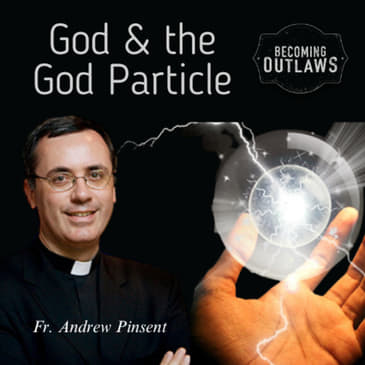
Join us in this thought-provoking podcast episode as we delve deep into the fascinating world of particle physics and theology. Our guest, Dr. Andrew Pinsent, a renowned physicist and theologian, takes us on a journey to understand the enigmatic "God Particle" and its profound significance. We'll explore what the God Particle really is, why it matters to our understanding of the universe, and the intriguing theological implications it holds.
The God Particle, scientifically known as the Higgs boson, was discovered at CERN, the European Organization for Nuclear Research, in 2012. Dr. Pinsent will unravel the mysteries surrounding this elusive particle, explaining how it plays a pivotal role in our understanding of the fundamental building blocks of the cosmos.
But the conversation doesn't stop at the scientific level. We'll also delve into the theological aspects of this discovery. How does the existence of the God Particle relate to questions about the nature of the universe and the divine? Dr. Pinsent will share insights into the harmony between science and faith, exploring how the study of the universe can deepen our understanding of spirituality.
Furthermore, we'll address some of the concerns and misconceptions surrounding CERN and particle smashing. Is there any truth to the idea that particle collisions could create black holes or open other dimensions? And what about the notion of "losing demons"? Dr. Pinsent will provide a clear and scientific perspective on these claims, dispelling myths and separating fact from fiction.
becomingoutlaws.com
00:00:00
Gathered among the outlaws, he said.
00:00:02
Come follow me. People from all walks of life
00:00:06
since have been becoming outlaws.
00:00:12
You may have seen in your social media feeds lately some pretty
00:00:16
crazy claims about something going on by scientists in
00:00:20
Geneva, Switzerland, Elon Musk. He's even called it demon
00:00:25
technology, that we're summoning the demon, meaning we could be
00:00:29
experimenting with science and technology to a degree that we
00:00:32
could open up something that who knows if we can control it.
00:00:36
For instance, some claim with the experiments being run we
00:00:40
could accidentally open a black hole sucking the entire planet
00:00:43
and universe into it. Others claim they could be
00:00:47
opening portals into other dimensions and literally opening
00:00:50
a portal to hell, allowing demons to enter our realm.
00:00:54
I almost called this episode Highway to Hell because of that.
00:00:58
But come on people, demons are biblical concept.
00:01:00
If you believe in scripture, you believe in demons and they're
00:01:03
already roaming the world. So anywho, why?
00:01:07
Why do I have so many episodes on science?
00:01:10
Some have asked. I thought you focused on
00:01:13
profound questions of faith. Well, faith, science and
00:01:16
philosophy when discussed and pursued, they fully shouldn't
00:01:19
and really cannot be separated. Modern culture has attempted
00:01:23
this divide, making them three distinct areas, yet all ask the
00:01:27
same questions, don't they? You know, how did we get here?
00:01:30
Why are we here and where are we going?
00:01:34
Pursuing these answers in any of these areas will quickly overlap
00:01:38
into the other. They can't remain divided at
00:01:41
some point, and in the past they weren't.
00:01:43
It seems to be kind of a a modern way of analyzing the
00:01:46
world is just set these into different camps, but Holistic
00:01:49
View puts them together. Scripture itself explains that
00:01:54
we learn of God through His written word, sure and through
00:01:57
the physical world we live in, Roman says, for since the
00:02:01
creation of the world, his invisible attributes, his
00:02:04
eternal power, his divine nature have been clearly seen being
00:02:09
understood through what has been made the physical world.
00:02:14
We have Bible study after Bible study to learn about God, but
00:02:18
sometimes ignore science or even hostile to it.
00:02:22
So anyways, back to the scientists doing experiments in
00:02:25
Geneva. CERN, the European Organization
00:02:28
for Nuclear Research, for years have been colliding anatomic
00:02:31
particles at high speeds underground in Switzerland to
00:02:34
unlock the mysteries of the origin of the universe,
00:02:38
essentially trying to reproduce the moments of The Big Bang, the
00:02:43
explosion of particles that burst the universe into motion.
00:02:47
One of scientists greatest discoveries was announced on
00:02:49
July 4th, 2012 of the Higgs Boson particle soon after to be
00:02:55
known as the God Particle. What is the God particle?
00:02:59
How was it discovered? What else is CERN searching for,
00:03:02
and why? Are there any validity to these
00:03:05
crazy conspiracies in the fears of such explorations?
00:03:09
And does this research lead us to a deeper knowledge of God,
00:03:12
and if so, how to help us with these questions is Doctor Andrew
00:03:18
Pinsent. He is a research director of the
00:03:20
Ian Ramsey Center for Science and Religion of the Faculty of
00:03:23
Theology and Religion at the University of Oxford in England,
00:03:28
and Doctor and Father. Pison was actually a particle
00:03:33
physicist on the Delphi experiment at CERN.
00:03:36
He has degrees in philosophy and theology and a second doctorate
00:03:40
in philosophy. There it is.
00:03:41
It's a perfect combo. If you're going to get educated,
00:03:44
there's faith, science and philosophy.
00:03:48
Welcome, Sir. Hello hello all to all your
00:03:51
listeners. Good to be here.
00:03:54
I appreciate it. I don't know who.
00:03:56
I don't know who else I can have.
00:03:58
I'm speaking from a slightly rainy, cold Oxford in England,
00:04:02
so greetings, United States, Yeah.
00:04:05
I'm speaking from a chilly, snowy northern Michigan.
00:04:08
Well, Midwest Michigan. Yeah, what technology.
00:04:11
Speaking of technology we got used to is just we're talking
00:04:14
across the world recording at the same time.
00:04:16
It's nuts anyway. The Higgs boson or the God
00:04:24
particle? What is it and what and why does
00:04:27
it matter? OK, so let me just start with
00:04:31
that phrase. God particle.
00:04:34
And I have to shatter some illusions perhaps because this
00:04:37
was actually used to sell books. So there's a book by Leon
00:04:43
Letterman, very famous physicist, and the publisher
00:04:46
said don't write about a book, you have a boring physics title.
00:04:50
Give it, call it the God Particle.
00:04:52
And people that so made the book very famous and people have
00:04:59
caught on. So if you go to Amazon today and
00:05:01
look up God Particle, find lots of books, all the same kind of
00:05:05
title. But actually it's not directly
00:05:09
to do with God, although arguably arguably it may be a
00:05:14
Catholic God particle because it gives things mass, so it gives
00:05:19
things so. So that's the only joke I know
00:05:24
in particle physics. But it's it's the theology is is
00:05:29
not the direct issue of the particle.
00:05:31
The particle is like the missing piece of the puzzle.
00:05:34
And there's something called the standard model in particle
00:05:38
physics. It's been active.
00:05:41
It's been the the account of material reality that's been
00:05:47
more or less accepted by a particle physicists the last
00:05:50
half century. But there was a piece missing.
00:05:54
The theory predicted that was a particle that was missing and we
00:05:58
discovered it, we think in 2012, and it's called the Higgs boson
00:06:04
and known as a God particle, but not directly to do with God,
00:06:09
although of course I think indirectly of course is to do
00:06:11
with God. So the particle itself, how does
00:06:15
it affect me as a person? How does it affect the universe,
00:06:17
our everyday lives? What is it doing?
00:06:19
Why? Why did we need?
00:06:20
To discover this, I have to again, I'm sorry, breaking
00:06:24
illusion. It doesn't have any direct
00:06:25
effect on our daily lives, but something we invented along the
00:06:31
way of looking for the Higgs boson has changed all our lives.
00:06:36
I bet every single one of your listeners today has already used
00:06:40
this technology, and it's called the World Wide Web.
00:06:45
So anyone who uses the Internet, if you if you look at the web
00:06:49
address you see there are three letters www.theworldwideweb and
00:06:55
that started at CERN when I was working there the late 1980s,
00:07:00
early 1990s. And we used a kind of protocols
00:07:05
worked out in the United States by a group group called DARPA,
00:07:10
the Defence of Arts Research, something agency called what is
00:07:13
called. But we started connecting
00:07:15
together physics documents, linking them together with with
00:07:19
hypertext. Now, anyone who's a young child
00:07:24
at this, in this era will be so familiar with this, it's like
00:07:28
breathing. You pick information out the
00:07:31
air, you click on a document, you go to another document,
00:07:34
click a document, go to another document.
00:07:36
But it's all started, and it started at CERN in the late
00:07:39
1980s, early 1990s. And it caught the whole world by
00:07:43
surprise because we started by collecting physics documents,
00:07:46
and then people caught on outside CERN.
00:07:49
They started adding other documents, adding other
00:07:52
documents, and it grew and grew. And in almost no time, it seems
00:07:57
the whole world was linked to this thing called the World Wide
00:08:00
Web. I remember two years after I was
00:08:02
at CERN, I was in the South of Brazil in a in a state called
00:08:07
Santa Catarina. And there was I saw a restaurant
00:08:10
with a website address. I was amazed.
00:08:13
I thought this has got everywhere in almost no time, in
00:08:16
the blink of an eye. And so the whole world's
00:08:19
connected today. So if you ask me, how does the
00:08:22
exposure affect our lives directly, Not at all.
00:08:26
Indirectly in every possible way.
00:08:28
Yeah, So what is? How do they find the particles?
00:08:34
Why are we looking for particles?
00:08:36
OK, OK, so it's it's an ancient quest.
00:08:40
What is the world made of? So in theology we'd we'd studied
00:08:44
the the what we what is Revelation tells us about the
00:08:49
Creator and the Redeemer of the world.
00:08:53
But in the in the world of particle physics, the question
00:08:58
is what is the world made of? What is the most basic stuff the
00:09:02
world's made of? And it's not.
00:09:06
It's not a difficult, it's not an easy quest because you break
00:09:09
these into smaller and smaller pieces.
00:09:11
It's harder and harder to see what's there.
00:09:14
It's harder and hard to make sense what we see.
00:09:18
But the only way we know of doing this is to is to basically
00:09:23
to hit things very hard. We hit things very hard and we
00:09:27
see what happens. That's basically it.
00:09:31
So one way of thinking about this.
00:09:33
Imagine you've got a piano and you throw it down a flight of
00:09:37
stairs. So you've got a piano and you
00:09:40
throw it down a flight of stairs and listen to the sound it makes
00:09:43
when it hits the bottom of the stairs.
00:09:48
Smash, smash, smash. Now take another piano and do
00:09:53
the same thing. Same piano, but it's another
00:09:56
version of the same piano and you throw it down the flight of
00:09:59
stairs, maybe hear a different sound, take another piano, do
00:10:05
the same thing, throw it down the side of stairs and and each
00:10:11
time you can hear the cacophony of sounds and the it's different
00:10:17
because the way the piano hit the ground was different each
00:10:19
time. Maybe different kind of strings
00:10:21
were pulled or smashed or whatever, and but but if you
00:10:28
could do this many thousands or even millions of times with
00:10:32
pianos, you might be able to reconstruct what the piano was
00:10:37
like before you smashed it. Make a model of what the piano
00:10:42
was like before you smashed it. And this is so.
00:10:46
This is how we do particle physics.
00:10:48
We we can't directly see the interior of the atom, but what
00:10:53
we do is we smash matter as hard as we can and we get a cacophony
00:10:58
as it's like like that that that noise of particles coming away.
00:11:05
And by careful study of what is generated over millions and
00:11:11
millions of collisions we can we can build up a picture of what
00:11:15
the interior of the atom is like before we smash it.
00:11:20
That's basically how particles works.
00:11:22
It's about hitting things as hard as possible and seeing what
00:11:25
happens. How is to the layperson's mind
00:11:32
you think, I want, I want to understand the universe.
00:11:34
And we think of the universe as you know we see stars and Suns
00:11:38
and planets. But then you're talking about,
00:11:41
we want to understand that by examining quantum physics like
00:11:46
you're going to go as small as you possibly can to explain the
00:11:52
biggest things that are why? Why is that?
00:11:56
Or how is that? How do we learn what the big
00:11:59
things are by this going minute? Well, all kinds of ways, because
00:12:04
a lot of things we see in in everyday life start with the
00:12:08
very small. So even the even the electronic
00:12:14
communication signals under the Atlantic Ocean are transmitting
00:12:18
your image to me and my image to you.
00:12:20
They're transmitted through waves of light and
00:12:26
electromagnetism through through through fiber optic cables under
00:12:31
the ocean. So very tiny things affect our
00:12:35
lives. So the very small and the very
00:12:37
big are often linked together. In addition, the modern theory
00:12:44
of cosmology is that the universe starts in a very hot,
00:12:47
dense state. It's called The Big Bang, as you
00:12:50
mentioned it, in fact in your introduction.
00:12:52
And here's a question for your listeners and perhaps for
00:12:54
yourself, Ken, who invented The Big Bang theory?
00:12:58
Do you know who invented The Big Bang theory?
00:13:00
I can't do a name, but I think you might be semi impressed that
00:13:03
I do believe it was a Catholic priest.
00:13:05
That's right, yes. His father Lametra, almost no
00:13:08
one knows that it was a Catholic priest.
00:13:11
Well done. It's a Catholic priest in
00:13:13
Belgium. So not not a, not a particularly
00:13:17
it's a prominent country in terms of big personalities.
00:13:20
But this priest was also a physicist and mathematician in
00:13:27
in Belgium and he used Ironside's equations and he made
00:13:31
a remarkable prediction. He said the universe is
00:13:34
expanding and he gave a way of testing it.
00:13:37
He said that light will be stretched over long distances
00:13:41
and galaxies would would be receding from us.
00:13:45
Even today we're in the aftermath of an explosion.
00:13:49
And even today the galaxies are moving away from us.
00:13:52
And he gave a way of testing this and a famous American
00:13:55
astronomer called Wilson he did the measurements in the sorry
00:14:04
about 19291930 then what's called the Mount Wilson
00:14:08
observatory in California And and he found it was true.
00:14:13
The universe is expanding. So Big Bang Theory.
00:14:16
Now if the if The Big Bang theory is even partly accurate
00:14:21
then the whole cosmos starts smaller than a grapefruit,
00:14:27
smaller than a Pebble, smaller than a grain of sand.
00:14:31
And so the very small and the very big are linked together.
00:14:35
Today, astronomers look at the structures of not just galaxies,
00:14:40
but great filaments of collections of galaxies.
00:14:44
It's a kind of cosmic web of galaxies.
00:14:46
But we think that start this this web starts with tiny, tiny
00:14:51
little fluctuations in the initial Big Bang.
00:14:55
So the bigger the smaller LinkedIn our everyday lives
00:14:59
today, but also in the entirety of the cosmos.
00:15:02
I think you see the patterns and creation everywhere.
00:15:05
Listening to you talk, taking it to something I can understand
00:15:09
would be I'm a full grown adult. But if you take me back, I was
00:15:13
smaller and I was smaller. I was an infant, I was a fetus,
00:15:17
fetus. I was down to some.
00:15:19
Cells. So you work your way backwards,
00:15:22
and you deconstruct the origins of the bigger thing that
00:15:25
develops. Yes, we're we all start as one
00:15:28
cell. Right.
00:15:29
Every human being starts as one cell.
00:15:31
Isn't amazing. That is so here's I had this
00:15:37
question for you but it's hard for me to I don't know enough
00:15:40
about the science to put it in the in the correct words.
00:15:43
So when you're talking about, you're talking about the
00:15:45
Internet. I think about the hoves, the
00:15:47
excuse me, the what do you call the God particle?
00:15:50
What's the real name? So.
00:15:51
The the Higgs boson. The Higgs boson.
00:15:52
Thank you. So I don't want to get too
00:15:54
technical in this program but the Higgs or or the is it the
00:15:59
Higgs field caught my attention and a little bit of study where
00:16:04
well fields in general. I wanted to talk to you a little
00:16:06
bit about meaning. Right.
00:16:11
Meaning this is kind of what I meant by how does it affect our
00:16:15
lives? And that are these things
00:16:16
flowing through us at all time? There are particles that make up
00:16:19
the universe, they just make up matter in that the particle they
00:16:22
found is a part of a field that they thought there was a
00:16:26
particle in it. But what are these fields?
00:16:29
Right, that's a nice question, and I think I think physicists
00:16:34
are a bit guilty of making things complicated.
00:16:36
So here's so. But there's a kind of general
00:16:40
rule, which is that anything that's a field pretty much can
00:16:44
also be represented as a particle.
00:16:47
So it goes back to the early you mentioned quantum mechanics
00:16:50
earlier today, earlier in this session, and it starts with the
00:16:56
study of light. And light behaves like a wave,
00:17:01
like a field, but it can also sometimes behave like a
00:17:04
particle. We all, we call it the photon,
00:17:08
it's a, it's a particle of light but but but this so so light is
00:17:14
very strange. It's both has wave like
00:17:17
behaviour that then we call it a field and it has particle like
00:17:23
behaviour then we call it a particle.
00:17:25
And that's the same with the Higgs boson.
00:17:27
The Higgs boson is a particle in, in a certain sense, but it's
00:17:32
also a field which permeates the whole of space.
00:17:35
Yes, we can't detect it normally.
00:17:37
It's a very hard thing to detect, but it's one.
00:17:39
It's something that's detection under the extreme conditions we
00:17:42
were able to create at CERN over the last decade.
00:17:45
Let me give you another example of a field.
00:17:49
So it's gravity. Gravity is, of course, we're
00:17:52
very familiar with gravity. And just in the last few years,
00:17:55
there's been an amazing experiment in the United States.
00:17:59
So both at two ends of the United States, separated a very
00:18:03
long distance apart, there's something called a gravitational
00:18:07
wave detector at both ends of this long baseline United
00:18:11
States. And for the first time in the
00:18:14
whole of human history, we've detected gravitational waves.
00:18:19
So gravity is more like a very constant.
00:18:23
It's like a very constant force pulling us to the Earth and
00:18:27
putting things together in the cosmos.
00:18:29
But it's also can be a wave carrying information and we've
00:18:35
wanted for decades to discover gravitational waves and in the
00:18:39
last few they permeate the whole of space but they're incredibly
00:18:44
hard to detect And just in the last few years in the United
00:18:47
States we've had the first successful gravitational wave
00:18:50
detection so and it and it's great because it transmits
00:18:53
information to us from really exotic events.
00:18:57
So maybe 2 black holes collide, or a black hole and you saw
00:19:01
collide in a distant Galaxy thousands of thousands of
00:19:07
millions of light years away and we can detect on Earth with this
00:19:11
massive shock goes to the cosmos and we can now detect those
00:19:15
shocks through tiny changes in gravitational waves.
00:19:19
So it's an exciting time. I don't.
00:19:23
OK, so this thought this won't even be a question.
00:19:26
I'll start a topic see if you can finish the thought for me
00:19:29
and you're you need to do it because of a physicist and and a
00:19:35
faith expert is. So when I think of things like
00:19:40
you're talking about gravitational waves or even just
00:19:44
microwaves or the waves that carry broadcast signals that are
00:19:47
flowing at all the times, I don't understand how information
00:19:51
is on a wave and it's permeating everything but but yet
00:19:55
scientists are at least comfortable with it.
00:19:58
Understand it better than I do, but uncomfortable.
00:20:01
With the thought that there's a God that could be everywhere at
00:20:04
all time, Richard Dawkins says it's wishful thinking.
00:20:07
It doesn't make sense. But yet the science version
00:20:10
makes sense to them when to me it's not that different.
00:20:14
If you had a if we can believe that there's A and we know it's
00:20:18
true, a wave that is carrying television, audio and visual
00:20:23
signals at all times, it's just doesn't have personality or
00:20:29
emotion or thought. It's just information.
00:20:35
It's not that far of a stretch to think there could be.
00:20:40
I don't want to call Gotti Wave, but something that is has
00:20:44
intelligence, that behaves the same way, that carries
00:20:48
information on behalf of somebody else, Let's say if
00:20:54
you're talking like a Trinity and can permeate everything at
00:20:58
all times and communicate with those who are willing to get
00:21:02
into that signal. But it's has intelligence.
00:21:05
That's lovely. Well, I I'd also say that the
00:21:09
Bible has certain privileged Michael privileged images of God
00:21:15
or privileged metaphors of God. So, for example, God is a
00:21:18
consuming fire. That's right.
00:21:20
Or God is a rock. But another one, which is in the
00:21:24
1st letter of John if I recall correctly, is God is light.
00:21:28
God is light. So light is is repays some
00:21:32
careful reflection because it's a it's a privileged metaphor for
00:21:36
God. And the ancient Greeks do this
00:21:38
actually before, even before Christianity as well in a in a
00:21:41
certain more restricted sense. So yes, it carries almost all
00:21:47
information comes to us through light.
00:21:49
It's an amazing thing. Yeah, so if you the skeptic's
00:21:54
view of God would be like, well, it's like Santa Claus.
00:21:57
Can he really be at all places almost simultaneous in one
00:22:01
evening and do it's impossible. Yes, it's very hard to think
00:22:05
about that. But when you, when you think of
00:22:08
when you think and then you must have like, you know, reindeer
00:22:13
that have the same abilities, they're almost all places at one
00:22:16
time. But when you think about, well,
00:22:17
broadcast signal or whatever, this is Wi-Fi.
00:22:20
I'm talking to you, You're in England right now.
00:22:22
We're talking live by informational signals.
00:22:26
What if that signal just had intelligence where there's God?
00:22:29
That's the Holy Spirit right there.
00:22:33
I'd be careful my description. I will call it a a a privileged
00:22:37
image of God. And you have to, you have to use
00:22:40
multiple images to to get closer to truth.
00:22:45
But certainly it is a it is a privileged image of God to refer
00:22:48
to light. And light has, remember I talked
00:22:51
about light being a particle on the wave?
00:22:54
So it has particularity and concreteness like a particle,
00:22:58
but it also permeates everything like a wave.
00:23:01
So we don't even have to think of theology we can think of.
00:23:06
We can think of the things we've discovered in science for the
00:23:08
last century or so to give us some similar kinds of ways of
00:23:12
thinking about things. So the natural world trains us,
00:23:15
if you like, to think about these kinds of realities.
00:23:20
I jotted down. They were on my head.
00:23:22
I jotted them down. Scriptures that I thought when I
00:23:25
was kind of prepping for this or listening to the lectures and
00:23:28
and whatever, some of them sounded like scriptures were
00:23:32
talking like you're talking about waves that permeate
00:23:34
everything. Some of those science things
00:23:36
sound like scripture that say in him we live, move and have our
00:23:40
being. Yes, yes.
00:23:42
And and here's another one we refer to.
00:23:44
I talked about The Big Bang earlier.
00:23:46
Now, if you even said to people 100 years ago the whole universe
00:23:49
exposed that of a point in a blurst of light.
00:23:53
People, people more scientifically trained people
00:23:56
would have said you're crazy, but but the older theologians
00:23:59
would have said, I know that. I've heard that before,
00:24:01
actually. And in fact, The Big Bang Theory
00:24:05
is much more popular among Christian thinkers than among
00:24:09
atheists for about 30 years. And there's very funny, there's
00:24:13
a few funny things people don't really know about this.
00:24:15
So I mentioned the theory was invented by a priest and the
00:24:20
Pope of the time, Pope Pius and the 9th, I think, sorry, 11th
00:24:25
apologist, 11th No Pius, 12th, my apologist.
00:24:29
He said he was very keen on The Big Bang Theory, but that's
00:24:32
almost too keen so so Father La Major said just just be a bit
00:24:37
more cautious, but he was enthusiastic.
00:24:41
But the theory was condemned in the Soviet Union and in fact
00:24:45
there's a various meeting of astronomers in 1948 in Leningrad
00:24:49
is is called Saint Petersburg, today it's called Leningrad
00:24:53
after Lenin. And they said we must oppose The
00:24:57
Big Bang theory because it is encouraging the priests.
00:25:03
We were supposed The Big Bang theory is encouraging the
00:25:05
priests. And the materialists of the
00:25:07
Soviet Union did not like cosmology.
00:25:09
They they at least they didn't like it until the 60s.
00:25:14
Because if if matter is your God, then you can't conceive of
00:25:19
a creation of matter. You can't conceive of the
00:25:22
creation of the cosmos or or that the whole cosmos was so
00:25:26
different Once Upon a time. So it's not true.
00:25:32
The Big Bang isn't isn't really directly about creation, but it
00:25:36
is about the evolution of the cosmos.
00:25:39
And that's and that is incredible.
00:25:41
And it's it was a massive cultural shock and it was the
00:25:45
Christians who are much more enthusiastic about it than the
00:25:48
atheists. Now the atheists have got used
00:25:50
to it and now they claim it's all it's it's an atheist theory
00:25:52
and it's all about, well, it's our theory.
00:25:55
They're very good at taking over our stuff.
00:25:59
Even if they think God is dead, they say, can we have his
00:26:01
things? That's the next, always the next
00:26:03
line. Can we have his things right?
00:26:05
Yeah. So.
00:26:07
Sorry, no, I'm sorry. The first time I heard The Big
00:26:08
Bang Theory, I thought, oh, there you go.
00:26:10
It lines up with scripture, God spoke, and things started
00:26:13
blowing into existence. You are right, Ken.
00:26:15
And that's a natural way of thinking and you think that's
00:26:18
awesome. Well, I've heard that before,
00:26:20
but and the initial reaction across the world was very
00:26:24
similar. So it was the IT was the Thaus,
00:26:27
or many Thaus, who were keen on it, and it was the atheists who
00:26:32
were terrified who were actually terrified.
00:26:34
In Britain we had a whole group of atheists who created a theory
00:26:38
called Steady State Cosmology. But it's it's real purpose was
00:26:42
to undermine The Big Bang, to try to find a different way of
00:26:44
thinking about it. And they were intelligent
00:26:46
people. They came up with some good
00:26:48
ideas. But that theory died.
00:26:51
It's not. It's not the way we think about
00:26:52
cosmology today. So explain how you view this
00:26:58
scripture in light of your understanding.
00:27:03
It's it's kind of Part B of a scripture, but he upholds the
00:27:06
universe by the word of his power.
00:27:13
This is an area I I confess I'm not so theologically trained in.
00:27:18
So you've got me on a slightly awkward point where I probably
00:27:23
can't advise you as carefully as some people would, but certainly
00:27:31
the two things from two things to bear in mind.
00:27:33
First, God does make the whole of creation possible.
00:27:37
No, he doesn't just create things, he also sustains the
00:27:41
world. That's the first thing.
00:27:43
But I would also say on top of that that God is a phrase from
00:27:48
is a famous theologian called Thomas Aquinas.
00:27:51
And he said God has given his creatures the dignity of being
00:27:58
causes. God has given his creatures the
00:28:01
dignity of being causes. Now what that means is the
00:28:05
cosmos is not like a machine, it's more like a garden.
00:28:10
So think about a gardener. Gardener looks after the garden
00:28:13
and plants plants. But that gardens does not gives
00:28:17
the makes it possible to have the plant growth, but the plants
00:28:21
do grow themselves, you know, so there is in the work of a
00:28:25
gardener, there is the the prime cause, the gardener and there
00:28:29
are all these secondary causes in the the principles of growth
00:28:34
of the plants. And I I don't think in the
00:28:38
accident that the Genesis uses the image of the garden for
00:28:41
creation and that is a healthy way of thinking.
00:28:45
I think it's in line with a lot of what we're now discovering
00:28:48
about the world, which we didn't know even 100 years ago.
00:28:52
So God, God sustains creation, but God has also given his
00:28:56
creatures the dignity of being causes in creation.
00:29:01
So we we have the potential to be fruitful and we can also mess
00:29:07
things up, as you know, the storogenesis that they mess
00:29:09
things up, certainly that's not the matter.
00:29:12
So yeah, it's a seed principle, like a garden.
00:29:14
Everything's a seed. It grows over time with the
00:29:18
right nurturing the right elements.
00:29:20
Let me ask you this. It's hype.
00:29:22
It's it's guessing, I guess educated guess.
00:29:25
But when scientists are dividing molecules and dividing and
00:29:30
dividing and going small as they can to find the origin or even
00:29:34
find the, if I'm correct in understanding, what we haven't
00:29:40
really found is what holds it all together.
00:29:42
And I don't know if that's where dark matter comes in or is there
00:29:45
like an energy or the life of things like that gives life to
00:29:51
the seed that then life grows? Do you think there's a
00:29:54
scientific answer for everything?
00:29:56
Do you think at some point there's just an energy or
00:29:58
something holding, like with a verse I read where God may have
00:30:02
spoke things to get it going and it's all a seed and growing?
00:30:07
Or there's an element of divine power at the core of it all that
00:30:14
holds all things together in that he can also revoke it at
00:30:17
times when he creates a new world kind of thing.
00:30:20
Like once he with holds back his essence, that matter ultimately
00:30:25
is on a foundation of some kind of divine energy.
00:30:30
Right. I would say that certainly is
00:30:37
true in in, in terms of revelation, God sustains
00:30:41
everything. That's certainly true.
00:30:43
I'd also say it's true scientifically.
00:30:48
There are certain things that bind other things together.
00:30:50
I mentioned gravity earlier, but you've got lots of waves
00:30:53
permeating all of creation. We talked about a few of them
00:30:56
already. Gravity is one example.
00:30:59
Light is another example. The Higgs boson is another
00:31:03
example. The Higgs field.
00:31:05
So you've got lots of things of binding things together in
00:31:08
creation, and that's that's incredibly important.
00:31:12
It's not just chaos, it has a kind of unity, but it's unity
00:31:17
that enables freedom. And that's there is spontaneity
00:31:23
in the garden. There is we as participators in
00:31:31
in God's action in the world. We can also do things.
00:31:34
We can contribute that growth or we can rip it up.
00:31:37
You know there are things we can do to be involved in that
00:31:40
process. So, so yes, I agree with agree
00:31:43
with all this and I think this is a is a kind of consonance
00:31:46
between what theology teaches, the science teaches without
00:31:50
making them exactly the same thing.
00:31:52
They're not exactly the same thing but it's a bit like light.
00:31:56
Light is an image of God that's actually used in the Bible.
00:32:01
It doesn't mean it's it's not to say it is God, but it is a
00:32:05
privileged image of the gods. It's privileged because it is in
00:32:10
scripture and and so you got to pay pay careful attention to
00:32:15
these images. Before we wrap up here, I did
00:32:20
allude to in my little monologue, you know the
00:32:23
conspiracy theories of going back to the CERN and the
00:32:27
experiments. So just in a high summary, what
00:32:29
I didn't mention was the specifics like what they're
00:32:34
doing underground. Could you just give a quick
00:32:35
overview of the Hydro Hydrogen Collider?
00:32:39
You did talk about smashing particles, but if these are
00:32:43
these concerns, real concerns or concerns based on non education
00:32:48
of what's going on? OK.
00:32:50
So so there are two questions here.
00:32:51
What goes on the Hadron Collider and is there is there any
00:32:55
danger. So let me the first thing about
00:32:57
what goes on the Hadron Collider.
00:32:59
It's basically a big microscope, that's all.
00:33:02
And as mentioned at the beginning of our discussion, we
00:33:06
have to hit things as hard as possible, get as much energy
00:33:09
into smaller space as possible and the way we do it is pretty
00:33:14
amazing. We we we collide matter and
00:33:16
antimatter at nearly the speed of light, so it's like 2 cars
00:33:22
colliding head on. And multiply that almost
00:33:25
infinitely and you get what we do.
00:33:26
And so we hit things head on. That's just a matter of getting
00:33:30
as much energy as possible into a tiny volume of space.
00:33:34
So that's what we do at CERN to study the world.
00:33:37
Is there any danger? I'd say no.
00:33:40
And the reason is that nature is much more powerful than we are.
00:33:44
So every day the Earth's atmosphere is hit by particles
00:33:48
that are much, much more powerful than anything human
00:33:52
beings can create at sun. So the universe we've got lots
00:33:56
of stars burning over the cosmos and gently they gently and
00:34:00
steadily burn. Every now and again, something
00:34:03
really catastrophic happens, like a star explodes or two
00:34:08
black holes collide and suddenly you get a pulse of energy.
00:34:12
And every now and again a high energy particle hits the Earth's
00:34:16
atmosphere, much, much more powerful than anything human
00:34:19
beings can create. And and we're still here after
00:34:23
billions of years. So I don't think there's any
00:34:25
danger of anything that CERN can do because we're amateurs in the
00:34:29
energy business compared to what the cosmos can do.
00:34:34
All the conspiracy theories I heard, they didn't concern me,
00:34:37
but just hearing, well, The Big Bang is from little particles
00:34:42
that collided and that's what we're trying to recreate.
00:34:45
Just on the layman's level. That sounds very dangerous, like
00:34:48
that you'd accidentally create. Well, I think that I think that
00:34:54
the conspiracy theorists are not, are not entirely wrong to
00:34:59
be concerned about what physics can do, because we've seen what
00:35:02
physics can do in the nucleus, in the, in the, the harnessing
00:35:08
of nuclear energy and that has some benefits, but of course
00:35:11
it's dangerous as well for humanity.
00:35:13
But but that's about the misuse of technology.
00:35:16
It's not about fundamental research.
00:35:18
And fundamentally CERN is is there's nothing secret about
00:35:25
CERN. That's the first thing anyone
00:35:26
can go there and study it. You go take, there are visitor
00:35:29
tours. I've taken visitor tours there
00:35:31
myself even I've also worked there and it's it's it's
00:35:37
complicated work but it's not secret work and we're just
00:35:40
studying what the universe is made of.
00:35:42
There's no danger to humanity from from the from the physics
00:35:47
itself. I don't know what human human
00:35:50
beings are very clever at making a misusing stuff but I don't
00:35:54
know what's going to happen in the future.
00:35:55
But for fundamentally, this is, this is not dangerous at all.
00:36:00
And what's also lovely at CERN is that it is very cooperative.
00:36:05
So here's the problem. At the end of the Second World
00:36:08
War, the world scientists were all gathering in the United
00:36:13
States because it was the only rich country that had not been
00:36:16
bombed or had its economy destroyed.
00:36:19
So if you wanted to study physics, you went to United
00:36:22
States, especially California, right.
00:36:26
So the countries of Europe were a bit worried because we're
00:36:28
losing all our physicists. And so they, they cooperated
00:36:31
together to build the CERN laboratory in Geneva and now the
00:36:36
United States involved in CERN and so is Russia and so is China
00:36:42
and so is Japan and so is India. It really is.
00:36:46
And the the research is not about, it's not directly
00:36:49
commercial at all. It's about the study of the
00:36:51
world which the whole of human being, the whole of humanity has
00:36:56
an interest in. So it's actually a rather lovely
00:37:01
and good thing in the world. It's it's it's whether it's
00:37:07
useful or not, it's very hard to say directly, directly, probably
00:37:13
not frankly. But indirectly it's changed all
00:37:16
our lives like the Internet for example and the the the
00:37:22
electricity that's transmitting our signals comes from an
00:37:24
earlier stage of the same physics, you know.
00:37:27
So, so indirectly there are probably huge implications.
00:37:33
We haven't got Warp Dr. yet, but that'll be nice.
00:37:37
But no, it's it's a good thing there's there's nothing directly
00:37:42
to be worried about. In fact, it's in fact it's good
00:37:44
that all these bright people working on on something very
00:37:48
wholesome and a long way that a long way that continue.
00:37:54
Last question is it's. Certainly.
00:37:56
I'll just say one more thing. When I was at CERN in the late
00:37:59
80s, there was still something called the Soviet Union and that
00:38:04
they wanted to contribute to Sir, but they didn't have much
00:38:06
cash, but they did have a lot of iron because it had a lot of
00:38:10
tanks. So we got, we got a whole, we
00:38:12
got all the all the iron from my experiment came from the Soviet
00:38:15
Union. So everyone contributed to
00:38:18
whatever they were good at, you know?
00:38:20
Yeah, good. Once the Higgs boson or the God
00:38:23
particle was found, was it? Was there a little bit of a
00:38:28
sense, you know, after the the joy died down of now what?
00:38:34
Or was it the beginning of Now we can get rolling.
00:38:37
Wow. That's a really good question.
00:38:39
And the, the and and there is a guilty truth about physics today
00:38:43
is that we're not quite sure what to do next.
00:38:46
Now that may change. There may be some young person
00:38:49
at a United States university or at Oxford or something like
00:38:53
suddenly come up with the next step.
00:38:55
But right now we are at a bit of an impasse.
00:38:57
We we have. We finished the last piece of a
00:39:03
pic, a picture of the cosmos at A at a small level.
00:39:09
But it's not a picture we like very much.
00:39:10
We want to find more and we're not quite sure where to go next.
00:39:15
I wish I had the answer. I don't have the answer and no
00:39:17
one else does in the whole world today.
00:39:19
But we are. But we are building new machines
00:39:23
to see what the what the world will tell us about what to do
00:39:27
next. Right now we're in partial
00:39:29
physics. We're a little bit stuck, but in
00:39:31
many other areas of physics were accelerating.
00:39:34
So I mentioned the gravitational waves.
00:39:36
I was so excited by this. I'm still excited by this.
00:39:38
This is a big United States breakthrough.
00:39:41
Another one may have heard of the James Webb Space Telescope,
00:39:44
which was launched on Christmas Day over a year ago.
00:39:50
And it's working brilliantly. By the way, the the NASA
00:39:55
administrator, the man who runs NASA, he was so he was so he was
00:39:59
so grateful that this telescope had not blown up on the
00:40:02
launchpad. After 30 years of work that he
00:40:05
quoted Psalm 19, the heavens became the glories of the Lord.
00:40:09
I think the Canadians and European scientists were a bit
00:40:11
shocked at this at the head of NASA citing scripture, but you
00:40:16
can see he was so he was almost beside himself with excitement
00:40:20
that they actually managed to get the, the, the, this $10
00:40:24
billion telescope into space. Without destroying it on at
00:40:28
launch so so that's the kind of risk you take in science and
00:40:32
it's it's not always easy but James Rose phase telescope is
00:40:35
awesome it's it's opening up the world in new ways and so we've
00:40:39
got wonderful new tools New Horizons spacecraft is still
00:40:44
it's in the outer solar system and so it's an exciting time
00:40:47
with science. We've got more more we've got
00:40:49
more instruments more tools than ever before in the history of
00:40:52
the human race. But we do need a few new in the
00:40:55
particle physics my own field we do need a few new ideas that's
00:40:59
true at the moment. So maybe maybe some of your
00:41:01
listeners will help. Yeah, I'll pass it on.
00:41:04
They have a good idea. I I can't appreciate.
00:41:08
I can't thank you enough. I appreciate your time this
00:41:10
morning. I appreciate it very much being
00:41:12
here, Ken. Very good questions, and I wish
00:41:14
all of your listeners the most. And as a priest, I'd say for all
00:41:19
of you, the really important thing is your is your soul more
00:41:23
than anything else in the whole world.
00:41:25
Everything else rots away. All your material goods will rot
00:41:29
away. Our civilization is not in a
00:41:33
great state at the moment, I'm sorry to say, but all these
00:41:36
things pass. But the one thing forever, which
00:41:40
in fact really drove, drove in the end into the priesthood, Was
00:41:45
was was the fact. Our soul is forever and it's the
00:41:48
best investment you can make is to invest in our souls to pray
00:41:51
and study and love and the rest will be will take care of
00:41:56
itself. Gathered among the outlaws, he
00:42:00
said. Come follow me from all walks of
00:42:03
life since and then becoming outlaws.