
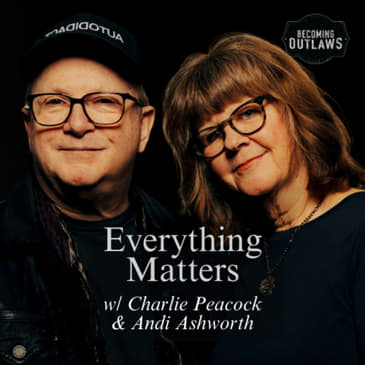
Do you feel at times your seemingly mundane life and daily routines don't have meaning in the big picture? Be encouraged that your life not only matters, but has true meaning and impact in God's Kingdom. Charlie Peacock & Andi Ashworth join Becoming Outlaws to share these ideas straight from their new book, 'Why Everything That Doesn't Matter, Matter So Much: The Way of Love in a World of Hurt.' Charlie Peacock is a 4 time Grammy winner as a Christian music artist, producer, and composer. Andi Ashworth is a writer and co-founder of The Nashville House.
[00:00:00] and the world was. He said, GO, Zaywame, We both more walks in our sense, and then becoming our voice. Today's topic should hit home for everyone. We've all at times felt overwhelmed by the struggles in the pain and living our lives.
[00:00:20] Then we see the pain in our own communities, and even in chaos out in the suffering in the wider world. We may think, how can I do anything to be a positive force with such large problems out there?
[00:00:34] When I'm overwhelmed with my own large problems, how could I love others? When I actually need love myself, and I'm struggling to keep my own head above emotional and spiritual water.
[00:00:45] Well, there's a student to be released a book to give us insights and hope into how to move forward in the right direction
[00:00:52] and have a life of impact that those around us and beyond. The book is titled, Why Everything That Doesn't seem to Matter Matter So Much, The Way Of Love In A Hert World.
[00:01:05] The authors are Andy Ashworth, who also wrote, Real Love A Real Life, The Art and Work Of Carrying, and is also the co-founder of The Art House in Nashville. The other author is Charlie Peacock, recording artist, producer, composer, and four-time Grammy winner. Welcome to you both.
[00:01:25] Hey, thank you for having us. Yes. If you don't mind Charlie, I want to show you a couple pictures you've never seen before. Okay. This isn't like this is your life and for those who are mentioning, I'll make it quick, who can't see, they're just listening. But sure.
[00:01:40] This would have been about 1990 maybe. Yeah. And there you are, that's on the left is Charlie at a sound check for concert. And there he is performing. I snapped to those. I was seeing that concert. I think. Okay, great.
[00:02:01] And then here on the left is the same sound check you were touring with Margaret Becker. There she is. Yeah. There's the three of us, Jimmy A. I love it. You. And then whatever I'm wearing right there, I don't know.
[00:02:18] I did notice that Mom pants and tucked in shirts look like, Yeah. The last picture, the reason I have a picture of me and Rich Mullins is because he's wearing a Charlie Peacock tour t-shirt. That's amazing. Anywhere that the entire show. Will you send me these photos?
[00:02:38] I would love to have them. I assure well. I could probably make them a little nicer. I just need to do that. Just send me the raw photos. Yeah. I would love to have those. Those are great. That's are fun. Thank you for that.
[00:02:51] I would have to put down memory lane. Yeah. Now, I noticed after reading some of your buy-al stuff that you've guys have been amazingly married almost 50 years. And in these pictures, you're wearing a wedding ring. Mm-hmm.
[00:03:07] And as young as you look, you were already a seasoned husband at the time. That's right. Yeah. I mean, yeah, I had already been married for. Well, when I was 33, I had at that time. I think I was 33. I've been married for 15 years. Wow.
[00:03:27] In either of your minds back then, if you could place your mind back in 1990-ish, that was 1991. Yeah. Your views of what mattered to you, your views of Christianity, what you wanted to do in it? You were rolling the kingdom, your role in marriage? Whatever.
[00:03:52] Your view of a life, your worldview. Mm-hmm. How has that altered from then till now do you think? We were in a transition stage then I would say because we had come from California where we were involved with the non-denominational church and moved to Nashville
[00:04:19] where we sort of went from being in the midst of this kind of California post-Jesus movement, non-denominational fellowship to Presbyterianism. And that was sort of our first kind of dipping our toe into real from a theological position or reformed space.
[00:04:48] But prior to that, I would say that we came to the mid-South from California like I say in transition because we were already on to the idea that everything mattered. That there were no small people and no small places or things.
[00:05:06] And I think what was going to happen though when we landed here was that that was really going to start to get fleshed out.
[00:05:15] And that those were going to be the big years that that whole next decade from say 1989 to 99 was going to be the years that we both really, really applied ourselves to that idea studied and took seminary classes.
[00:05:33] And just became voracious readers on the subject and have many mentors and teachers. Would you agree with me? I would agree. Yeah.
[00:05:43] And I think in those years, as Charlie said, all of those ideas that we had some really good teachers in the beginning of our life in Christ. We came on to eateth and Francis Schaefer pretty early on.
[00:06:00] And their work at Librey, Switzerland and Switzerland then and now with branches all over the world. But when we came to Nashville which was 89 and then by 1991, we were beginning to do well lots of different things but beginning to host a lot of people.
[00:06:25] We bought an old church and we moved our family in and we began to have a gathering place where people came to just to be in one-on-one conversation. To be in gatherings with other teachers or authors or theologians or artists.
[00:06:45] And so we began to just deepen, I think, our understanding of what it means to actually serve people in these really big ways of sending music out into the world.
[00:06:59] But also these very daily small ways of feeding people and caring for them and cleaning up behind them and before them and raising our family and writing, learning to write, following our love of writing and studying. All of those things were kind of developing in those years.
[00:07:24] So as everything matters come from a theological ground point. I mean that's really rooted in the Christ calling, even the whole idea of the scripture calling Jesus, the agency of creation. So your teacher of which you are disciple, the one you're following Jesus.
[00:07:55] In a sense, if we speak in human terms, has his mind wrapped around everything that exists, right? And then we have the whole testimony of the creation story, right? The idea that something is made and then there's a profession given about what is made. It's called Good.
[00:08:22] And so when we pointed ourselves in the direction of Christ and started following him, that meant we were following him into this huge story that included everything.
[00:08:37] And included things that you and I might think are nonsense or worthless or, you know, it might be a blob fish and you know, a thousand feet in the ocean and we're trying to figure out what possible purpose does this thing up.
[00:08:54] Well, many in the church function that way, you know, forget all the esoteric I mean there's things like I've lived through 40 years now of people asking, you know, what is Christian about this lyric.
[00:09:10] And so I may be singing about the fact that I really like a mountain stream, right? And have a Christian say well, that's great, but when are you going to start making Christian music.
[00:09:27] So it's that idea that like, well, okay, maybe we have a different idea about what it means to be a Christian here because for me it means that everything matters there's no stray molecule
[00:09:39] that Jesus is Lord overall, he's a little girl, Lord over you and I and Lord over all the stuff. And he has put us in a stewardship role to care for all that he loves.
[00:09:56] And so that means I mean, that's a massive gig. It's a huge huge gig that takes all the people in the world to accomplish that gig. But it does matter to him. There like I said, there are no small people and no small places or things.
[00:10:12] I think for us, we've been for ourselves trying to answer that question. Why bother? Why bother sorting your trash and recycling? Why bother making a person a birthday card instead of purchasing it at Walgreens? Why bother, right?
[00:10:32] Well, we think we bother because it's a part of what it means to be not only human but a new way to be human that is found in Christ. And that is to take all of these things seriously.
[00:10:46] And to pour ourselves into demonstrating what love looks like in a really tangible way. So it's like, what does love with the planet look like? What does love in the neighbor look like?
[00:10:59] And we're just continuing to ask those questions about every aspect of our life and then pray for wisdom to execute the form of proximate faithfulness.
[00:11:15] Yeah, see if I can, if I got this right going back to you talking about having Christian lyrics or not, you know, I think of the term that used to be used the sacred and the secular.
[00:11:28] And then I forget the name of the fish you mentioned, but let's say that fish out there discovered or undiscovered is living God's purpose. It was created and it's just being that fish.
[00:11:39] Yeah, in that is humans or believers to live day to day as God's creation keeps us in the sacred.
[00:11:50] We don't have to be called to a specific ministry with the name Jesus on our lips all the time. It's the life we live and we allow him to live move in our being.
[00:12:04] And there really doesn't become a divide in the secular the sacred you're just living out. So your lyrics are, you could love somebody and you write about it and you express it. It's just a sacred as if you sing about a resurrection.
[00:12:19] Yes, yes. And what you've just dialed in on is the difference between Christianity as a brand that has always been made, it may contemporary for the current generation and the idea of falling Christ everywhere and everything which is massive right small digetration.
[00:12:46] It involves the entire world, all people groups. It can't be branded it's too big. So the kingdom way that Jesus initiated is this really massive big cosmic thing that it just resists all these tiny niche thinking and brand thinking.
[00:13:12] But we live in a time when this is the way people respond to the world don't they they want everything reduced down to the smallest common denominators and that just doesn't work.
[00:13:24] I mean we can we can say yeah are common denominators Jesus, but then out from Jesus just goes and just this massive cosmic story right.
[00:13:35] And and so we do find ourselves at odds often with people who wear brothers and sisters with in Christ who are always practicing reductionism they're always trying to reduce something down to the smallest thing that we can say it's this or here's the list of 10 things that you do.
[00:13:58] And now you're Christian or if you say these things in this way I'll know your Christian and you know again having been involved in and out with Christian music in particular over the years.
[00:14:15] I've just been a witness to that so much how this is this good thing the idea that you want to make music for a particular people group in their needs.
[00:14:26] All of a sudden it becomes this thing where where people start to define that as music and it's like no no no no that's just us seeing you and loving you and wanting to make something for you and maybe it's something that you take back to your churches.
[00:14:44] Maybe it becomes part of your musical worship that's all good and fine but don't in any way think that this idea of Christian music or contemporary Christian music or worship music or modern worship whatever anybody's calling it today somehow.
[00:15:01] symbolizes all that Jesus is doing through music on the planet because it's just one tiny little drop in the glass. Right. Andy how would you describe the what is the mundane that matters how mundane are we talking about and why does why does our day-to-day life. Matter.
[00:15:28] Perfect question for Andy. Thank you. Thank you for that. I think that well first first of all tell you why I know this.
[00:15:39] I've been keeping journals sort of more diary journals the kind that record life but also reflect so since 1984 and all I have to do really is look back through the years on.
[00:15:57] You know each week that has passed and I see details that I've written down about that week that month that year the people who came through our life.
[00:16:13] The years of our children of our grandchildren of meals cooked and just so many details and I realize and it's always really helpful to me because it helps me realize that there is no small part in all of that.
[00:16:36] So I have a chapter in this book and it's called yeah why no part is too small to matter to those who need reminding of the greatness of small things.
[00:16:49] So it really takes nobody escapes the daily and the ordinary and the taking the garbage out and doing the dishes and doing the laundry as well as the things that might be more glorious and
[00:17:05] bigger and maybe have a title to it. But all of those things are part of what it means to be human, what it means to care for each other, what it means to care for a place, what it means to actually enable life to continue on.
[00:17:24] You know going to the grocery store, bringing home food, preparing it for others so that they can continue to live or to offer it to others that outside of your household.
[00:17:36] So over the years I just really had to reckon with that for my own self, especially because we have had a big life of hospitality and caring for others through our home. I really had to kind of wrestle with that just all this matter.
[00:17:56] You know, and I think it really does and I just think it's not one of the ways that we have on the Jesus has given us is to feed hungry people and welcome strangers and care for the sick and all of those kinds of things they're done in our actual lives.
[00:18:18] The lives that we're given, the lives that we live in in particular place, neighborhoods, city. You know they're not they're not done in general, they're done in specific and so we all have whatever might be a larger title that we have with thousands small tasks that.
[00:18:41] So we can start to stop our reading and stop using work Monday because it's like, you know we could have say a task that we're doing that we dislike very much.
[00:18:58] We see that it's integrated into the whole you know so we can hold in a pinning go like I don't like doing that, you know, but at the same time we can appreciate.
[00:19:09] But this needs to get done because it's a part of this bigger whole and and so there's a thousand of those things and sure maybe we have some hierarchy of things that we really love to do.
[00:19:21] Every human being does, but we have stopped yes sort of you know saying those aren't good things just because we dislike them we see them out it's integrated and that's important.
[00:19:37] Those earlier pictures I showed you I was about I don't know 20 years old and I saw my place in the kingdom at the time as getting involved in media.
[00:19:48] Christian music had been impactful in my life so I'm going to help promote people like rich mollins and Charlie peacocks on radio or whatever so that they can get their message to the world.
[00:20:03] And later in life I end up with well kids special needs a daughter had to work to jobs go back to grad school all of the other got canceled and for a brief time I thought you know what I'm not doing what God called me to do but in that midst of the day to day life forces you into.
[00:20:27] Begin to realize this isn't any different like this is the calling for my time. That's for kids for family or even purposes you can't see if you can resign yourself that well resigns probably the negative way to look.
[00:20:45] Become to the realization that it's not doesn't have to be masses or waving a Jesus banner it could be the day to day. Life and you're still moving the kingdom forward I think that's what I think that's what the general idea of your your book is.
[00:21:04] Yes, absolutely and if I'm on the right track if you could expand on on a life the kind of story your life lives you guys alluded to that because I think of you know spread the gospel and it's a certain evangelical message we bring but what can our life in general Charlie's been on stage and.
[00:21:29] I don't remember it's called being the light or the light but that one of your original song still is rent free in my head. Yeah, hello. So you can see those great songs and the very scriptural.
[00:21:40] But at the same time you have a normal day to day life and like you mentioned grandkids and kids so the totality of your life. Do you see one is more of ministry or the other or do you see it as one tapestry.
[00:21:54] Yes tapestry is a great way to say it. I love that definitely see it like that we definitely understand life in terms of. As you say all that God calls us to which is which is quite.
[00:22:14] It's that's quite large. It's our relationships. It's the way our gifts and talents are used the way that we. It's we're called to neighborhoods. We're called to family making. We're called to friendships. We're called to.
[00:22:32] You know, again we have concerns. We have interests. We have things that compel us forward. I've been a writer since I was a little girl but I didn't have any big.
[00:22:47] Notions of wanting to be a published writer. It's just part of who I was from from my youngest age. But as an adult. When I at one point when I was in my 40s, I looked back and I saw well I've always been this person.
[00:23:05] It's just it's what matters to me. It's what I need to. It's almost like oxygen. I need books. I need to write in some former fashion. And but all the steps along the way.
[00:23:20] And you know, and even just to even to write a book to write anything you labor over words and sentences one little bit at a time. You know, your your parent or your grandparents to your specific people.
[00:23:40] It's just so very specific. And I love to think of it as our given lives. What are the lives gotten has given us and.
[00:23:51] You know, so the whole is the place that matters that we live out our calling to him and our love a family and our love of other people.
[00:24:01] The love that he's put inside of us. I love to garden. It's something that I always you know, if I only had a little.
[00:24:11] A couple of pots and no no nowhere else to plant. I would need to plant some flowers in those pots, but it's you know the things that that drive us that that we care about and again the people we care about all those all those things. That's how we find our lives.
[00:24:28] And the place is that we are our and our planted. Yeah, I think part of the imaginative creative life is. Two things negatively you could say that it is the goal is to rid oneself of hypocrisy.
[00:24:48] And then on the positive side, it would be to really embody all that it means to be a disciple of Jesus to like like I mentioned earlier to really get inside that story and live it out day to day.
[00:25:07] And the reason why I mentioned the hypocrisy part because this is one of the problems with the evangelistic language. If we put all the emphasis on that is that we can go out and quote Bible scriptures to our neighbors.
[00:25:32] But if we live in ways that are contrary to what that's actually teaching. Then it's very confusing to the world. It's very confusing like even imagine during times when there's been believers who because of their eschatology thought, okay Jesus is coming back you know tomorrow.
[00:25:58] Yeah, in the real day to day lives they were still concerned with daily living. They were still concerned with determining whether they were going to go to college or not all of these different things.
[00:26:10] So I think it's it's part of our work is to eliminate those confusing elements in our lives and to live in such a way that it really feels congruent with what it is we're proclaiming about reality through the through the scripture and through what it means to follow Jesus.
[00:26:29] And that's just a lifetime work. I mean, we we definitely suffer embarrassment from things that we did when we were young Christians.
[00:26:39] What we the way we lived out the Christian life the way we portrayed it to others and I think just incrementally over the last 40 plus years we hope that we've been.
[00:26:53] You know, making adjustments along the way that that's that part of the maturing and Christ and and what what Christians would call sanctification and the Holy Spirit working in you to to bring to you wisdom and knowledge that you perhaps did not have at the jump.
[00:27:12] Is that what you refer to as theology of our history? What you just kind of encapsulates there.
[00:27:20] Yeah, but I would I would be really careful with the artistry part making sure that the listener knows that we're talking about the artful life for every Christian and not not the idea of vocational artists.
[00:27:36] Yeah, whereas this is why if I use words like story or art. I'm always they always have a multiple application right I may be talking about sure me and my musician friends you know we're making some music and and yeah, we can call that musical artistry but almost every principle.
[00:27:59] Every philosophical idea about it every musical idea or artistic idea can be extrapolated outward into day to day life.
[00:28:09] And so to me what what I've tried to do for myself is to is to create a life where there's this seamless integration of the artistic mind and the theological mind completely integrated with daily life.
[00:28:27] And vice versa right daily life is moving into my art all the time and this whole artistry theological part is moving into daily life. And so that they just become like this and and that's what you talked about earlier is like getting rid of that sacred secular divide.
[00:28:48] And the idea that it's either it really is all gods or it's not and if it is all gods then then. What we do as we mature as human beings is to incorporate all of it and appreciation for all of it into the whole life. Andy and closing.
[00:29:13] If I'm just hypothetically going to think of a hypothetical person and I have someone in mind, but let's say a divorced woman got a couple kids at home. Because of the stress and anxiety she's actually her health isn't that good.
[00:29:29] So not only in the day to day, but struggling in the financial day to day relational ship struggle. The day to day with kids and trying to get them to be the best they can be all in the background there's a little bit of guilt that.
[00:29:46] He's not doing a god calling in her life or not being able to involve in a church or a ministry. But she'll get to it one day, but all of that is a daily almost overwhelming for sure like. Is this worth it and why?
[00:30:05] What do you want your book to say to that person? Oh, I want her to know that she is beloved and that she is. She is so loved by God in and he just I think he's just waiting for us to say please help me in everything.
[00:30:37] I pray about absolutely everything. Nothing. You know, from the smallest things to the biggest things to just every kind of help that I need and but I think that it is. It is such beautiful news to know that.
[00:31:00] God is with us in the life that we have not the life that we may someday have or. It only looks a certain way or it's only happening if we're in a church or in something that has a specific name that is ministry that.
[00:31:21] Because all of life for all of us were in Christ. Our ministries are everyday life whatever that looks like. So I think that there's a great great need for an understanding that ordinary life whatever that is for us.
[00:31:42] It matters so much that is the life that we are living in Christ. We are living in Christ. And I think that we are living in Christ. And that we are living in Christ. There is no there's no place in our life that God is not with us.
[00:32:11] God does not see that that is not he is not sovereign over. And not close to us and not leading us as our good shepherd. And I think those reminders they're really helpful to me. I hope those would be a good reminders.
[00:32:31] How the moment outlaws we said, come follow me. We have more walks of life since and then we're coming outlaws.