
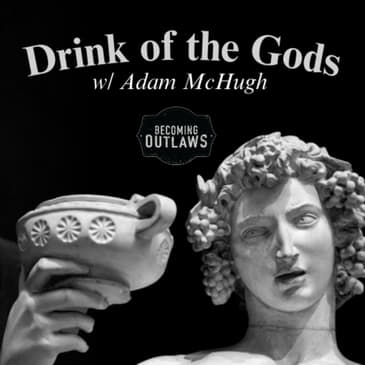
Wine has long been regarded as the "Drink of the Gods," esteemed by royalty and revered in divine contexts throughout recorded history. The Bible mentions wine more than 200 times, describing it as a "Gift from God." In Christianity, wine symbolizes the blood of Christ, representing the covenant that promises salvation to humanity.
Author Adam McHugh, who is also a former minister and certified wine expert, joins the Becoming Outlaws podcast. He discusses the historical and religious significance of wine and talks about his new memoir, "Blood from a Stone." In the book, McHugh shares his personal journey, detailing how wine played a pivotal role in bringing him from a state of "death" to a renewed life.
Blood From a Stone Available Now on Amazon
https://a.co/d/ehKsWqb
00:00:00
Gavin among the outlaws who said come follow me, people from all
00:00:05
walks of life since have been becoming outlaws.
00:00:11
Welcome to Becoming Outlaws. If this is your first time here
00:00:14
becoming outlaws, we engage celebrities, scholars, different
00:00:19
diverse voices and candid conversations about following
00:00:22
Jesus defying societal norms. And explaining profound and
00:00:27
often not so profound questions of faith.
00:00:31
And today we entitled This Drink of the Gods.
00:00:35
Before we get started, please subscribe on whatever platform
00:00:37
you are listening to or viewing this.
00:00:40
Like it. Share it.
00:00:41
It helps the algorithms so more people you know can listen in
00:00:45
the future. You know the deal.
00:00:46
Thank you. There's a newly released book
00:00:49
and from I understand it's doing pretty well called Blood from a
00:00:53
Stone. A Memoir of how Wine Brought me
00:00:56
back from the Dead, and you can tell from the title why I
00:01:00
grabbed it. I was interested, got through it
00:01:03
quickly so I could talk to the author.
00:01:05
It's the personal account of a graveyard shift Hospice
00:01:09
chaplain, a grief counselor who, through struggles and various
00:01:15
detours in life, finds his way to becoming a wine expert in
00:01:20
living in the California wine country.
00:01:23
As a sommelet and giving wine tours a whole different life
00:01:28
that it once maybe seemed like a fantasy and he made that
00:01:32
transition. What I found most personally I
00:01:35
liked about this tale was the history presented of wine
00:01:40
throughout civilization, the various cultures, it's always
00:01:47
been like the drink of kings through history, the drink of
00:01:50
gods. It's the center of community,
00:01:54
the center of family life, and even makes its way as the
00:01:57
representation of the heart of Christianity, and even a toast
00:02:02
to the Kingdom to come, all from a drink.
00:02:06
Adam McHugh is a wine tour guide, Sam Lane, a certified
00:02:09
specialist of wine. He's also the author of a couple
00:02:13
few other books, one being The Listening Life of Introverts,
00:02:15
another in The Introverts in the Church, and he's a regular
00:02:18
contributor to Edible Santa Barbara in Wine Country.
00:02:23
Welcome, Adam. Thanks, Ken.
00:02:25
Thanks for having me on the show.
00:02:27
Thanks for coming. Glad you're here.
00:02:29
So let's start with the title. So Blood from a Stone, for one,
00:02:35
it's it's an appealing title. It kind of grabs you a little
00:02:37
bit. I'm familiar with like, getting
00:02:39
you can't get blood from a turnip, Blood from a Stone.
00:02:43
Is that the same kind of concept?
00:02:45
And what does it mean to you? And why is it the head title of
00:02:48
of your memoir? It's a a phrase that I first
00:02:52
heard in the South of France when I was on a a wine tour
00:02:57
about 15 years ago. There's a very famous wine
00:03:01
region down in the Provence region, not far from the town of
00:03:05
Avignon called Chattanoof Dupop. Which means new house or new
00:03:09
Chateau of the Pope. Because believe it or not, there
00:03:12
was about a 70 year period where the papal throne was located in
00:03:16
Auvignon rather than in Rome. It was relocated in the 1300s
00:03:21
and so I was on this wine tour and one of the the big features
00:03:26
of the shats need to pop wine region.
00:03:28
Instead of dirt between the vines, you have these big round
00:03:32
rocks called galettes. And you have these shrubs, these
00:03:37
kind of grape shrubs growing out of these rocks, right?
00:03:42
And so I I mentioned to our wine tour guide, I have no idea how
00:03:46
anything can grow out of this sort of soil and out of these
00:03:49
huge rocks. And this wine tour guide says
00:03:52
that's why the local expression here is that making wine is like
00:03:56
squeezing blood from a stove. And it just hit me like a ton of
00:04:01
bricks. And people don't ever believe me
00:04:04
when I say this, But I honestly said to myself, in that moment,
00:04:07
I'm going to write a book by that title.
00:04:09
And I did, about 10 years later. But I finally did it.
00:04:14
Yeah, the subtitle memoir about wine brought me back from the
00:04:16
dead. So typically you'd expect
00:04:20
stories. You know, getting away from
00:04:24
alcohol brought me back from the dead.
00:04:25
So yours is A twist on that, obviously.
00:04:28
And it's catchy. And just to ask you, how did
00:04:32
wine bring you back from the dead?
00:04:33
That's the whole book. So it's kind of a big question,
00:04:36
but in general what? What do you mean by that?
00:04:40
Right. So it's a play on a few
00:04:42
different things and it's a the subtitled seems to draw a lot of
00:04:46
people in. So I'm happy about that.
00:04:48
But, and one the simplest level is actually pretty
00:04:52
straightforward in that before I moved to, I'm in what's called
00:04:57
the Santa Inez Valley of California, here on the Central
00:04:59
Coast, north of Santa Barbara, before I moved up here, got into
00:05:04
the world of wine. I used to live down in the LA
00:05:07
area near Pasadena, and I was a Hospice chaplain.
00:05:11
I worked with people who have been given a terminal diagnosis
00:05:15
and I actually worked a lot of nights, more than more than
00:05:18
days, at least in the second stint that I did that job.
00:05:21
And so I was going from home to home often on what we call death
00:05:25
visits, where the patient had died.
00:05:27
And I had to go and and comfort the the family and sort of wait
00:05:30
for the Mortuary to show up and and be with them.
00:05:33
And so that was my life. For years was being with those
00:05:38
people who've been given six months to live or less.
00:05:42
And now I live here in wine country, and which is so full of
00:05:48
life and so full of abundance, and it feels so very different
00:05:52
from the life of grief and loss that I used to.
00:05:55
To live day in and day out. So the trajectory of the whole
00:05:58
book of my whole work is from Hospice, chaplain to wine tour
00:06:03
guide and sommelier and that kind of, you know, that's the
00:06:07
the overarching plot of the whole book.
00:06:09
So, back from the dead. Obviously there's multiple
00:06:12
meanings there, but I'm specifically referring to my
00:06:15
time working with people who had just died.
00:06:18
Yeah, And I'm trying to recall what did you call yourself, the
00:06:22
Grim reapers? Grim Reapers, Wingman.
00:06:26
Wingman Yeah, I almost titled this episode The Grim Reapers
00:06:29
Wingman, but I didn't want to focus just on the Hospice part.
00:06:32
But I thought that was a good title.
00:06:33
Right. Because the Hospice part is like
00:06:35
the first, you know, third of the book.
00:06:38
And then the rest of it is me sort of grappling with a new
00:06:41
life and why letting go of my sort of role in identity as an
00:06:45
ordained minister and as a Hospice chaplain.
00:06:49
As a Hospice chaplain. So most people listening to what
00:06:53
Hospice is, but that's where you go to die comfortably.
00:06:58
Exactly. Is there a way to put it so you
00:07:00
go there expecting not to come out, and your family expects
00:07:04
this person or you not to come out, and you're the guy they
00:07:07
call to comfort family and to help people pass from this life
00:07:13
to the next? And what's that do for a person?
00:07:16
Does that take a? Special kind of person, or what
00:07:18
kind of person ends up with that job?
00:07:20
And not only did you have that job, you had like the graveyard
00:07:23
shift. It's like a culmination of
00:07:27
burden. Wouldn't it be?
00:07:29
Yeah, those last few years I I worked, I did a couple of stints
00:07:35
in Hospice and the first few years I worked during the day
00:07:38
and that actually really helped kind of brighten your mood, just
00:07:42
having sunlight streaming through these windows.
00:07:44
But then just sort of due to the economy back, this is back in
00:07:48
like 2008, 2009 when everything fell apart.
00:07:52
The the only work that I could find was working the midnight to
00:07:55
8 on call shift, often three to five nights a week.
00:07:59
And and so not only was I, and so normally what I I was called
00:08:05
for with what we call death visits where someone had just
00:08:08
died and then it was just required for the Hospice service
00:08:11
that someone would go and be with the family and that was
00:08:15
usually the chaplain and then you.
00:08:17
But I would have to drive through these, you know, dark LA
00:08:20
freeways. I lived about 45 minutes east of
00:08:22
where most of our patients were. And so, you know, I was, I was
00:08:26
sort of felt like I was kind of The Walking Dead myself.
00:08:30
You know, driving through these dark, kind of smoggy LA freeway,
00:08:33
so houses I'd never been to, to be with people that I had never
00:08:36
met and to try to bring some teaspoon of comfort to their
00:08:40
lives and, you know, one of the one of the darkest nights of
00:08:44
their life. And so not only was it just an
00:08:46
emotional, you know, was it emotionally taxing to be doing
00:08:51
that sort of job. And often one of the hardest
00:08:53
parts was just that they were strangers every single time.
00:08:56
I had no familiarity with them. Not all.
00:08:59
And I would never see them again, but then you're just
00:09:01
you're living sort of in reverse.
00:09:03
I was living during the dark hours of the night when everyone
00:09:07
else was sleeping. And then I would kind of sleep
00:09:09
in fits throughout most of the morning and the early afternoon
00:09:13
and wake up in in the evening when everyone else had kind of
00:09:16
finished their day. And I was just starting my day
00:09:19
and it was very disorienting in so many different ways.
00:09:23
That being said, I should, I should say, you know.
00:09:28
The job itself was very meaningful at times.
00:09:32
It was very like they were very profound moments when you hold
00:09:36
someone's hand as they take their last breath, which I did
00:09:39
on multiple occasions. And so it was kind of strange
00:09:43
and and special work. And I don't want to discount
00:09:47
that, but, and it changed me really in so many different
00:09:51
ways, but at the same time the sort of the emotional burden and
00:09:55
the psychological burden which is this slow leak on my soul
00:10:00
that eventually just made it impossible, impossible for me to
00:10:03
do that work anymore. Yeah.
00:10:05
I can imagine. Is there a high turnover rate
00:10:09
for that work? It's yes and no.
00:10:13
There were some people that absolutely astounded me that
00:10:16
just seemed like they were just tailor made for that work.
00:10:19
One of my colleagues, I think she was about 75 and she just
00:10:23
couldn't retire. It was just the work that she
00:10:26
loved, and she had done it for 40 years and it was just what
00:10:31
got her up in the morning and she loved it.
00:10:34
But then there were lots of people like myself who struggled
00:10:37
a lot with what's called compassion fatigue.
00:10:39
Which feels like depression, though it's a little bit more
00:10:42
circumstantial than medical depression.
00:10:45
And so but there there was a fair amount of turnover among
00:10:50
the social workers and chaplains.
00:10:51
But then there were some people that just seemed tailor bait for
00:10:53
the job. I was not one of those.
00:10:55
People, yeah, before we move on to a little more cheery and
00:10:59
gladness with wine. And for you personally, dealing
00:11:06
with death? Hands on, face to face kind of
00:11:11
thing. Or at least within the moments
00:11:12
after most people avoid. Nobody likes to go to funerals.
00:11:21
It's not a good time. Nobody likes to face their own
00:11:23
mortality. And it's hard to look at death.
00:11:27
It's hard to look at sick and suffering's hard to look at.
00:11:30
But yet, one of my favorite scriptures and actually as soon
00:11:33
as I started a Facebook account many years ago, it says like
00:11:35
quote or what's your favorite quote?
00:11:37
You could put it. Mine's always been.
00:11:39
Ecclesiastes 27 Just because it's so important that it's
00:11:44
better to be in the House of mourning than a House of
00:11:46
feasting, because death is the destiny of every man, and the
00:11:52
living should take this to heart.
00:11:54
And there's a lot of soul changes or reflection or
00:11:58
contemplation. Contemplation, which I noticed
00:12:01
was one of your job descriptions in a bio.
00:12:04
It said it, said the writer author.
00:12:08
Sommele contemplative. I thought, that is like the
00:12:11
coolest. I want to add that to mine, just
00:12:13
to add, like, I think about stuff.
00:12:15
Seriously. I think about stuff is a job
00:12:18
anyway, where you contemplate mortality.
00:12:21
Not everybody does it, and when they do, we're the Billy Grahams
00:12:24
of the world. We're so successful as
00:12:26
evangelists because they make you for a moment think about
00:12:28
your own mortality if you died today.
00:12:31
And then they give you a message and it hits you.
00:12:34
But somebody who lived in the culture of facing mortality?
00:12:38
What's that do to a person? To that I know you had
00:12:42
Compassion Fatigue, but did it heighten your faith, strengthen
00:12:47
it? Or did it just make you did have
00:12:50
an opposite effect because Death is so horrible it was a.
00:12:56
It was very complicated and I mean the answer to that question
00:12:59
is yes, I. I experienced on many, many
00:13:05
occasions, you know, a compassion fatigue that felt
00:13:08
like depression because it just kind of felt like there was a
00:13:12
futility to what I was doing in my work.
00:13:16
There was a futility to what we're all doing in our lives
00:13:20
because there is an end to all of this.
00:13:22
And and really the a lot of the hardest part was not actually
00:13:26
watching people die. The hardest part was watching
00:13:28
people watch people die. Watching these family members
00:13:33
lose people that they had had in their lives for 80 years, 90
00:13:39
years, 30 years, sometimes a lot less.
00:13:42
But that was the hardest part for me, was watching people
00:13:45
grieve, their loved ones die. That was what made the biggest
00:13:49
impact. On me.
00:13:51
So there was certainly an aspect where I began to treasure my
00:13:55
family relationships, my friend relationships, my my marriage,
00:14:01
you know, more, even more than I did before.
00:14:05
But in I think actually what it drove me to do was to sort of
00:14:09
see there is an end to all of this and the dreams that I have
00:14:15
within me are not going to bubble.
00:14:18
Forever. And so I think ultimately it was
00:14:22
Hospice that drove me to seek other passions, another
00:14:27
lifestyle that I never would have gotten to if I hadn't have
00:14:31
spent so much time watching people die.
00:14:35
And, you know, in some ways it was a faith strengthener.
00:14:39
In some ways, it was actually very difficult for my faith to
00:14:43
watch people grieve so often. And you get kind of this skewed
00:14:47
perspective on humanity and it kind of feels like it leads you
00:14:51
with nowhere to go when you spend that much time with death.
00:14:54
But I think ultimately it actually just said well.
00:14:58
I have these dreams, I have these passions, and I want to
00:15:02
seek another life because of what I have seen here.
00:15:06
Yeah. And you mentioned futility,
00:15:08
which is interesting or life's futility when you see death so
00:15:11
much. But that's the whole theme of
00:15:12
Ecclesiastes is. And kind of what you're living
00:15:14
is. You got to face the futility of
00:15:18
life because. And you might as well make sure
00:15:22
you like, obey God, follow God, but eat, drink and be married,
00:15:26
because tomorrow we die kind of thing.
00:15:29
So you make you make a pretty cool like tour guide with as you
00:15:32
bring a level of depth and understanding to life where it's
00:15:35
not just toasting and living a California lifestyle in the
00:15:38
vineyard countries with a naivete of life, but with a
00:15:44
depth of you can I think it extra enjoy a drink of the fruit
00:15:49
of the vine and a good meal with friends and an afternoon on the
00:15:53
countryside sharing knowledge with people.
00:15:57
Knowing that this is a pleasure, but you can, I would think,
00:16:03
bring some kind of sense of, I guess, the lack of naivete that
00:16:07
it's you can appreciate the pleasure more.
00:16:10
Yeah, I would agree with that. And you know, I I drive these
00:16:15
people all the time, every, you know, every week from Santa
00:16:18
Barbara up to our wine country near the San Inez Valley.
00:16:22
And there's all sorts of fascinating conversations that
00:16:26
come up when you're spending that much time in a car with
00:16:29
people. And I think I'm always aware
00:16:33
that. You know, these vacations that
00:16:36
people are on, these little wine tours that I'm taking people on
00:16:39
is really a respite for them in a really hard life.
00:16:43
I'm always aware now of the challenges that everyone faces
00:16:49
and it definitely can make me appreciate more like these
00:16:52
these. These six hours or so that I get
00:16:54
to introduce people to these beautiful places and talk to
00:16:58
them about the wines and geology and all the different, like
00:17:01
history and features of this area.
00:17:04
And it's never frivolous for me. It's not just, you know, this,
00:17:10
just it's it's a luxury in the sense that I'm aware now of the
00:17:14
hard realities of life that every single person faces,
00:17:18
whether they're rich or poor. And I can.
00:17:22
You know, I I I'm able to not just show them a good time, but
00:17:27
but I think how people appreciate just the the moment
00:17:31
that the moment that they're getting to experience together
00:17:34
in this beautiful place. Yeah.
00:17:36
In reading a book it's it's a great combination because I'm
00:17:42
not a wine connoisseur and that I would buy a wine book and want
00:17:46
to know about wine. I don't know the notes of wine
00:17:50
and. One tastes good or one tastes
00:17:52
bad That's about my education level and but so I think someone
00:17:58
who does know all of that would find your book really
00:18:03
interesting and entertaining. It's funny, but even someone
00:18:06
who's not the storytelling is grabbing.
00:18:11
But as well as it came off to me, as I'm sure you know and
00:18:15
appreciate the different, the notes and the flavors and.
00:18:19
But it seems to me that in what you brought out of it for me was
00:18:22
the enjoyment of the bottle you have based on not just what it
00:18:27
tastes like, but the soil it came from, the community that
00:18:32
had a heritage of families handed it down for 100 years.
00:18:36
That's all they've known. And they personally cultivated
00:18:40
this. And you had to have this kind of
00:18:41
goat with this kind of whatever to make this kind of whatever to
00:18:44
put in the mix. And it only comes from this
00:18:47
little. Village off in whatever country.
00:18:50
And then and then you have, if you sat with the family or
00:18:53
learned about their culture and enjoyed that with them and
00:18:56
conversation and community, then you go back and you buy that or
00:19:01
order it or off the shelf or and you drink it.
00:19:03
That's a whole nother multilayer that, but that tastes good or
00:19:07
bad. I'm happy to hear you say that.
00:19:10
And the idea was that I was going to try to write a wine
00:19:13
book that non wine people would actually enjoy.
00:19:17
You know, we'll pick it up to the readers to determine whether
00:19:21
I pulled that off or not. But I tried to be.
00:19:24
Funny, which wasn't easy to do in a book that has a lot to do
00:19:27
with Hospice and grief and death.
00:19:28
But I knew the book could get really gloomy if if I didn't try
00:19:33
to lighten it. But I like what you're saying
00:19:36
for me, wine. I actually really I've studied
00:19:39
wine very carefully now for 15 years.
00:19:42
And so yes, I can do the notes and I can get as pretentious as
00:19:45
I want about evaluating the sensory, you know, experiences
00:19:49
of a particular wine. But for me, wine is really about
00:19:52
place. And my whole journey has been
00:19:55
about seeking a sense of place, a sense of belonging and
00:19:59
attachment to the soil that's under my feet and the people who
00:20:05
cultivate the vine and and make the wine like an attachment,
00:20:09
like a communal attachment to them as well.
00:20:11
And so for me, wine has this amazing transporting effect
00:20:16
where it can be this portal into a different place in a different
00:20:20
time. And if you have gone and met
00:20:22
these farmers like I did? In the South of France on that
00:20:25
trip and tasted wine in their farm houses or in their in their
00:20:29
barns. And then when you when you bring
00:20:31
that wine home or you find it in a store and you open it, it's
00:20:35
it's like a liquid memory kind of coming alive again.
00:20:39
And so that the reason why I keep holding on to wine so much
00:20:43
is is not just because I really like how it tastes or smells,
00:20:46
but because it takes me to particular places.
00:20:49
And it also feels like here, living in the San Andres Valley
00:20:52
where you know, most of my favorite wines are it, It
00:20:55
grounds me, it gives me a foundation.
00:20:57
And so it's it's that sense of place that really keeps me
00:21:01
holding on to wine as much as I do.
00:21:04
Yeah, and you threw in. I'm kind of a history buff, so I
00:21:07
latched on to this references to the history of wine, and it
00:21:11
really has been through antiquity, through different
00:21:14
cultures as a main drink. And I would assume a lot of that
00:21:18
has to do with the lack of. Clean water or bacteria in the
00:21:22
water so they have a somewhat fermented drink to kill the
00:21:25
bacteria. But why?
00:21:29
What's some examples of just how far back it goes and how it was
00:21:32
represented, and why it was like a drink of kings or the drinks
00:21:37
of gods and religion, right. As far as I know the the history
00:21:42
of wine goes back about 8000 years and the earliest evidence
00:21:46
of winemaking has been discovered in the Caucasus
00:21:48
mountains of southern Georgia near the Black Sea.
00:21:52
And from there it seemed like it it moved along what we call the
00:21:56
Fertile Crescent or Mesopotamia, you know sort of South of South
00:22:01
of the Black Sea and then along to what's called the Levant
00:22:04
which we would call Palestine and Israel and and what was
00:22:07
ancient Syria at the time and then down into Egypt.
00:22:11
And and I love the history. I was a history major in college
00:22:15
and I studied a lot of history in grad school as well and and
00:22:19
so I. And that's why I had to wrap a
00:22:21
lot of the history of flying around my own story, because I'm
00:22:24
just so fascinated by all of that.
00:22:28
And wine was the wine of kings for one simple reason at 1st,
00:22:32
and that's because it was really expensive.
00:22:34
It was very hard to make Ancient Egypt.
00:22:37
It was really the the emperors and sort of the noble classes
00:22:41
that were able to afford it. It was too hot in most of Egypt
00:22:45
to be able to grow grapevines and and so they had to import it
00:22:49
from. Israel actually was a huge
00:22:53
supplier of some of the best wines in Egypt and and so you
00:22:58
just couldn't afford it. And then it wasn't really until
00:23:01
the Greeks, you know, centuries later, that wine became a little
00:23:05
bit more democratized and sort of your.
00:23:07
All classes of people began able to afford it because the climate
00:23:13
was better. And then by the time we got to
00:23:15
the Romans, it was a pretty ubiquitous thing, though it was
00:23:19
still always a status symbol. And the Roman The Romans made
00:23:23
sure that all of their all of their soldiers marching
00:23:26
throughout the Mediterranean always had a good supply of wine
00:23:30
from Italy. But then they started planting
00:23:31
grapevines everywhere they went along the Mediterranean.
00:23:35
So the Roman Empire really helped shape what's now the
00:23:39
modern wine industry. And as far as like biblical
00:23:43
history goes, which intertwines with the history itself, I mean
00:23:47
we see it all through scripture, whether we in our particular
00:23:52
upbringing wanted to look at that or not.
00:23:54
It's mentioned hundreds of times.
00:23:56
It's considered a gift from God. It's a humankind.
00:24:01
It's Jesus. First miracle was turning water
00:24:06
into a wine for a party and not the first.
00:24:09
After they already ran out, he gave him more to drink and a
00:24:13
good time. And would you know, is it the
00:24:17
first thing we see of a new civilization in the story of
00:24:20
Noah is him being drunk, but he had to plan a vineyard to do
00:24:23
that. He plants a vineyard, one of his
00:24:25
first things to do, and we get down to even Jesus himself using
00:24:32
the drink as a symbol of blood for the new covenant of all
00:24:35
mankind, salvation. And then goes as far as to say,
00:24:39
I'm not going to drink this again with you, with the fruit
00:24:41
of the vine, until I drink it with you a new and a Kingdom
00:24:43
like it'll be a heavenly toast for an arrival of a a Kingdom to
00:24:49
come. Besides, his parables were full
00:24:51
of vineyards and wines and. Wine tenders and new and old
00:24:57
wine skins, You can't get away from it being a part of culture
00:25:03
in that Have you gathered? Do you feel like a depth of
00:25:09
having been an ordained minister and an expert in wine, so you
00:25:14
have an interest in history, in scripture, in wine?
00:25:19
They have some kind of maybe formulated idea of wine or a
00:25:22
layer of depth of understanding that maybe us come and lay
00:25:25
people wouldn't have or or don't respect.
00:25:30
What's amazing to me is all the intersections between what I
00:25:34
studied in seminary, you know, 20 plus years ago to what I
00:25:39
study in wine now. And I mean, it's because it goes
00:25:44
back to the ancient world and through all the great empires of
00:25:49
the ancient world, especially, you know, the Greeks and the
00:25:52
Romans who were of course contemporaries of, you know, 1st
00:25:56
century Judaism that we study in the Gospels.
00:26:00
And and what that's what amazes me about it as the wine as a as
00:26:05
a symbol of life as a symbol of abundance.
00:26:10
And I mean you go back to when the the spies in the in the in
00:26:14
the book of Joshua like spy out Canaan, right.
00:26:27
The promised land is. They go to see the promised land
00:26:19
as they're coming out of the wilderness and getting ready to
00:26:21
come into Jericho, and what is it that they bring back as a
00:26:25
symbol of how? It's a huge grape cluster that's
00:26:31
suspended between, you know, that's on a pole, that's hanging
00:26:34
down from poles, which is actually over over centuries
00:26:38
come to represent Jesus on the cross for a lot of Christians.
00:26:42
And you know, that's the symbol of the good life and the
00:26:46
abundance and the and the blessings of God that are
00:26:49
offered in this land. And that theme runs all the way
00:26:54
through Scripture, that that wine is a gift of God.
00:26:59
Someone 04 says, you know, to gladden the human heart.
00:27:01
That's my favorite text in the scriptures.
00:27:03
And as a blessing and as as something that is given to us,
00:27:08
not only to, you know. And so in the ancient world,
00:27:11
absolutely there it was used as an antiseptic because the water
00:27:14
supply was sort of suspect really until Roman aqueducts.
00:27:17
And. And so, yeah, the acids and
00:27:19
alcohols absolutely were killing bacteria that might make you
00:27:23
sick. But it was that wasn't the only
00:27:25
purpose. It was used as, As for rituals.
00:27:29
It was used as a symbol of the good life.
00:27:31
It was used as a as an expression of community and
00:27:35
conviviality and joy. And, you know, so much so that
00:27:38
it's the picture we have of what the Kingdom is going to be like
00:27:42
at that wine at the center of the table because of what it
00:27:45
represents. So there's just so many layers
00:27:48
that you can easily and I plan to spend an entire lifetime
00:27:52
studying. This is random, but that's how
00:27:56
my brain worked. Did you know that Nikola Tesla
00:27:59
was known for taking a shot of whiskey every day just to kill
00:28:04
the bacteria in his system? I didn't know that.
00:28:07
Yeah. Except during Prohibition.
00:28:09
Except Prohibition, because he didn't want to be a rule
00:28:11
breaker. So he stopped.
00:28:12
And then when prohibition to end he started up with a shot of
00:28:14
whiskey that's that's funny. It would it would work.
00:28:18
It's it's probably why a lot of like Latin countries like eat
00:28:22
really spicy Peppers to kill the bacteria in your stomach as
00:28:25
well. But personally I'm a fan of of
00:28:28
more imbibing and as as really sort of a a communal expression
00:28:32
of of of joy and and coming together.
00:28:35
So let's talk about that, the communal expression.
00:28:37
So here we're living in a culture where people don't even
00:28:39
sit down to dinner anymore and it's a social media
00:28:44
relationships as opposed to in person.
00:28:46
And if you do, it's a loud restaurant or they're just.
00:28:52
I mean, some families keep the culture, but if you do, it's
00:28:54
usually because it's a cultural family who's kept tradition that
00:28:58
you sit around with family and friends and like you see in
00:29:02
Scripture, they just recline at a table and they're laughing and
00:29:05
talking and they're having gross, probably little fish
00:29:12
rough it, whatever they need back in the Mediterranean,
00:29:13
whatever they had their diet and they're drinking wine and it's
00:29:17
just a a symbol of that. Of living a life together.
00:29:24
I am. They had a hard lives, hard
00:29:27
physical lives, easy death, young deaths and all this.
00:29:32
But they could forget all of that over some good food,
00:29:38
relaxation, some wine and just enjoy life in each other and I.
00:29:46
And that's what seems like wine. I'm not trying to glorify wine
00:29:49
anyway, but that's what the Bible symbolizes and it seems
00:29:52
like that's what we see through culture and I.
00:29:54
That's what I got out of your book anyway.
00:29:57
Yeah, absolutely. And I one of the things that
00:30:00
I've always that I say in the book is that nobody hurries away
00:30:03
from the table when there's good wine on the table.
00:30:07
And it's something that and that is you know you talk about how
00:30:11
does place shape you and living in wine country has very much
00:30:15
slowed me down. You know just we kind of move to
00:30:19
the to the rhythm of life here according to the seasons of the
00:30:21
vines anyway. And so there's there's often not
00:30:24
a lot of hurry though we're getting in the harvest and
00:30:26
that's the only time that's in your real sense of urgency
00:30:28
around here. But those long meals around the
00:30:31
table, I mean those are my with people that you love and and you
00:30:35
know, newcomers that you want to meet are all some of my favorite
00:30:38
moments in life for sure. And and I think we can trace
00:30:44
that back, you know, thousands of years and you said exactly
00:30:47
right that the life is hard. Life is short, especially as it
00:30:50
was back then. And those moments were moments
00:30:53
of of respite and peace and joy. And they still are today.
00:30:58
My, my, I come from a family where Sunday night dinner was
00:31:02
very much sacred. And and my wife and I have, you
00:31:05
know, kind of continued that on. And and the only day actually of
00:31:09
the week that we actually open a bottle of wine, like I'll taste
00:31:12
wine all the time. But it's the only time we really
00:31:14
sit and enjoy a bottle of wine is on Sunday nights.
00:31:18
And we, you know, stretched out that meal as long as we as we
00:31:21
possibly can. So it feels like a special and
00:31:24
sacred time for us. Yeah, in your.
00:31:28
So the book is a a journey from Hospice chaplain.
00:31:35
You had struggling home life, marriage, lost work and I've
00:31:42
been in those both of those places and at the same time.
00:31:46
So I could totally relate. But yet you were so focused on
00:31:50
I'm going to go to France and I'm going to have these events.
00:31:52
They're about Van Gogh. Visit the space Van Gogh was and
00:31:55
all this and. Looking back on this, I think
00:31:59
you called it a Corkscrew path to get to where you are today,
00:32:04
which we're all still on a journey, right?
00:32:07
But but you're successful author and you enjoy what you're doing.
00:32:10
You like where you live and, and such do you?
00:32:14
Do you see, looking back, that Corkscrew path is a a
00:32:20
providential hand popping the cork of the wine of your life.
00:32:27
Quite used that thought of it in terms of that language.
00:32:30
It's hard to stay and I don't want to sugarcoat it.
00:32:34
My journey has been very tumultuous.
00:32:37
I went through all kinds of upheaval to be where I am now.
00:32:44
I went through a divorce. I went through a brutally hard
00:32:47
job that I lost, and that was. And then I went through this
00:32:52
whole process of I'm glad I had the language of grief as part of
00:32:56
my job, that then I could apply that to the life transition that
00:33:01
I went through. That took years for me to really
00:33:05
let go of my previous life, let go of my role and my identity as
00:33:10
an ordained minister that I had spent so much time preparing to
00:33:14
be of letting go of, you know, of so many different things.
00:33:19
Therapy was a big help for me in that.
00:33:21
And and so I'm so happy that I had that language to say I'm
00:33:25
actually grieving the loss of someone that I used to be and a
00:33:29
life that I used to have. It's not something I'm going to
00:33:31
be able to rush through. This is going to take a long
00:33:34
time and I'm going to be sort of in between for a while in the
00:33:39
wilderness, as I put it in the book.
00:33:42
And so I when I, you know, my life now it is, it's I'm
00:33:46
genuinely happy. I have a good healthy marriage.
00:33:50
I like the work that I do. I got to spend years writing
00:33:54
this book. And so, you know, it's easier to
00:33:57
sort of praise God in the midst, you know, in this sort of
00:34:00
situation. But I just, you know, I had to
00:34:04
go through that grief in order to be here.
00:34:06
But but I can say fully that I am incredibly grateful and much
00:34:12
more probably aware of how, like good my life is at this point
00:34:18
after having gone through all of that pain.
00:34:21
Right. And yeah, you meant to me in a
00:34:24
former ordained minister. Ordained minister is interesting
00:34:27
to me because because we're all ministers, right?
00:34:29
And everything we do, Do you see?
00:34:34
I mean, your life still is. You know, ministry as you go
00:34:37
through it, we're all called to go out and just live life and
00:34:41
enjoy it and grow and faith and share it in the way that's put
00:34:48
before us. It could be a sommelet, it could
00:34:50
be a writer or, you know, school teacher, whatever.
00:34:56
But do you feel like you're a former minister or a former
00:34:59
ordained minister? I don't know if I would separate
00:35:03
it that much. I don't usually use the language
00:35:05
of ministry anymore. I I wouldn't call myself a
00:35:11
minister or in ministry in any in any capacity to be honest.
00:35:14
It's just not language that I that I really use anymore.
00:35:18
However, that being said, like one of the lines that I use when
00:35:24
people say, when I tell them I used to be a Hospice chaplain
00:35:28
and a Presbyterian minister and now I work in wine and they say,
00:35:34
what an incredible change. And I say, well, they're not
00:35:37
that different. I used to listen to medicated
00:35:40
people in my previous work, and I still listen to medicated
00:35:44
people in my in my current work. They're just a lot happier now.
00:35:47
And so listening and presence, those those vital lessons that I
00:35:53
learned through my work as a Hospice chaplains, things that I
00:35:56
did not really have as part of my temperament before that have
00:36:02
been I I used, I apply that I live that day after day no
00:36:07
matter what context I'm in. And it's absolutely amazing what
00:36:10
sort of conversations you can get into when you have heard the
00:36:14
slower day with people on a wine tour or I work a couple days in
00:36:18
a wine or where we do private appointments and you have an
00:36:21
hour and a half with people and then usually those wine
00:36:24
conversations last about 30 minutes.
00:36:26
And then that the rest of the hour and a half is talking about
00:36:30
life and and you know, sort of what you've experienced and
00:36:33
where you're headed. And the level of depth is
00:36:36
actually really remarkable. And sometimes more so than it
00:36:39
was when I was, you know, sitting with people who were
00:36:42
dying who weren't really able to to communicate or people that
00:36:46
were in frozen in such grief that they weren't really able to
00:36:49
communicate either. And there's, you know, different
00:36:50
forms of communication that happens in those times.
00:36:53
But I still very much see, like, listening and presence as
00:36:58
absolutely central to who I am and things that I've taken
00:37:03
directly from my Hospice chaplaincy days.
00:37:06
Yeah. Before we wrap this, I think is
00:37:12
even your second chapter. It's right up front.
00:37:15
Van Gogh with the way of Van Gogh or something like that,
00:37:18
yeah. What about Van Gogh?
00:37:21
Why is he so upfront in a whole chapter to himself and what
00:37:24
could you end us with some tidbits?
00:37:27
You know, I can't recall if top of my head exactly what I read.
00:37:29
I know I chuckled a few times, you know, and thought it was an
00:37:31
interesting chapter. What?
00:37:33
What do we glean from Van Gogh? I I was obsessed with him 15
00:37:39
years ago, and it was probably because my life, you know, was
00:37:43
so full of struggle and pain. And I just related so much to
00:37:47
the sort of tortured, starving artist in him at the time.
00:37:52
I still very much love his work. And I have a the his red
00:37:56
vineyard at Arle that sits in my in my living room, which is my
00:38:00
all time favorite work of art. And there were just some
00:38:05
parallels that I so I chose. I had my choice for our trip to
00:38:11
to France, so we're going to spend time in Paris.
00:38:14
And then I knew I wanted to go to one of the major find
00:38:18
producing regions and there's many and they're amazing and
00:38:21
profound and historic sites. But I chose the South of France
00:38:24
in large part because that's where Van Gogh had lived and
00:38:27
painted. And I wanted to go and sort of
00:38:29
walk in his footsteps, which I was able to do it at ARL where
00:38:32
he lived and painted Starry Night and all that.
00:38:34
But there were just some kind of eerie parallels, I guess that I
00:38:38
was experiencing at the time. Nowadays I probably wouldn't
00:38:41
quit see it as quite so parallel but you know he was a missionary
00:38:45
actually to to a coal the coal community in Holland and he
00:38:52
ended up being sort of rejected by the church and and not really
00:38:56
finding a way that he could belong over the long term.
00:38:59
And I've experienced some of that as well.
00:39:02
And then, but he found his true calling after being basically
00:39:07
rejected as a as a missionary and going through all sorts of,
00:39:11
you know, travails about that. But then he found his calling as
00:39:15
an artist shortly thereafter. And I think there was just some,
00:39:19
some level of my subconscious where I was seeking something
00:39:22
new when I went to France that I was, I was still working as a
00:39:26
Hospice chap that I heard in between states.
00:39:28
But there I knew that there was something more that I was
00:39:31
seeking, and I was just connecting with his story,
00:39:34
whether consciously, subconsciously, and I just find
00:39:37
it. But, you know, here's a man that
00:39:39
found his true calling sort of in the midst of, and after going
00:39:43
through a great deal of rejection, a woman that he loved
00:39:47
to rejected him, you know, a church that he wanted to serve,
00:39:52
that rejected him, a community that couldn't really support
00:39:55
him. And that's what drove him to his
00:39:59
true calling. And I think there's some real
00:40:01
parallels in my story as well. When did he sell his first
00:40:05
painting? As far as I know, you read
00:40:09
different things, but what I had read, what I've read many times,
00:40:13
is that he only sold one painting in his entire lifetime.
00:40:17
And it's the one that I have the the Red vineyard at Arle.
00:40:21
I definitely recommend look it up.
00:40:23
It's a stunning brilliant piece of work and there's a man sort
00:40:27
of walking down this this rain slicked Rd. on the top right of
00:40:30
the painting that I'm convinced his Van Gogh.
00:40:33
Though I'm probably wrong and but I still like related to that
00:40:38
and I kind of use that image throughout the first couple
00:40:41
chapters of the book but as far as I know he only sold one
00:40:44
painting in his entire lifetime. That's nutty.
00:40:48
Yeah. Could you imagine you like we
00:40:51
look at somebody's, we just think of him as a painter and
00:40:54
this and that and his actual whole life.
00:40:56
He only sold one painting while he's.
00:40:58
Living. It's remarkable.
00:40:59
It's remarkable. Hey, thanks for being on where?
00:41:02
So you're on Amazon. Where do you recommend people
00:41:05
go? Is that the place to go or do
00:41:06
you have a website? I don't really have a website
00:41:09
anymore. You can contact me on Instagram.
00:41:12
Adam McHugh Wine. The book's called Blood from a
00:41:14
Stone, a memoir of how wine brought me back from the dead.
00:41:17
I'm a huge fan of supporting local bookstores.
00:41:20
You can order it through any bookstore anywhere, or you can
00:41:23
find it on Amazon. Or bookshop.org is a great
00:41:26
option as well because they support local bookstores through
00:41:31
their work. Great.
00:41:32
All right. Thank you so much, Adam.
00:41:34
Thank you, Kev. He counted among the outlaws, he
00:41:37
said. Come follow me people from all
00:41:41
walks, and I've since have been becoming outlaws.